




What is the best height adjustment for trekking poles for older adults?
For older adults – whether they are walking on pavement, park paths, or gentle trails – the correct height adjustment of trekking poles is crucial for safety, comfort, and injury prevention. Unlike younger hikers who may frequently change pole length for steep terrain, seniors typically walk on flatter ground and need a single, reliable setting that works for most conditions. The best height adjustment for older adults is the 90‑degree elbow rule with a small allowance for terrain changes. Here’s how to find it and why it matters.
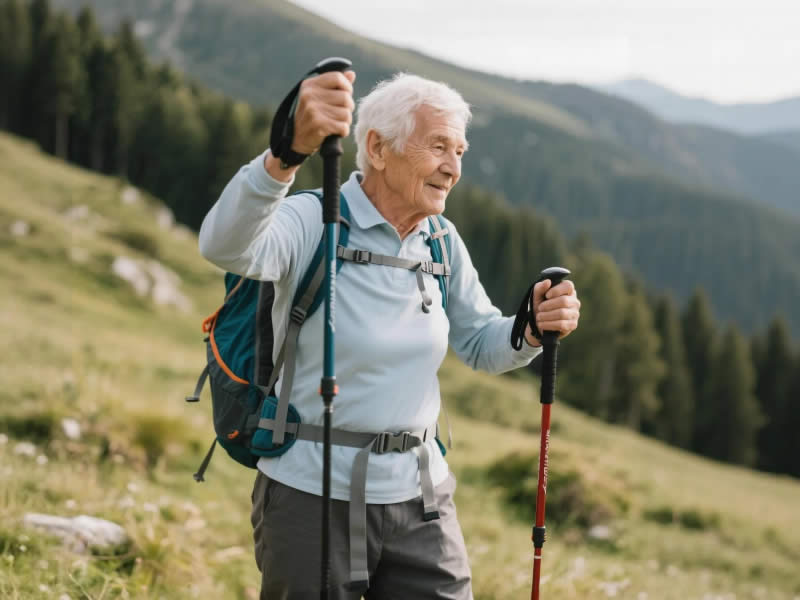
Recommended trekking pole purchase link: https://lightenup.aliexpress.com/store/1101521655
The 90‑degree elbow rule – gold standard for flat ground
- Stand upright with your back straight and arms relaxed at your sides. Wear the shoes you normally walk in.
- Bend your elbow to a 90‑degree angle (your forearm should be parallel to the ground). Make a light fist.
- Adjust the trekking pole (with rubber tip on the ground) so that the top of the grip touches the underside of your fist. The tip should be flat on the floor.
- Lock the pole at this length. Mark the shaft with tape or a permanent marker for future reference.
This 90° elbow angle creates the most efficient and comfortable arm position. It reduces strain on the shoulders and neck, allows for a natural arm swing, and ensures the wrist strap can transfer weight properly.
Why this height works best for older adults
- Minimises shoulder and neck strain – Poles that are too high force you to shrug your shoulders; poles that are too low make you hunch forward. Both cause pain and fatigue.
- Optimises balance – At the correct height, the poles act as outriggers, providing stability without interfering with your natural gait.
- Allows relaxed grip – With the strap correctly adjusted (hand up from below), the strap bears weight, and your fingers can relax.
- Safe for pavement and indoor use – Use rubber tips at this length for walking on hard surfaces.
Small adjustments for different terrain
While the 90° rule is the baseline, slight changes can improve comfort on slopes:
- Gentle uphill – Shorten poles by 2–3 cm (about 1 inch). This keeps your arms low and prevents them from rising too high, which strains shoulders.
- Gentle downhill – Lengthen poles by 2–3 cm. This allows you to plant the pole ahead of your body, providing a braking effect and reducing knee impact.
- For uneven ground (grass, gravel) – Stick with the flat‑ground length, but be prepared to plant more firmly.
For seniors with limited mobility or arthritis
- If you have reduced shoulder flexibility, you may need a slightly shorter pole (elbow less than 90°) to avoid discomfort. Experiment in 1‑cm increments.
- If you have weak wrist or grip, ensure the strap is correctly used (hand up from below) – this allows the strap to take weight even if you cannot grip tightly. The pole height is less critical than the strap technique.
- If you use a rollator or walker, trekking poles are not a substitute. The 90° rule applies only when you are walking without a wheeled aid.
How to test if your pole height is correct
After setting the length, walk a few metres on a flat, hard surface. Pay attention to:
- Shoulder tension – Do you feel like you are lifting your shoulders? If yes, poles are too long.
- Lower back discomfort – Do you feel hunched? Poles are too short.
- Arm swing – Is it natural, opposite to your leg movement? Good.
- Wrist angle – Your wrist should be straight (not bent up or down). If bent, adjust length.
Common mistakes to avoid
- Using the manufacturer’s height chart without personal adjustment – Charts are a starting point; individual arm length and shoe height matter.
- Setting poles too long – This is the most common error. Seniors often think longer poles give more support, but they strain the shoulders and can cause imbalance.
- Not marking the correct length – After finding your setting, mark it. This saves time and ensures consistency every time you use the poles.
- Forgetting to re‑check after changing shoes – Thicker‑soled boots add 1–2 cm. Re‑adjust accordingly.
A note on wrist straps and height
Correct pole height works together with correct strap use. Even with perfect length, if the strap is not adjusted properly, you will grip the pole too tightly and lose the benefit. Always:
- Insert hand from below the strap.
- The strap should sit between thumb and index finger.
- Tighten so the strap is snug but not tight.
- Relax your fingers – the strap bears weight.
Final recommendation for older adults
Start with the 90‑degree elbow rule on flat ground. Use rubber tips for pavement. Mark your setting. For most seniors, this single length works for the majority of walking – on flat paths, gentle slopes, and even moderate hills. Only adjust by 2–3 cm for sustained uphill or downhill sections. If you experience shoulder or back pain, re‑check your length and strap technique. With the correct height, trekking poles will feel like natural extensions of your arms, improving balance and confidence without causing new aches. Remember: poles should help you walk better, not force you into an awkward posture. Take the time to set them right – it makes all the difference.




