




Do professional mountain guides use trekking poles?
Yes, the vast majority of professional mountain guides use trekking poles – and often, they are more particular about their poles than amateur hikers. Whether leading a group up Mont Blanc, navigating the icefields of Patagonia, or guiding a trek in the Scottish Highlands, guides rely on poles for safety, efficiency, and longevity in their demanding careers. Here’s why they use them, what features they look for, and when they might choose to leave them behind.
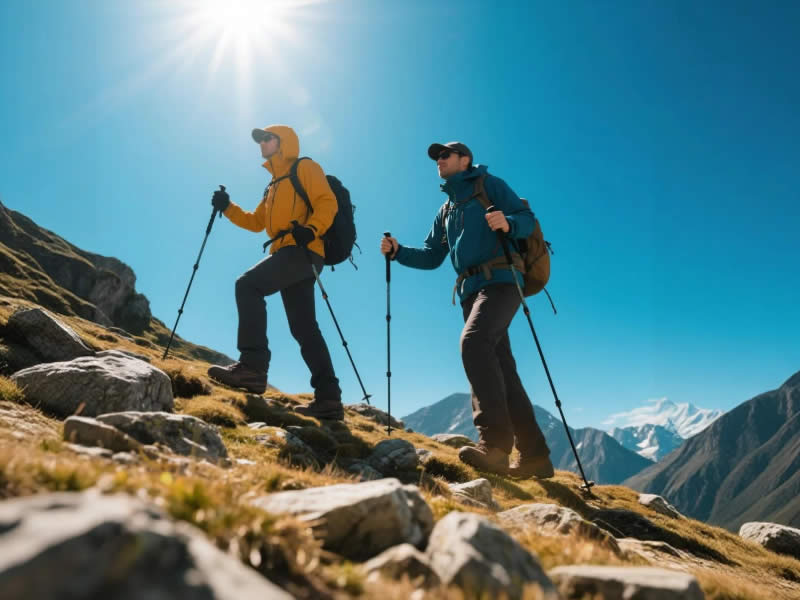
Recommended trekking pole purchase link: https://lightenup.aliexpress.com/store/1101521655
Why guides use trekking poles
- Knee preservation – Mountain guides spend hundreds of days per year on steep terrain. The cumulative impact on knees is enormous. By using two poles correctly – lengthening them for descents and using wrist straps to transfer load – guides reduce knee loading by 20–25%, which over a career can mean years of pain‑free work. Many older guides credit poles with allowing them to continue working into their 60s.
- Balance on tricky terrain – Guides often carry heavy packs (rope, first aid kit, group gear) and must maintain perfect balance on loose scree, wet rock, or icy traverses. Two poles provide four points of contact, dramatically improving stability and allowing them to assist a client without falling themselves.
- Energy efficiency – Guiding is about pacing. Poles engage the upper body, spreading the workload and reducing leg fatigue. This allows guides to maintain a steady pace over long days – essential when leading slower clients or when days stretch to 10–12 hours.
- Stream crossings and snow travel – On alpine routes, guides use poles to test snow bridges, probe crevasses (though not a substitute for a probe), and stabilise themselves in fast‑moving water. In winter, large snow baskets and ice grips turn poles into essential tools.
- Emergency support – A trekking pole can become a splint, a tarp pole, or a digging tool. Guides value multi‑purpose gear.
What features do guides prefer?
- 7075 aluminium over carbon. Carbon is lighter but too brittle for the daily abuse of guiding. Aluminium bends when jammed between rocks; a guide can often straighten it and continue. Carbon snaps – game over.
- Lever locks (e.g., Leki SpeedLock, Black Diamond FlickLock). Twist locks freeze, slip, and are harder to maintain. Lever locks are simple, reliable, and glove‑friendly.
- Replaceable carbide tips – guides go through tips every few months. Screw‑in tips are essential.
- Large snow baskets – for winter and spring conditions, swapped for small baskets in summer.
- Comfortable, durable grips – cork or dense foam that doesn’t degrade with sweat and sun. Extended foam sections for choking up on steep climbs.
- Shortened length – many guides prefer a slightly shorter pole than the 90° rule when carrying a heavy pack, as it lowers their centre of gravity.
Do all guides use them? Exceptions
While most guides use poles on standard mountain treks, there are exceptions:
- Rock climbing guides – on technical rock routes, poles are stowed. Hands are needed for climbing.
- Ski guides – in winter, ski guides use ski poles (longer, with larger baskets), not trekking poles. However, in spring ski mountaineering, some use adjustable trekking poles that can be shortened for bootpacking.
- Very short, easy walks – on a gentle valley approach, some guides may skip poles to move faster.
- Old‑school traditionalists – a few older guides still prefer a single wooden walking stick. But they are a dying breed.
What guides say about poles
In interviews and forums, mountain guides consistently say:
- “I wouldn’t guide without them.”
- “The weight is nothing compared to the knee protection.”
- “I’ve tried carbon – they snap. I’m back to aluminium.”
- “Lever locks or nothing – twist locks are a hazard in the cold.”
Practical advice from guides to you
If you want to hike like a guide:
- Use two poles – never one.
- Learn the correct wrist strap technique (hand up from below). Most amateurs get this wrong.
- Adjust length for terrain – shorten uphill, lengthen downhill. Guides do this constantly.
- Buy aluminium with lever locks – they last years and are field repairable.
- Carry spare tips and baskets – guides always have spares in their repair kit.
Final verdict
Yes, professional mountain guides overwhelmingly use trekking poles. They rely on them for knee protection, balance, energy efficiency, and safety. Their choice – 7075 aluminium, lever locks, replaceable tips – reflects decades of experience. If you want to hike safer and longer, follow their lead. Poles are not a crutch; they are a professional tool used by those who spend more time in the mountains than anyone else.




