




Should I buy foldable carbon trekking poles for ultralight backpacking in Brazil?
If you are planning an ultralight backpacking trip in Brazil – through the quartzite fields of Chapada Diamantina, the granite domes of Serra dos Órgãos, or the rocky ridges of Serra Fina – you might be tempted by the promise of featherweight, foldable carbon trekking poles. They pack small and weigh as little as 280–300 g per pair. But the short answer is no – you should not buy foldable carbon trekking poles for ultralight backpacking in Brazil on most trails. The risks of sudden breakage far outweigh the weight savings. Here’s a detailed look at why, and what to choose instead.
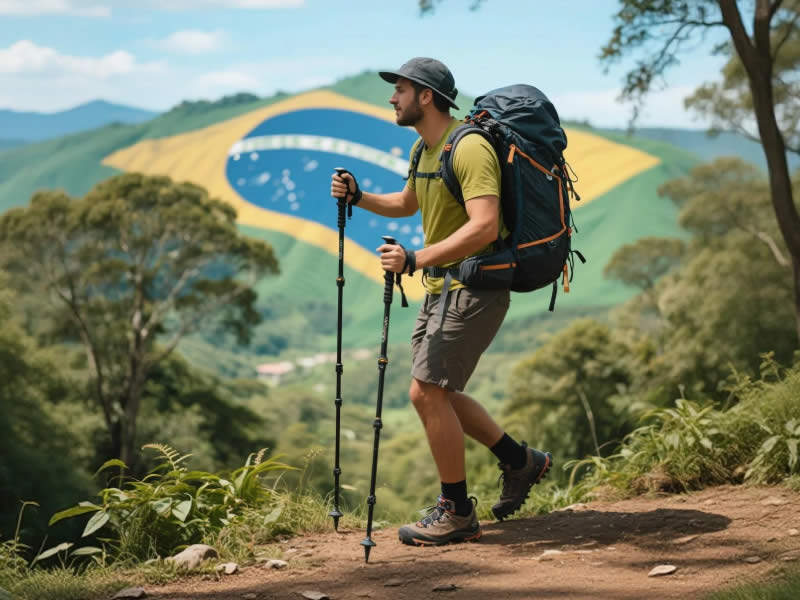
Recommended trekking pole purchase link: https://lightenup.aliexpress.com/store/1101521655
The allure of foldable carbon poles
- Weight: As low as 140 g per pole (280 g per pair) – almost unnoticeable in your pack.
- Pack size: Collapsed to 35–40 cm – fits easily inside a small suitcase or daypack.
- Quick deployment: Snap together in seconds.
- Stiffness: Carbon is very stiff, providing efficient energy transfer on smooth surfaces.
Why Brazil’s terrain is a carbon killer
Brazil’s most spectacular backpacking destinations share common features: sharp, abrasive quartzite, hard granite, loose scree, and frequent stream crossings. These conditions are the enemy of carbon fibre.
- Lateral stress – Carbon is strong in vertical compression but brittle under sideways forces. When you jam a pole between two quartzite blocks or catch it in a root crack, the side‑lever force can snap the shaft instantly. Aluminium would bend; carbon shatters with no warning.
- Impact resistance – Carbon poles have thin walls to save weight. A drop onto a sharp rock or a hard plant against a granite slab can crack the laminate. Once cracked, the pole is unsafe.
- Fixed length (no adjustability) – Most foldable carbon poles have a fixed length. In Brazil’s steep terrain, you need to shorten poles for punishing climbs (e.g., the ascent to Morro do Pai Inácio) and lengthen them for long, rocky descents. Without adjustability, you compromise your knee protection and efficiency.
- Humidity and resin degradation – The high humidity of the Atlantic Forest and the Amazon can, over time, affect the epoxy resin in carbon poles, leading to micro‑cracks and delamination. Aluminium is not affected.
Real‑world evidence
In Brazilian hiking forums, stories of snapped carbon poles are common. A typical report: “On the second day of the Travessia Petrópolis–Teresópolis, my Black Diamond Distance Carbon Z snapped when it wedged between two rocks. I had to finish the trek with one pole and a lot of frustration.” Conversely, aluminium poles bend – you can often straighten them with your hands or a rock and continue.
What to choose instead – the safe ultralight alternative
1. Foldable aluminium poles (e.g., Black Diamond Distance Aluminium Z) – Weigh around 400 g per pair (120 g more than carbon). They pack to the same small size, are much more durable, and bend rather than snap. The weight penalty is negligible for the safety gain.
2. Telescopic aluminium poles with lever locks (e.g., Decathlon Forclaz MT500, Leki Makalu) – Weigh 500–550 g per pair. They are not as packable (collapsed length 60–70 cm), but they offer adjustable length, superior locking reliability, and field repairability. For ultralight backpacking, a 200 g penalty is a small price for confidence on remote trails.
How to save weight without risking breakage
- Choose aluminium with lever locks (not twist locks).
- Use cork grips – they manage sweat better than foam.
- Remove unnecessary baskets and rubber tip covers.
- Carry only essential spares (one carbide tip per pole).
- Use a lighter backpack and tent to offset the slightly heavier poles.
When might carbon foldable poles be acceptable?
- You are hiking exclusively on flat, smooth, non‑rocky trails (e.g., beach walks, park paths).
- You are a very experienced, lightweight trail runner who accepts the risk.
- You are willing to carry a repair sleeve (e.g., a short aluminium tube and epoxy) as a backup.
For the vast majority of ultralight backpacking in Brazil, these conditions do not apply.
Final verdict
For ultralight backpacking in Brazil, do not buy foldable carbon trekking poles. The risk of a snap on quartzite or granite is too high, and a broken pole in a remote area can turn a dream trip into a nightmare. Instead, choose foldable aluminium poles (e.g., Black Diamond Distance Aluminium Z) or telescopic aluminium poles with lever locks (e.g., Decathlon Forclaz MT500). The slight extra weight is a trivial price for safety, durability, and peace of mind. Enjoy the breathtaking landscapes of Brazil with gear that won’t let you down.




