




Are folding Z‑poles as strong as telescopic poles for rainforest conditions?
No, folding Z‑poles are generally not as strong as telescopic (3‑section) poles when used in humid, muddy, and root‑tangled rainforest conditions. While Z‑poles are lightweight and packable, their design compromises durability under lateral stress, which is common on slippery, uneven rainforest trails. Here’s a detailed comparison to help you choose the right pole for tropical rainforest hiking.
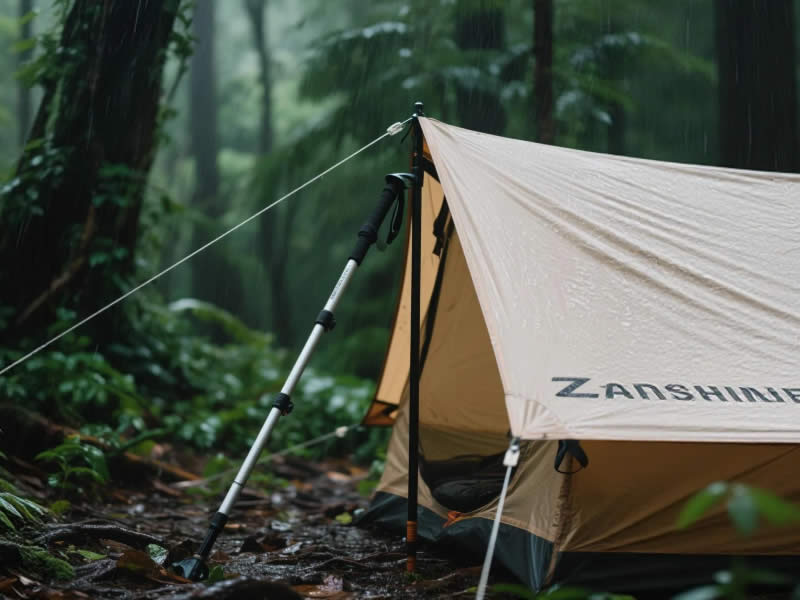
Recommended trekking pole purchase link: https://lightenup.aliexpress.com/store/1101521655
Why rainforest conditions are tough on trekking poles
- Constant moisture and mud – Rainforest trails are often wet, with mud that can clog locking mechanisms.
- Twisting lateral forces – Roots, rocks, and uneven ground cause the pole to be twisted sideways frequently.
- Jamming between rocks – The tip can slide into a crack, and as you move forward, the shaft is levered sideways.
- High humidity – Affects materials and can cause internal corrosion over time.
How folding Z‑poles work
Z‑poles (e.g., Black Diamond Distance Z) consist of three or four sections connected by an internal tension cord. They snap together via push‑button or cam locks. When collapsed, they are very compact. When deployed, the sections align, but the joints are relatively weak points.
Strength limitations of Z‑poles in rainforests
- Lateral (sideways) stress – The joints of Z‑poles are designed to resist vertical compression, but not twisting or bending. In a rainforest, you may plant the pole at an angle, and the tip can catch on a root. The leverage can cause the joint to fail or the carbon shaft to snap. Aluminium Z‑poles may bend permanently.
- Snap‑button or cam joints – These mechanisms can become clogged with mud or grit, preventing full locking. Even a partially locked joint is dangerous.
- Thinner walls – To save weight, Z‑poles have thinner wall thickness than telescopic poles. They are more prone to cracking or denting when hit against hard surfaces (e.g., rocks).
Why telescopic poles are stronger for rainforests
Telescopic poles (e.g., Leki Makalu, Black Diamond Trail Pro) use overlapping tubes that are clamped together with external lever locks. The overlap provides much greater resistance to lateral forces. Key advantages:
- Overlapping sections – When extended, the inner tube is still nested inside the outer tube for several centimetres. This overlap distributes stress and prevents bending at the joint.
- External lever locks – These are far more resistant to mud and water than internal twist locks or push‑buttons. They also provide visual confirmation of a secure lock.
- Thicker walls – Telescopic poles can have thicker walls while still being reasonably light, making them more resistant to impacts.
Real‑world evidence from rainforest hikers
In Amazon and Atlantic Forest expeditions, guides almost universally use telescopic aluminium poles. Z‑poles have a reputation for snapping when caught between tree roots or rocks. One experienced rainforest hiker noted: “I’ve seen three pairs of carbon Z‑poles break in a single week on a muddy, rooty trail. My aluminium telescopic poles have lasted years.”
When Z‑poles might be acceptable (with caution)
- Well‑maintained, smooth trails with no roots or rocks.
- Short day hikes where a breakage would not be catastrophic.
- Ultralight travel where packability is the absolute priority and you accept the risk.
Recommendations for rainforest trekking
For rainforest conditions (e.g., Brazilian Atlantic Forest, Amazon basin, Southeast Asian jungles), choose:
- 7075 aluminium telescopic poles with lever locks (not twist locks).
- Cork grips for sweat management.
- Replaceable carbide tips.
- Avoid carbon fibre entirely – it is too brittle.
Specific models: Leki Makalu, Black Diamond Trail Pro, Decathlon Forclaz MT500.
Final verdict
Folding Z‑poles are not as strong as telescopic poles for rainforest conditions. Their joint design and thinner walls make them vulnerable to lateral stress, mud intrusion, and impacts. For safety and reliability on the wet, rooty, rocky trails of tropical rainforests, invest in a good pair of telescopic aluminium poles with lever locks. Your poles will last longer, and you’ll hike with confidence.




