




Do ultralight trekking poles survive rough Brazilian granite terrain?
The short answer is no – most ultralight trekking poles, especially carbon fibre models, do not survive rough Brazilian granite terrain. Brazil’s iconic mountain ranges – such as Serra dos Órgãos, Pico da Bandeira, and the granite domes of Rio de Janeiro – are composed of hard, abrasive, and often sharply fractured rock. Ultralight poles, designed primarily for speed on smooth trails, are too fragile for the lateral forces, impacts, and abrasion of Brazilian granite. For safety and durability, you need 7075 aluminium poles with lever locks. Here’s a detailed explanation.
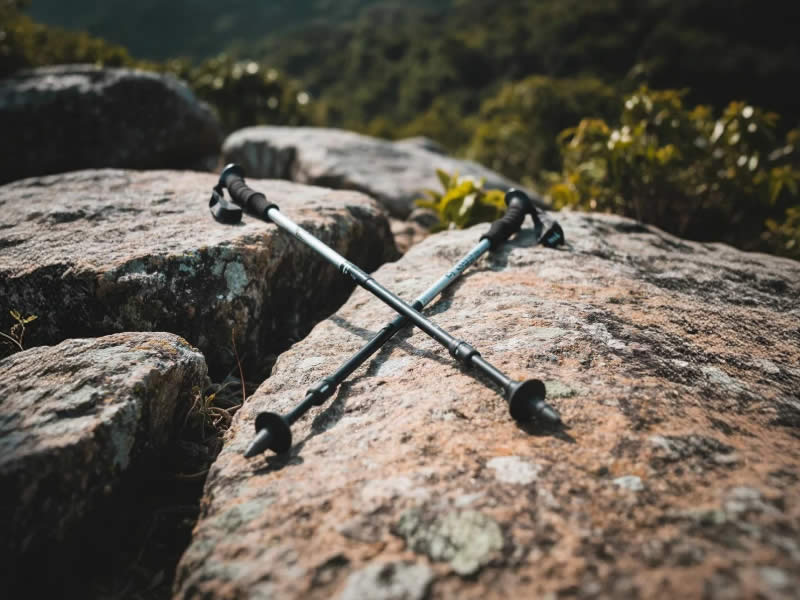
Recommended trekking pole purchase link: https://lightenup.aliexpress.com/store/1101521655
Why Brazilian granite is a pole‑killer
Granite is an intrusive igneous rock composed of hard quartz and feldspar crystals. It often forms:
- Polished slabs – Very slippery, requiring a sharp tip for grip.
- Blocky, angular boulders – Gaps and cracks that can trap a pole tip.
- Scree fields – Loose, moving rocks that apply lateral stress.
When you hike on granite, you will inevitably jam your pole tip into a crack or between two boulders. As you move forward, the shaft experiences a powerful sideways lever force. This lateral stress is the Achilles’ heel of ultralight poles.
What ultralight poles are made of
- Carbon fibre – Very light (150–200 g per pole), very stiff, but brittle. Under lateral stress, carbon snaps suddenly without warning. Once snapped, it is irreparable.
- Thin‑wall aluminium – Some ultralight aluminium poles use 6061 alloy or thin walls to save weight (e.g., 400–450 g per pair). They bend more easily than 7075 and may kink.
Why they fail on Brazilian granite
- Snapping – Carbon poles are notorious for shattering when wedged between rocks. A single bad plant can end your pole’s life.
- Bending – Thin aluminium poles can bend permanently, making them difficult to collapse or lock.
- Tip damage – Ultralight poles often have non‑replaceable or fragile tips. Granite wears down tips quickly.
- Lock failure – Many ultralight poles use twist locks or simple snap‑buttons, which slip or jam in muddy, humid conditions.
Real‑world evidence from Brazilian hikers
In online forums and guide interviews, stories abound: “My Black Diamond Distance Carbon Z snapped on the first day of the Travessia Petrópolis–Teresópolis.” “I saw a hiker’s Gossamer Gear LT5 shatter when he stumbled on the granite slabs of Pedra da Gávea.” Guides consistently recommend against carbon poles for granite terrain.
What works – 7075 aluminium with lever locks
The combination that survives Brazilian granite is:
- 7075 aluminium – Heat‑treated, strong, ductile. Bends rather than snaps. A bent pole can often be straightened by hand or by rolling on a flat rock.
- Lever locks (e.g., Leki SpeedLock, Black Diamond FlickLock) – External, self‑cleaning, and hold securely even when wet or muddy.
- Replaceable carbide tips – You will wear them out; being able to swap them is essential.
- Cork grips – Absorb sweat and stay non‑slip in high humidity.
Recommended poles for Brazilian granite
| Model | Material | Weight (pair) | Lock | Comments |
|---|---|---|---|---|
| Leki Makalu | 7075 Al | 520 g | SpeedLock | Gold standard, repairable, spare parts in Brazil |
| Black Diamond Trail Pro | 7075 Al | 540 g | FlickLock | Very robust, foam grip less ideal for sweat |
| Decathlon Forclaz MT500 | 7075 Al | 520 g | Lever lock | Best value, available in Brazil |
These poles are not “ultralight” – they weigh about 520–540 g per pair, compared to 300–400 g for carbon. The extra 150 g is a small price for safety and reliability on sharp granite.
When can ultralight poles be used?
- Well‑maintained, non‑rocky trails – E.g., park paths, forest roads, beach walks.
- Trail running on smooth terrain – Some runners accept the risk for weight savings.
- Short, gentle hikes – Where a broken pole would not be catastrophic.
For any hike that involves granite contact, leave the ultralight poles at home.
Tips for using poles on Brazilian granite
- Plant vertically – Avoid sideways angles. If the tip slides into a crack, reposition.
- Never use as a lever – Do not pull on the pole to climb over a rock step; use your free hand.
- Inspect after each hike – Look for cracks, bends, or splinters.
- Carry a spare tip – Granite will wear carbide; have a replacement ready.
- Use rubber tips on pavement – Approach trails may have paved sections; protect your carbide.
Final verdict
Ultralight trekking poles – especially carbon fibre – do not survive rough Brazilian granite terrain. They snap, bend, or their locks fail under the lateral stress and impacts typical of these beautiful but demanding mountains. For safety and longevity, invest in 7075 aluminium poles with lever locks, such as the Leki Makalu or Decathlon Forclaz MT500. The small weight penalty is trivial compared to the peace of mind of knowing your poles will not shatter on a remote ridge. Hike with confidence on Brazil’s granite giants – with the right gear.




