




How to adjust trekking pole length for descending muddy Atlantic Forest slopes?
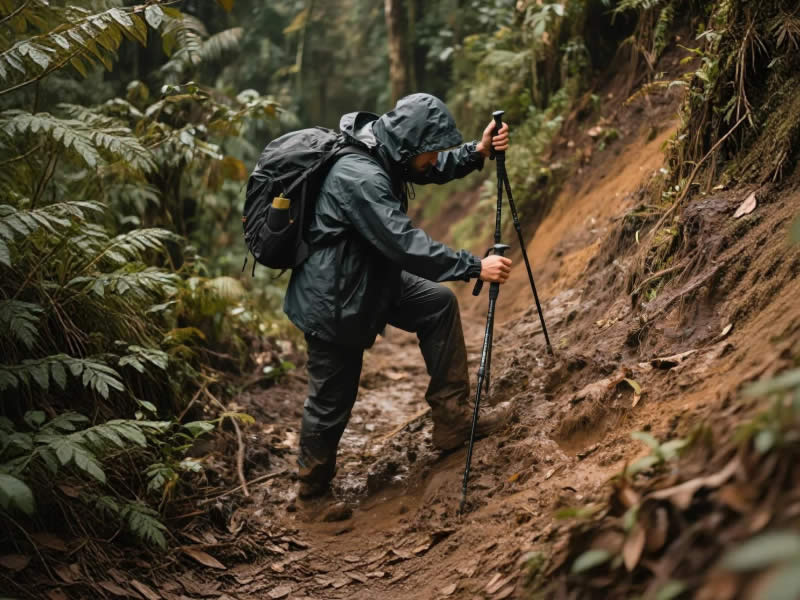
Descending a muddy, rain‑slicked trail in Brazil’s Atlantic Forest (Mata Atlântica) is one of the most treacherous tasks a hiker can face. The combination of steep gradients, wet clay‑like mud, hidden roots, and slippery rocks demands exceptional balance and joint protection. One of the simplest yet most effective techniques to stay safe and reduce knee strain is to lengthen your trekking poles by 5–10 cm (2–4 inches) for the descent. This small adjustment can make the difference between a controlled, comfortable walk down and a painful, jarring slip‑fest.
Recommended trekking pole purchase link: https://lightenup.aliexpress.com/store/1101521655
Why lengthening helps on muddy downhills
When you walk downhill on flat ground, your natural arm position is higher than on the flat. If you keep your poles at the standard length (elbow at 90° with tip on flat ground), your arms will be forced too high, or you’ll have to reach down awkwardly. Lengthening the poles allows you to:
- Plant the pole ahead of your body – This creates a braking angle. Instead of planting beside your foot, you reach forward and place the tip firmly into the mud. As you step down, you push on the pole, transferring a portion of your body weight from your knees to your arms. Studies show this can reduce knee joint loading by 20–25% on descents.
- Improve stability on slippery surfaces – With longer poles, you have a wider base of support. You can test the mud ahead before committing your full weight, and if your foot slides, the poles help you recover.
- Reduce quadriceps fatigue – By offloading your legs, you delay the burning sensation in your thighs, allowing you to descend longer without stopping.
How to determine your flat‑ground length
Before adjusting for descent, know your baseline. Stand upright with your hiking boots on. Hold the pole with the tip on the ground beside your foot. Bend your elbow to 90°. The grip should fit comfortably in your hand. This is your flat‑ground length. Mark it with tape or a permanent marker.
Adjusting for muddy Atlantic Forest descents
- Add 5–10 cm (about 2‑4 inches) to your flat‑ground length. For a 170 cm tall hiker, flat length might be 115 cm; set poles to 120–125 cm for descent.
- Ensure you do not extend past the “STOP” mark on the pole shaft. Over‑extension weakens the pole and can cause it to snap.
- Use lever locks (e.g., Leki SpeedLock, Black Diamond FlickLock) for quick, tool‑free adjustment. Twist locks are slow and less reliable in wet conditions.
Technique for descending muddy slopes with lengthened poles
- Plant both poles together ahead – Place them about 30–50 cm in front of your forward foot, slightly wider than shoulder width.
- Push down firmly – As you step forward, push the poles into the mud. The carbide tip should bite through the surface layer.
- Lean back slightly – Keep your torso upright, leaning from the ankles rather than the waist. This shifts your centre of gravity uphill, reducing the forward pull.
- Take short, shuffling steps – Do not lift your feet high; slide them or place them flat. High steps increase the risk of a slip.
- Maintain three points of contact – Always keep at least one pole planted. Move one foot, then the other, then reposition the poles.
What about mud and tip choice?
- Use bare tungsten carbide tips – Rubber paw covers are deadly on mud; they have no bite. Carbide tips pierce the mud and find firmer ground below.
- Small baskets (4–5 cm) help prevent the pole from sinking too deep in soft mud, but remove them on rocky sections to avoid catching.
Wrist straps – critical for load transfer
Even with the correct length, you must use wrist straps properly. Insert your hand up through the strap from below, so the strap sits between thumb and index finger. Tighten snugly. When you push down on the pole, the strap bears your weight – your fingers simply guide. This technique prevents hand fatigue and ensures that the load is transferred from your knees to your arms.
Practice on a gentle slope first
Before tackling the steep, muddy trails of the Atlantic Forest, practice the lengthened‑pole descending technique on a moderate, grassy slope. Get comfortable with the rhythm: plant both poles ahead, step, push, repeat. Once it feels natural, you’ll be ready for the real thing.
Common mistakes to avoid
- Keeping poles at flat length – This is the most common error. You’ll lean forward, strain your back, and get no braking.
- Lengthening too much – Over‑extension (past the STOP mark) can break the pole or make it hard to plant solidly.
- Planting poles beside your feet – This offers no braking effect. Always plant ahead.
- Gripping too tightly – Relax your fingers; let the strap work.
- Using rubber tips – They slip instantly on mud. Remove them.
Final verdict
For descending the muddy, steep slopes of the Atlantic Forest, lengthen your trekking poles by 5–10 cm beyond your flat‑ground length. This simple adjustment, combined with correct planting technique (both poles ahead, push down) and proper wrist strap use, will protect your knees, improve your balance, and make the descent far safer and more enjoyable. Invest a few seconds to adjust your poles before each downhill section – your knees will thank you for every step.




