




How to use trekking poles for boulder hopping in Itatiaia National Park?
Itatiaia National Park, located in the Mantiqueira Mountains of southeastern Brazil, is home to some of the country’s most dramatic granite landscapes. The trails – especially those leading to the Prateleiras plateau or the Agulhas Negras peak – are dotted with massive boulder fields, loose granite blocks, and slippery lichen‑covered rocks. “Boulder hopping” – moving from one large rock to another – requires agility, balance, and careful foot placement. When used correctly, trekking poles can be a valuable aid; used carelessly, they can become a dangerous hindrance. Here is how to master boulder hopping with poles in Itatiaia.
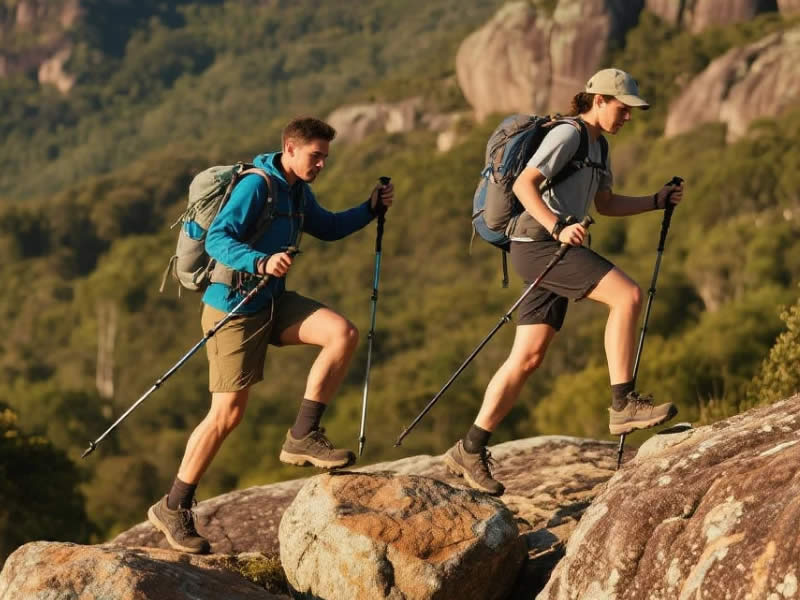
Recommended trekking pole purchase link: https://lightenup.aliexpress.com/store/1101521655
When to use poles – and when to stow them
- Use poles for: Hopping between large, stable boulders where you have room to plant; crossing sections with flat rock surfaces; testing the stability of a rock before stepping.
- Stow poles for: Any section where you need both hands for balance or to grip holds (e.g., scrambling up a steep boulder step, crossing a narrow gap). Trying to hold poles while using your hands is a recipe for a fall.
Prepare your poles for boulder hopping
Before entering the boulder fields (e.g., the approach to the Agulhas Negras shelter), adjust your poles:
- Shorten them significantly – Reduce length by 10–15 cm from your flat‑terrain setting. A shorter pole gives you better control, prevents the shaft from hitting your face, and reduces the chance of jamming between rocks.
- Remove wrist straps – or keep them very loose. If you slip, you don’t want a pole attached to your wrist. It can twist your arm or prevent you from catching yourself.
- Use carbide tips – remove rubber covers. Carbide bites into granite even when wet or covered in lichen.
- Remove large snow baskets – small summer baskets are fine; remove them entirely if they catch on rock edges.
Technique for boulder hopping with poles
- Test each boulder before stepping – Use one pole to tap or press down on the next boulder. Check if it wobbles, is slimy, or is unstable. A solid rock will feel firm; a loose one will shift or tilt. This probing is invaluable in Itatiaia, where many boulders have weathered loose.
- Plant on flat rock surfaces – Avoid planting in crevices or between boulders where the tip could get stuck. If the tip jams, you may fall forward or snap the pole. Look for flat, grippy areas.
- Plant vertically – An angled plant on a sloping rock can skid. Push the tip straight down. Apply firm pressure – you need the carbide to bite into the rough granite.
- Keep three points of contact – Before lifting your foot, ensure both poles and your plant foot are stable. Then move one foot, then reposition the poles. This is the core of safe boulder hopping.
- Use poles as outriggers – On wide, flat boulders, plant both poles to the sides to widen your base. This is especially useful on convex rock surfaces where your feet may feel unstable.
- For narrow gaps between boulders, use one pole to brace on each side (if possible). Step through, keeping your weight centred.
Special considerations for Itatiaia’s terrain
- Granite lichen – Many boulders are covered in a thin, slippery lichen (especially in the shade). Carbide tips bite through it, but your boots may slip. Test each hold with your pole; if the pole skids, the rock is probably too slick for a safe foothold.
- Morning dew – The boulder fields can be very slippery early in the day. Wait for the sun to dry them or use extra caution.
- Quartzite veins – Some rocks have smooth quartz veins that are like glass. Avoid stepping on them. Use your pole to identify these sections.
- Altitude – The high plateaus (over 2,400 m) can be windy and cold. Shorter, colder fingers make gripping harder; use foam‑grip poles for better insulation.
Common mistakes to avoid
- Planting between boulders – The tip can get wedged. As you move forward, the pole can snap or you can trip. Always plant on solid rock.
- Using full‑length poles – Long poles hit rocks above you, throw you off balance, and can cause you to tip forward.
- Keeping wrist straps tight – If you fall, a strapped pole can twist your arm. Remove straps or leave them very loose.
- Relying solely on poles – Use your free hand for balance on large rocks whenever possible. Poles are aids, not replacements for your hands.
- Lifting both poles at once – Maintain three points of contact at all times. Move one pole, then a foot, then the other pole.
When to stow poles altogether
For sections of true scrambling (e.g., the final approach to the summit of Agulhas Negras via the “Travessia das Agulhas”), stow your poles on your backpack. Use both hands to grip holds. Trying to navigate steep boulders with poles in hand is dangerous. Collapse your poles, attach them to your pack using side compression straps or daisy chains, and proceed with hands free.
Recommended poles for Itatiaia’s boulder fields
- Leki Makalu – 7075 aluminium, lever locks, cork grip. Shorten easily, durable.
- Decathlon Forclaz MT500 – Budget aluminium, lever locks, cork/foam grip. Good value.
- Black Diamond Trail Pro – Foam grip, FlickLock, very robust.
Final thoughts
Boulder hopping in Itatiaia National Park is a thrilling experience that rewards careful technique. Trekking poles are a valuable aid when used correctly – for testing rocks, providing extra balance, and preventing slips. But they must be shortened, used with carbide tips, and stowed when hands are needed. Practice on smaller boulder fields (e.g., around the Prateleiras) before tackling more exposed sections. With patience and practice, you’ll move efficiently across the granite giants, enjoying one of Brazil’s most spectacular landscapes.




