




What is the correct way to hold trekking poles on flat Brazilian trails?
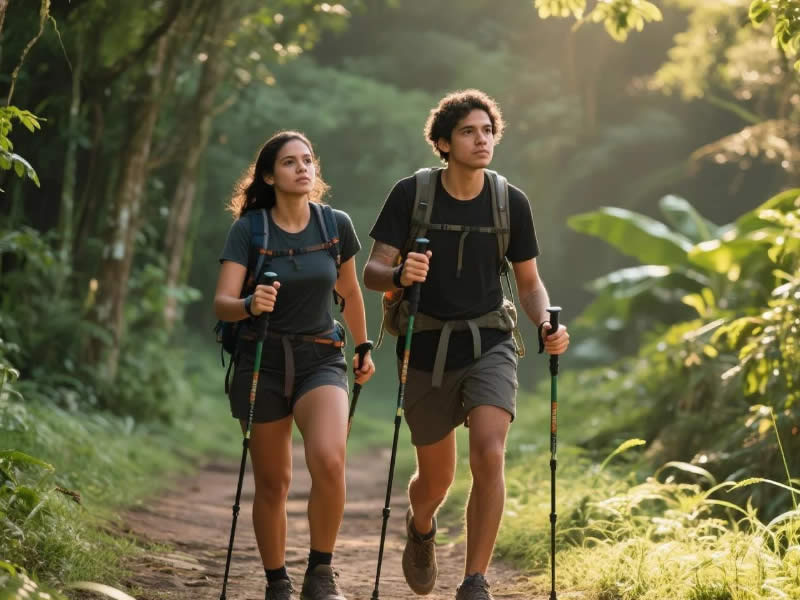
Even on flat terrain – whether you’re walking a sandy beach path in Florianópolis, a gravel road in Chapada dos Veadeiros, or a flat stretch of the Atlantic Forest – holding your trekking poles correctly is essential for efficiency, comfort, and injury prevention. Most beginners make the same mistakes: gripping too tightly, using the strap incorrectly, or adopting a clumsy, unnatural rhythm. Here is the correct way to hold and use your poles on flat Brazilian trails.
Recommended trekking pole purchase link: https://lightenup.aliexpress.com/store/1101521655
The biggest mistake: gripping the pole like a hammer
The most common error is slipping your hand through the strap from above and then death‑gripping the handle. In this position, the strap does almost nothing – your fingers bear all the weight. After a few kilometres, your forearms ache, your fingers may go numb, and you develop painful blisters. The correct technique flips this entirely.
Step 1: Insert your hand from below the strap
Open the wrist strap so it forms a loop. Insert your hand up through the loop from below. Then bring your hand down onto the grip. The strap should now sit between your thumb and index finger, crossing the back of your hand. This is the only correct way.
Why from below? – When you push down on the pole, your hand presses into the strap, which transfers the force directly to your arm. Your fingers can relax. If you insert your hand from above, the strap hangs loosely and does nothing.
Step 2: Adjust the strap tension
Use the slider or buckle to tighten the strap so it is snug but not cutting off circulation. You should be able to slide a finger between the strap and your hand. The goal: when you relax your fingers completely, the pole should stay attached to your hand by the strap alone. Test this by opening your hand while walking – the pole should dangle from your strap.
Step 3: Grip lightly – like holding an egg
Once the strap is adjusted, place your fingers around the grip lightly. Your palm should rest on the grip, but you should not need to squeeze. The strap bears your weight, not your fingers. If you find yourself gripping tightly, consciously relax your hand. Many hikers need to remind themselves every few minutes.
Step 4: Use the opposite arm‑leg rhythm
On flat ground, your natural walking motion is contralateral: when your right foot steps forward, your left arm swings forward. Your poles should follow this same pattern.
- Right foot forward → plant left pole down beside your forward foot.
- Left foot forward → plant right pole down.
This diagonal rhythm uses your body’s natural counter‑rotation, making walking effortless. If you plant the same‑side pole (right foot with right pole), you will twist your torso, waste energy, and risk back pain.
Step 5: Plant near your heel, not far ahead
When you plant the pole, the tip should contact the ground when your hand is roughly level with the heel of your forward foot. Do not over‑reach – planting too far ahead strains your shoulder and pulls you off balance. A short, controlled plant is more efficient.
Step 6: Push back lightly, then lift
After the plant, give a gentle push backward (not downward). This adds a tiny amount of forward propulsion. Then lift the pole and swing it forward for the next plant. The motion should be smooth and rhythmic, like a pendulum swinging from your shoulder.
Adapting for Brazilian flat trails
Brazil’s flat trails can be varied:
- Sand (beaches or dunes): Use larger baskets or sand baskets to prevent sinking. Keep the same grip technique, but you may need to push a little harder.
- Gravel or packed dirt: Standard small baskets work fine. Carbide tips are good; if the surface is very hard, rubber tips reduce noise and save the carbide.
- Pavement or cobblestones: Always use rubber tip covers. The grip technique remains the same, but you may want to shorten the poles by 1–2 cm for a slightly lower arm position.
- Humidity and sweat: Cork grips are excellent because they absorb sweat and stay non‑slip. Foam grips can become slippery; if you have foam, consider wearing lightweight gloves.
Common mistakes on flat trails
- Planting both poles together – This disrupts your natural gait and wastes energy. Save double planting for steep uphills or descents.
- Lifting the poles too high – The tip should barely clear the ground. A high lift wastes energy.
- Gripping tightly – Let the strap work. Relax your fingers.
- Poles too long or too short – On flat ground, your elbow should be at 90° when the tip is on the ground. Adjust until it feels natural.
- Looking down at the poles – Keep your eyes on the trail ahead; your peripheral vision will guide the tips.
Practice drill for flat trails
Find a flat, open area (e.g., a park). Walk 100 metres without poles, noting your natural arm swing. Then pick up your poles, adjust the straps correctly, and walk back. Focus on the opposite arm‑leg rhythm and the relaxed grip. Repeat until the movement feels automatic.
Final tip: maintain your straps
Wrist straps wear out from sweat and friction. Check them regularly for fraying. Replace them when the padding compresses or the webbing tears. A broken strap on a descent can be dangerous.
Conclusion
Holding trekking poles correctly on flat Brazilian trails is simple once you learn it: hand up from below, strap between thumb and index finger, light grip, opposite arm‑leg rhythm. This technique reduces hand fatigue, prevents blisters, and makes walking more efficient. Practice on easy paths before tackling longer hikes. With the right hold, your poles will feel like natural extensions of your arms – and you’ll wonder how you ever walked without them.




