




How to use trekking poles for trail running on Rio de Janeiro coastal mountains?
Trail running in Rio’s coastal mountains – like the trails of Floresta da Tijuca, Pedra da Gávea, or the Morro Dois Irmãos – combines steep climbs, slippery granite slabs, humid rainforest sections, and breathtaking views. Using trekking poles can boost your speed, reduce leg fatigue, and improve stability on technical descents. Here’s how to use them effectively for this unique terrain.
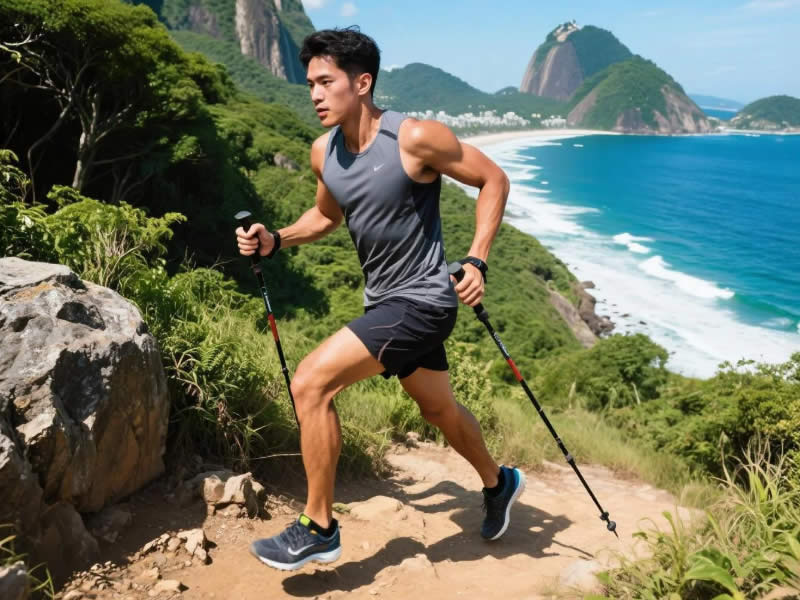
Recommended trekking pole purchase link: https://lightenup.aliexpress.com/store/1101521655
Choose the right poles for running
- Foldable carbon Z‑poles (e.g., Black Diamond Distance Carbon Z, Leki Ultratrail) – weigh 150‑180g per pole, pack small (36‑40cm). Light enough to carry when not needed.
- Aluminium foldable poles – slightly heavier but more durable (e.g., Black Diamond Distance Aluminium Z).
- Avoid telescopic hiking poles – too heavy and slow to deploy.
- Foam grips – lightweight and warm; cork is fine but heavier.
Set the correct length
For running, poles should be 2‑5 cm shorter than your hiking length. Stand with elbow at 90° – the tip should touch the ground. Then shorten by 2‑3 cm. A shorter pole promotes a faster cadence and prevents over‑reaching. For Rio’s steep climbs, you can choke down even more.
Master the running pole technique
- Light, quick plants – Do not plant hard like a hiker. A gentle tap, just enough to maintain rhythm. Over‑planting slows you down.
- Opposite arm‑leg rhythm – Right foot forward → plant left pole. Left foot forward → plant right pole. This matches your natural running gait.
- High cadence – Aim for 170‑190 steps per minute. Your pole plants should match your foot strikes. Use a metronome app to practice.
- Short stride, especially uphill – Keep your feet under your body. Poles help you maintain a quick turnover.
- Relaxed grip – Use wrist straps loosely (or not at all). Hold the poles like eggs – a death grip tires your forearms.
Stow poles on the run
On long flat sections or smooth descents where poles are not needed, fold them and attach to your running vest. Most vests have elastic loops or bungees on the front or back. Practice stowing and deploying while moving – it takes seconds.
Terrain‑specific tips for Rio coastal mountains
- Steep, technical climbs (e.g., Pedra da Gávea approach): Shorten poles further by choking down on the foam extension. Use double planting (both poles together) to pull yourself up. This saves your quads.
- Granite slabs (e.g., Pão de Açúcar trail): Use bare carbide tips – rubber tips slide. Plant vertically, push down firmly to bite into the rough stone. On wet slabs, test each plant.
- Rocky descents (e.g., Morro Dois Irmãos downhill): Keep poles short, use alternating light plants for balance. Do not over‑reach. If the trail becomes very steep and loose, stow poles and use your hands.
- Humid, rooty forest sections: Carbide tips bite into roots. Watch for mud – wipe tips after muddy patches.
- Stream crossings: Lengthen poles slightly, plant downstream, and move sideways. Keep your vest unbuckled in case you fall.
Drills for Rio trail running
- Stair climbing drill: Find a long staircase (e.g., Escadaria do Leme). Run up using double planting with poles shortened. Run down without poles (or with light touch) to practice descent control.
- Cadence drill: On a flat dirt track, run with poles, counting steps per minute. Aim for 180.
- Stow/deploy drill: On a safe trail, practice folding poles and attaching to your vest while jogging. Do it until it takes under 10 seconds.
What to avoid
- Planting too far forward – slows you down and stresses shoulders.
- Using hiking‑style heavy plants – running requires a light touch.
- Gripping tightly – relax your fingers.
- Forgetting to stow poles – carrying unfolded poles on descents throws off your balance.
Recommended poles for Rio coastal mountains
- Black Diamond Distance Carbon Z – ultralight, reliable, packs to 36 cm. Ideal for fast running.
- Leki Ultratrail FX.One – adjustable length (unique for folding pole), foam grip, slightly heavier (360g per pair). Good if you want to fine‑tune.
- Decathlon Forclaz Carbon MT900 – budget option, 310g per pair, packs to 37 cm.
Final thoughts
Trail running in Rio’s coastal mountains with trekking poles is a skill that transforms your efficiency and safety. Use light, foldable poles, set them slightly shorter than hiking length, master quick, light plants with a high cadence, and stow them on flats and easy descents. Practice on the steep staircases of Rio’s neighbourhoods before hitting the mountain trails. With the right technique, you’ll climb faster, descend with more confidence, and finish your runs with less leg fatigue – leaving more energy to enjoy the stunning views of Guanabara Bay and the Atlantic Ocean.




