




How to use trekking poles on flat vs steep Brazilian mountainous terrain?
Brazil’s mountainous terrain offers everything from the rolling, flat‑topped plateaus (chapadas) of the interior to the steep, granite peaks of the Serra do Mar and Serra da Mantiqueira. Using trekking poles correctly on these contrasting terrains is essential for efficiency, comfort, and safety. The same pole, adjusted differently, becomes a different tool. Here’s how to adapt your technique and pole settings for flat vs steep Brazilian terrain.
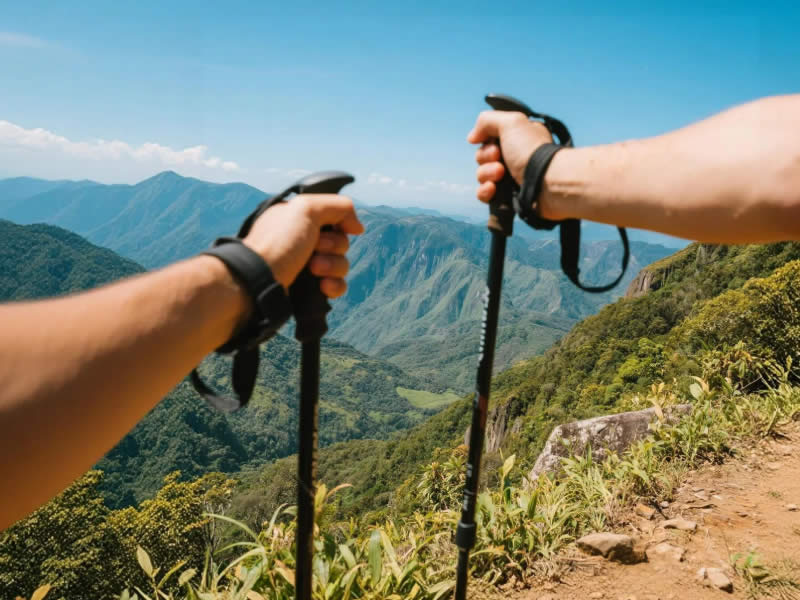
Recommended trekking pole purchase link: https://lightenup.aliexpress.com/store/1101521655
On flat terrain: rhythm and efficiency
Flat terrain in Brazil might be a sandy path in Chapada Diamantina, a gravel road in Serra do Cipó, or a wide firebreak in the Atlantic Forest. Here, the goal is a smooth, energy‑saving walking motion.
- Pole length: Set your poles so your elbow is at a 90° angle when the tip is on the ground (flat‑ground length). Mark this length on the shaft.
- Grip: Use the wrist strap correctly: hand up from below, strap between thumb and index finger. Relax your fingers – the strap bears weight.
- Planting rhythm: Use alternate planting – opposite pole to forward foot (right foot forward, left pole down). This matches your natural walking gait and is the most efficient.
- Arm swing: Swing from the shoulder, keeping elbows relaxed. Do not over‑reach; plant the tip when your hand is level with your forward heel.
- Push: Give a light backward push after each plant. This adds a tiny amount of forward propulsion without tiring your arms.
- Tip choice: On sandy or soft flat trails, use small baskets to prevent sinking. On hardpack or gravel, bare carbide tips are fine. On pavement, use rubber paw covers.
On steep Brazilian mountainous terrain: power and stability
Brazil’s steep trails – like the climb to Pico da Bandeira, the ascent of Pedra da Gávea, or the slopes of Serra dos Órgãos – demand more from your poles. Here, you’ll need to adjust both length and technique.
Uphill technique
- Pole length: Shorten your poles by 5–10 cm from your flat‑ground setting. A shorter pole keeps your arms low, allowing you to push down effectively without raising your shoulders.
- Planting rhythm: Switch to double planting (both poles together). Plant them about 30–50 cm ahead of your feet, then pull yourself up as you step. This engages your triceps and lats, taking load off your quadriceps.
- Choke down: If your poles have an extended foam section, slide your hand down to it for even more leverage.
- Strap use: Same as always – hand up from below, relaxed grip. The strap transfers weight from your legs to your arms.
- Short steps: Keep your feet under your body. Long strides waste energy.
- Body position: Lean slightly forward from your ankles, not your waist. Keep your chest open.
Downhill technique (steep descents)
- Pole length: Lengthen your poles by 5–10 cm from flat‑ground length. A longer pole allows you to plant ahead of your feet, creating a braking angle.
- Planting rhythm: Use double planting – plant both poles together ahead of your feet (30–50 cm forward), then step down. Push down firmly to brake. This transfers weight from your knees to your arms, reducing impact by 20–25%.
- Body position: Lean back slightly from your ankles, keeping your torso upright. Do not hunch forward.
- Three‑point contact: Always keep at least one pole planted. Move one foot, then the other, then reposition the poles.
- Tip choice: Use bare carbide tips on rock. On wet granite or quartzite, carbide bites well. Rubber tips are dangerous on steep slopes.
Adapting to Brazilian micro‑terrain
Brazil’s mountainous trails often mix short sections of flat, steep, and side‑hill within minutes. Be ready to adjust on the fly:
- Side‑hilling (traversing a slope): Adjust each pole individually – shorten the uphill pole, lengthen the downhill pole, so your torso stays level.
- Short, punchy climbs: Choke down on the foam extension without stopping to adjust length. Use double planting for 4‑5 steps, then return to alternate planting.
- Rocky steps (common on Pico da Bandeira): Shorten poles, use double planting, and pull yourself up each step. On the descent, lengthen poles and plant ahead.
Common mistakes to avoid
- Same length for all terrain – Adjust your poles for every significant change in slope. It takes seconds.
- Twist locks – In Brazil’s humid mountains, twist locks slip. Use lever locks (Leki SpeedLock, Black Diamond FlickLock).
- Rubber tips on rock – They slide. Always use carbide on natural surfaces.
- Gripping too tightly – Let the strap work. A death grip wastes energy and causes blisters.
- Using only one pole – Two poles provide bilateral support and even knee protection. One pole unbalances you.
Practical examples from Brazilian mountains
- Chapada Diamantina’s flat valley walking (e.g., Vale do Pati): Use flat‑ground length, alternate planting, small baskets for sandy trails. Enjoy the rhythm.
- Steep climb to the summit of Pico da Bandeira: Shorten poles, double plant, choke down on foam, use carbide tips. Your quads will thank you.
- Descending the quartzite slabs of Serra dos Órgãos: Lengthen poles, double plant ahead, push down to brake, lean back. Your knees will last for decades.
Final checklist for Brazilian terrain
- Flat ground: elbow at 90°, alternate planting, relaxed grip.
- Uphill: shorten 5–10 cm, double planting, choke down if needed.
- Downhill: lengthen 5–10 cm, double planting ahead, lean back.
- Carbide tips for rock and dirt; rubber tips for pavement only.
- Lever locks, not twist locks.
- Two poles, always.
Final thought
Mastering the transition between flat and steep terrain with your trekking poles is a skill that will make every Brazilian mountain hike safer, more efficient, and more enjoyable. Take a few seconds to adjust your pole length at each terrain change. Practice the alternate vs double planting rhythms on local hills. In no time, your poles will become an intuitive extension of your body – and you’ll wonder how you ever hiked without them.




