




How to use trekking poles for scrambling on rocky sections in Serra do Mar?
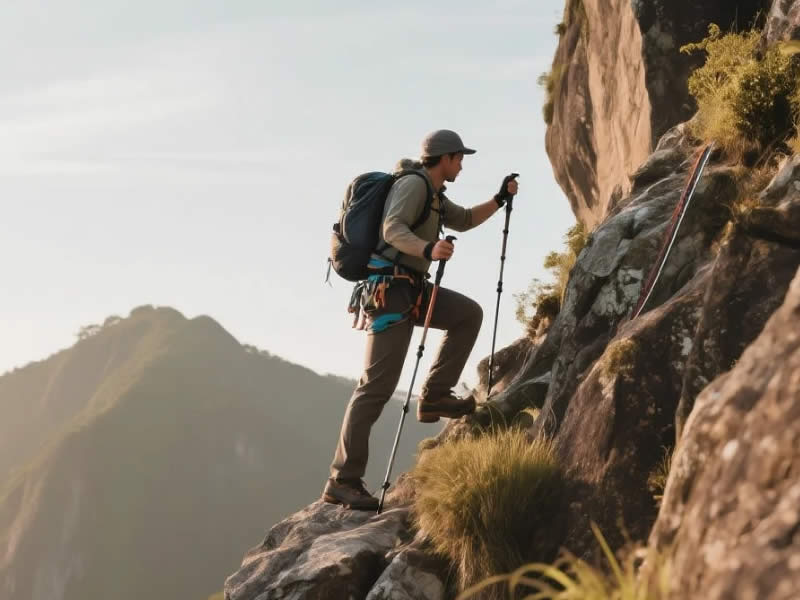
The Serra do Mar, a vast mountain range along Brazil’s southeastern coast, offers spectacular hiking but also some of the most challenging rocky sections you will encounter. Trails often involve scrambling over granite boulders, squeezing through narrow gaps, and climbing steep, lichen‑covered slabs. In such terrain, trekking poles can be a help or a hazard – it all depends on how you use them. Here is a practical guide to using trekking poles effectively and safely when scrambling on rocky sections in the Serra do Mar.
Recommended trekking pole purchase link: https://lightenup.aliexpress.com/store/1101521655
When to keep poles – and when to stow them
- Use poles for: Approaching a rocky section, walking on uneven but stable boulders, testing the stability of a rock before stepping, or for balance on easy scrambles (Class 2 terrain).
- Stow poles for: Any section where you need both hands for holds, where the rock is steep and exposed, or where a pole could get wedged and cause a fall (Class 3+ scrambling).
In the Serra do Mar, many trails (e.g., the ascent to Pedra da Gávea, the traverse of Morro da Urca, or the rocky crests of Ilha Grande) feature short, steep scramble sections. The golden rule: when in doubt, stow them.
Preparing your poles for scrambling
Before you enter a rocky section, take a few seconds to adjust your poles:
- Shorten them significantly – Reduce length by 10–15 cm from your flat‑terrain setting. A shorter pole gives you better control, prevents it from hitting your face, and reduces the chance of jamming between rocks.
- Remove wrist straps – or loosen them completely. If you fall or need to let go of the pole quickly, you do not want it attached to your wrist. Some hikers prefer to remove the strap entirely for scrambling.
- Use carbide tips, not rubber – The sharp point will bite into granite, while rubber tips slide.
- Remove large baskets – They can catch on rock edges. Small summer baskets are fine; remove them if they catch.
Using a single pole for balance
On easier rocky sections where you still need one hand free, consider stowing one pole and using the other for balance.
- Hold the pole in your uphill hand – On a side‑hill traverse, plant it on the uphill side. This keeps your downhill hand free to brace against rock.
- Use it as a cane – When stepping across a gap, plant the pole on the far side to test stability.
- Do not pull on the pole – If you need to pull yourself up a rock step, use your free hand on a real hold. The pole is for balance, not for bearing your full weight.
When to stow both poles
For true scrambling – where you are using your hands to grip rock or pulling your body up – both poles must be stowed.
- Collapse telescopic poles to their shortest length or fold Z‑poles.
- Attach them to your backpack – use side compression straps, daisy chains, or dedicated pole holders. Ensure they are secure and won’t swing.
- Cover the tips with rubber covers to avoid poking yourself or damaging your pack.
- Proceed with both hands free. Focus on three points of contact (two hands + one foot, or two feet + one hand).
Technique for easy scrambling with poles (Class 2)
If the rocky section is relatively stable and you do not need your hands, you can keep both poles. Use these tips:
- Shorten poles as described.
- Plant on flat rock surfaces – avoid planting in crevices or between boulders where the tip could get stuck.
- Plant vertically – an angled plant may skid. Push straight down.
- Test each plant – before committing your weight, press lightly to ensure the tip has purchase.
- Keep the poles close to your body – over‑reaching can pull you off balance.
- Use an alternating rhythm (opposite pole to forward foot) on moderate slopes, but be prepared to double‑plant on steeper steps.
Specific advice for Serra do Mar terrain
- Granite slabs covered with lichen – Carbide tips bite through the lichen. Use a firm, vertical plant. Test each plant – if the tip skids, find a rougher spot.
- Loose, blocky scree – Shorten poles and use double planting for stability. The poles help you test whether a rock will shift before you step.
- Narrow rock corridors – Stow poles; you’ll need your hands to brace against both sides.
- Wet, slippery rock after rain – Carbide tips work better than rubber, but still exercise extreme caution. Consider waiting for the rock to dry.
Common mistakes to avoid
- Keeping long poles – Long poles hit rocks above you, throw you off balance, and can cause you to tip forward.
- Leaving wrist straps tight – In a fall, a strapped pole can twist your arm or prevent you from catching yourself.
- Using poles as levers – Never pull on a pole to lift your body weight. It can snap (carbon) or slip, and you will fall.
- Planting between rocks – The tip can wedge, and as you move forward, the pole can snap or you can trip.
- Relying on poles for support on steep, exposed rock – If a pole fails, you could fall. Use your hands.
Practice on smaller boulder fields
Before tackling the rocky sections of Serra do Mar, practice your stow‑and‑deploy technique on smaller, safer boulder fields. Learn to collapse and attach your poles to your pack without stopping. Build the habit of removing straps and shortening poles before the scramble.
Recommended poles for Serra do Mar scrambling
- Leki Makalu (7075 aluminium, SpeedLock) – durable, can be shortened easily, and the cork grip is comfortable when you do use them.
- Decathlon Forclaz MT500 – budget aluminium with lever locks, good value.
- Black Diamond Trail Pro – robust, but foam grip may be less ideal in humidity.
Final thoughts
Scrambling on the rocky sections of Serra do Mar is one of the great joys of hiking in Brazil – but it demands respect. Your trekking poles are valuable tools on the approach and descent, but on the scramble itself, they often become a hindrance. Learn to shorten them, loosen or remove straps, plant on flat surfaces, and stow them when hands are needed. With the right technique, you will move safely and efficiently through the granite wonders of this stunning coastal mountain range. Enjoy the climb!




