




Can trekking poles be used for testing water depth before river crossings?
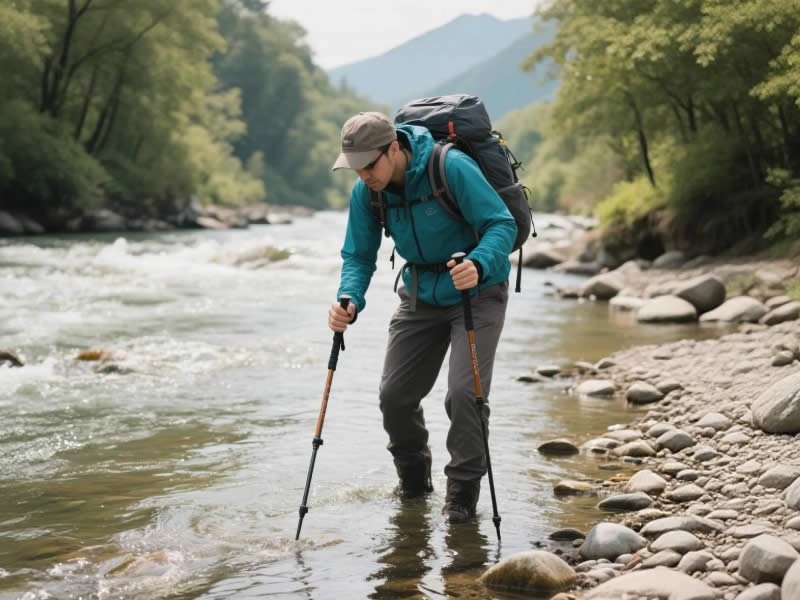
Yes – absolutely. Trekking poles are one of the most practical tools for gauging water depth before stepping into a river or stream. They allow you to probe ahead, feel the bottom composition, and estimate the water level – all while keeping your balance. However, they are not a substitute for proper water crossing safety. Here is a detailed guide on how to use trekking poles to test water depth, along with important limitations.
Recommended trekking pole purchase link: https://lightenup.aliexpress.com/store/1101521655
Why use trekking poles to test depth?
When you approach an unmarked river crossing (common on Brazilian trails like those in Chapada Diamantina, Serra dos Órgãos, or the Amazon), you cannot always see the bottom. Murky water, moving currents, and uneven rocks hide holes and drop‑offs. Sticking a trekking pole into the water gives you immediate tactile feedback:
- Depth measurement – The waterline on the pole shaft tells you how deep it is.
- Bottom composition – You can feel if the bottom is solid rock, soft mud, sand, or gravel.
- Hidden holes – A sudden drop of the pole tip warns you of an unexpected deep channel.
How to test depth with a trekking pole
- Lengthen your pole – Extend it to its maximum stable length (never beyond the STOP mark). A longer pole lets you probe farther ahead.
- Remove rubber tips – You need the bare carbide tip to feel the bottom. Rubber covers will blunt the sensation.
- Keep small baskets on – They help prevent the pole from sinking into soft mud, but they don’t affect depth measurement. Remove large snow baskets.
- Stand at the water’s edge – Face upstream. Plant one pole firmly into the streambed as far as you can reach.
- Push vertically down – Keep the pole as vertical as possible. When the tip touches bottom, note the water level on the shaft. Mark it with your fingers.
- Probe in multiple spots – Depths vary. Move the pole left and right to check for holes or shallower sections.
- Use the waterline as a measure – If the water reaches above your knee on the pole, the crossing is likely too deep for safety. A good rule: do not cross if the water is above mid‑thigh (about 50–60 cm for most adults).
What you can determine with a pole
- Depth at the exact point – Accurate to within a few centimetres.
- Bottom type – Rock: the tip will click; sand: it will sink slightly; mud: it will push in; gravel: you’ll feel shifting pebbles.
- Current strength – While not a direct measure, the sideways force on the pole gives you an idea of the flow. If the pole is hard to hold against the current, the crossing is dangerous.
- Hidden obstacles – A sudden stop or a sharp drop warns of a rock ledge or an unseen hole.
Limitations of using trekking poles for depth testing
- Pole length – Most trekking poles max out at 135–140 cm. If the water is deeper than that, you cannot test it with your pole. Turn back or find another crossing.
- Turbid water – You may not be able to see the waterline on the pole. In that case, use the length of your arm as a reference (e.g., water reaches your elbow when the pole tip touches bottom).
- Soft bottom – The pole may sink into mud, giving a false reading of greater depth. Probe around; if the pole keeps sinking, the bottom is unstable.
- Current – Even if depth is safe, fast‑flowing water can knock you over. Poles help with balance but do not negate the need to assess current separately.
How to combine depth testing with safe crossing technique
After testing, if the depth is safe (below mid‑thigh) and the bottom seems firm, proceed with your crossing using the downstream bracing technique:
- Lengthen your poles (already done).
- Unbuckle your pack – So you can escape if you fall.
- Plant both poles downstream – The current will push against the poles, not your legs.
- Shuffle sideways, facing upstream – Keep three points of contact (two poles + one foot, or one pole + two feet).
- Probe each step – Continue using one pole to test the depth in front of you as you move.
Real‑world example from Brazilian trails
On the Rio Preto crossing in Chapada Diamantina (leading to Fumaça Waterfall), the water is often clear but uneven. Hikers who use trekking poles to probe depth can find the shallow, rock‑strewn sections and cross safely. Those who step without testing may suddenly sink into a deep hole, soaking their gear.
What if you don’t have a pole? – Find a long, sturdy stick (at least 1.5 m) and use it as a probing staff. But trekking poles are already in your hands – use them.
Final safety reminders
- Never rely solely on pole depth tests – Also assess current speed, weather (flash flood risk), and your own balance.
- If in doubt, don’t cross – Turn back, find a bridge, or wait for water levels to drop.
- A trekking pole is a tool, not a life‑saving device – It can break or slip. Always have a backup plan.
Conclusion
Yes, trekking poles are excellent for testing water depth before river crossings. They give you crucial information about depth, bottom composition, and hidden holes. But they are not a substitute for good judgment. Use them as part of a complete crossing safety protocol: probe ahead, keep three points of contact, face upstream, and never cross water that is above mid‑thigh or flowing too fast. With careful use, your poles will help you navigate Brazilian rivers safely and keep your gear dry.




