




How to use trekking poles for pulling yourself up on steep jungle root climbs?
Steep, root‑entangled climbs are common in Brazilian jungles – whether in the Atlantic Forest, the Amazon, or the mountainous Atlantic rainforest of Serra do Mar. Unlike a clean mountain trail, a jungle slope is a chaotic tangle of thick roots, slippery mud, and loose soil. Using trekking poles to pull yourself up on these climbs can save your legs and prevent dangerous slips, but you need the correct technique. Here is a step‑by‑step guide to using your poles as climbing aids in steep, root‑filled terrain.
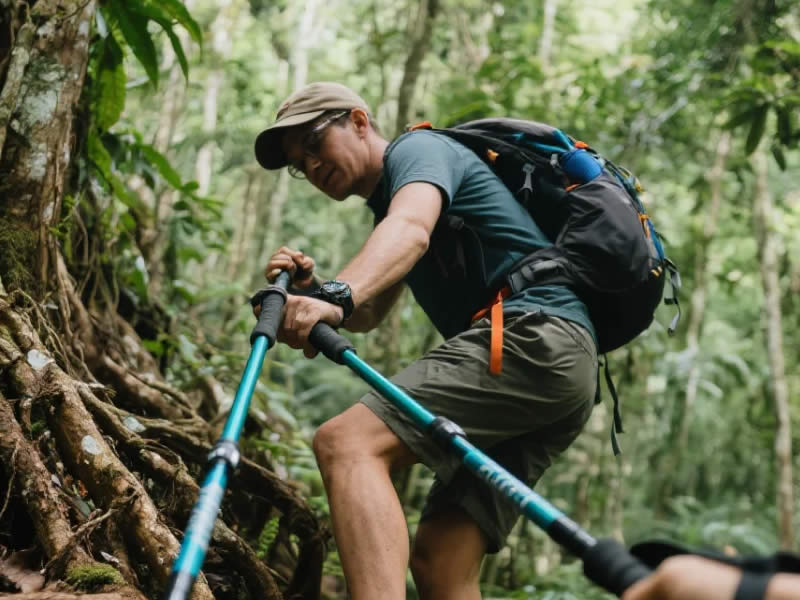
Recommended trekking pole purchase link: https://lightenup.aliexpress.com/store/1101521655
Why pulling with poles is different in the jungle
- Roots are irregular – You cannot always plant a pole in clean soil; you may need to brace it against a root or between roots.
- Mud is slippery – Carbide tips must bite into something solid, not just slide off.
- Handholds are scarce – Using poles to pull yourself up reduces the need to grab slimy roots with your bare hands.
Step 1: Shorten your poles significantly
For steep climbs, you need your poles shorter than your flat‑ground length. Reduce length by 10–15 cm (4–6 inches). A shorter pole gives you more leverage and keeps your arms low, preventing you from straining your shoulders. If you have extended foam grips, you can choke down even further.
Step 2: Choose the right planting spot
Do not blindly plant the pole into mud. Look for:
- A firm root that the carbide tip can bite into.
- A gap between roots where the tip can reach solid soil.
- A rock or a stable hummock of earth.
Avoid planting between two roots where the tip could get wedged and snap.
Step 3: Use double planting (both poles together)
On a steep jungle climb, alternating poles (opposite foot) is less effective because you are often moving one foot at a time. Instead:
- Plant both poles together about 30–50 cm ahead of your current position.
- Keep them shoulder‑width apart for stability.
- Push down firmly so the tips engage.
Step 4: Pull with your arms, using the wrist straps
The most common mistake is gripping the handle tightly and trying to pull with your fingers. That will quickly tire your hands and may cause blisters. Instead:
- Use the wrist straps correctly: hand up from below, strap between thumb and index finger.
- Let the strap do the work. When you pull, the strap will press against the back of your hand, transferring force directly from your arm.
- Relax your fingers – they are only there to guide the pole.
Step 5: Step up with the opposite foot
As you pull on the poles, simultaneously step up with the foot that is opposite to your strong side (or whichever foot is on a secure hold). The motion should be coordinated: pull with arms, lift with leg. This distributes the work.
Step 6: Keep your body close to the slope
Do not lean back away from the slope. Instead, keep your torso upright but close to the hill. Your body should be almost parallel to the slope. This keeps your centre of gravity low and ensures that your pulling force is directed upward, not outward.
Step 7: Move one pole at a time after each step
After you have taken one step up (both feet now on a higher root or ledge), you need to reposition your poles. Move one pole at a time, keeping the other pole planted for stability. Pull the first pole up to the next planting spot, push it in, then repeat with the second pole. Then take another step.
Technique for different types of jungle roots
- Thick, horizontal roots (natural steps) – Use the poles to pull yourself up onto the root. Plant the tips on the root itself or just behind it.
- Vertical roots (like small tree trunks) – Brace the pole against the root on the uphill side. Do not plant in the gap between the root and the soil; it may trap the tip.
- Slippery, muddy roots – Look for a small bump or a crevice where the carbide tip can lock. If the root is too slick, plant in the soil beside it.
What about using a single pole?
On very narrow, steep sections, you might stow one pole and use the other as a hand‑pulling aid. Keep the other pole in your downhill hand (the one away from the slope). But two poles are always better for balance and power.
When NOT to use poles to pull
- If the slope is extremely steep (over 40°) and you need both hands to grip roots – stow your poles and climb using your hands.
- If the soil is so loose that the poles cannot find any purchase – stow them and use your hands.
- If you are not confident in the pole’s lock – a collapsing pole on a steep climb could cause a fall.
After the climb
- Inspect your poles – Mud and grit may have entered the locks. Rinse with fresh water, dry, and lubricate the lever pivots.
- Check the carbide tips – If you planted on rocks or roots, they might be dull. Replace if needed.
- Wipe down your grips – Mud from your hands can make the grip slippery.
Practice on a safe slope
Before you need it on a real jungle trail, practice the pull‑up technique on a steep, grassy or dirt slope with good footing. Learn to coordinate the pull and step. Build the muscle memory so that on the root‑tangled climbs of the jungle, the movement is automatic.
Final thoughts
Using trekking poles to pull yourself up on steep jungle root climbs is a powerful technique that saves your legs and reduces the risk of slipping. Shorten your poles, plant both ahead, use the wrist straps to transfer pulling force, and step up with a coordinated motion. Keep your body close to the slope, move one pole at a time, and always check your plant for security. With practice, you will climb root‑covered slopes with greater ease and confidence, leaving you fresher for the rest of your jungle adventure.




