




Can broken carbon trekking poles be repaired in Brazil?
The short answer is generally no. Repairing a broken carbon fibre trekking pole in Brazil is not a reliable option for load‑bearing use. While some specialist composite repair shops might attempt a fix, the result will be weaker, heavier, and potentially dangerous. For the safety of Brazilian hikers tackling rocky quartzite and granite trails, it is far better to replace a broken carbon pole or switch to durable aluminium poles. Here is a detailed explanation.
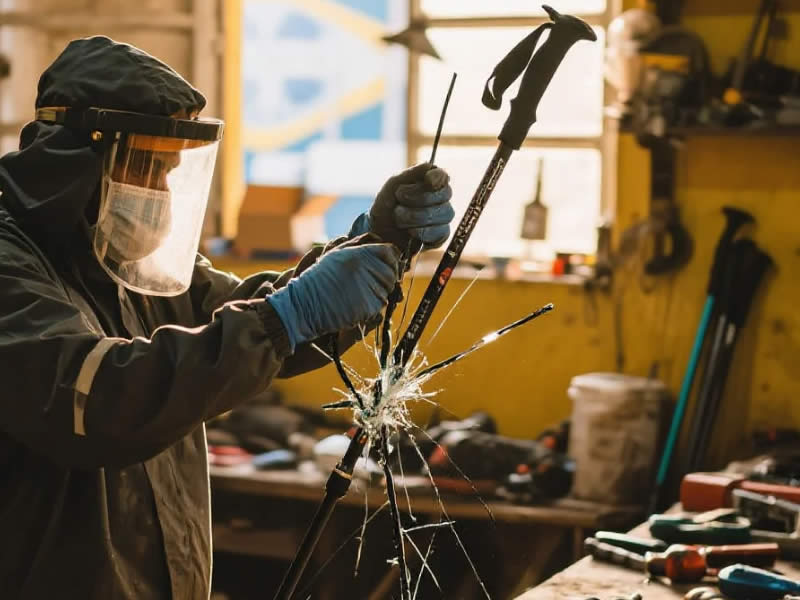
Recommended trekking pole purchase link: https://lightenup.aliexpress.com/store/1101521655
Why carbon fibre is difficult to repair
Carbon fibre gets its strength from continuous, oriented fibres embedded in epoxy resin. When a pole snaps or cracks, those fibres are severed. A repair – wrapping with new carbon fibre and resin – cannot restore the original strength because the load cannot be transferred continuously across the break. Key issues:
- Stress risers: The repaired area becomes stiff, concentrating stress at the edges, leading to new cracks.
- Hidden damage: Cracks may extend beyond the visible break, weakening the pole internally.
- Weight and bulk: A proper repair would add multiple layers of carbon and epoxy, making the pole unbalanced and possibly preventing it from collapsing.
- Field repair impossible: Unlike aluminium (which can be straightened), carbon repairs require a workshop, curing time, and specialised materials.
Are there repair shops in Brazil that accept carbon poles?
Very few. The main challenge is that trekking poles are not like bicycle frames (which some carbon repair shops handle). Pole shafts are thin‑walled and subject to high lateral stresses. A few possibilities:
- Composite bike repair shops (e.g., Carbon Bike Repair in some cities) might accept trekking poles, but the cost (often 200‑400 BRL or more) is typically higher than buying a new mid‑range pole.
- Custom fishing rod builders – They work with carbon but for fishing rods, which flex differently. Not recommended for load‑bearing use.
- DIY repair (strongly discouraged) – Watching YouTube videos and using epoxy and carbon cloth from Mercado Livre is not safe. The repair will be untested and prone to sudden failure.
Even if a shop claims to repair a carbon pole, no reputable shop will guarantee it for hiking. The liability is too high.
Why not just buy a replacement section?
Some premium brands (e.g., Leki, Black Diamond) sell replacement lower shaft sections for their poles. If your pole broke near the tip, you may be able to order a replacement section online and swap it yourself. This is the only safe “repair”. For carbon poles, replacement sections are available for some Leki models (e.g., Cressida). However, shipping to Brazil may take weeks and cost import duties.
Aluminium: the better choice for Brazilian trails
Given the difficulty of repairing carbon, many experienced Brazilian hikers choose 7075 aluminium poles. Aluminium bends rather than snaps. A bent aluminium pole can often be straightened in the field by hand or by rolling it on a flat rock. If a section is severely bent, replacement sections are available and cheaper than carbon. Aluminium is also more resistant to the lateral stresses of quartzite and granite.
What to do if your carbon pole breaks on a trail in Brazil
- If it snaps into two pieces: You cannot repair it in the field. Use a single pole for the rest of the hike, or find a sturdy stick as a temporary replacement. If you have a repair sleeve (a short aluminium tube and hose clamps), you can splint the break – but this is a temporary emergency fix, not a permanent repair.
- If it cracks but hasn't separated: You may continue with caution, but the crack will likely propagate. Consider retiring the pole.
- After the hike: Contact the manufacturer (Leki, Black Diamond, etc.) to see if they offer a warranty replacement or a discounted spare part. Some brands have a limited lifetime warranty that covers manufacturing defects.
Prevention: how to avoid breaking carbon poles in Brazil
- Use them only on smooth, non‑rocky trails – Carbon is fine on dirt paths, forest floors, and well‑maintained gravel.
- Avoid jamming the tip between rocks – Plant on flat surfaces.
- Never use the pole as a lever to pull yourself up steps or rocks.
- Shorten your poles on rocky sections – Less leverage reduces stress.
- Inspect for micro‑cracks before each trip – tap the shaft; a dull sound may indicate delamination.
Final verdict
Broken carbon trekking poles cannot be reliably repaired in Brazil for safe hiking. Do not trust DIY fixes or professional repairs that aren’t specifically designed for trekking poles. The only safe options are to replace the broken section (if available) or buy new poles. For most Brazilian rocky trails, 7075 aluminium poles with lever locks are a more durable and repairable choice. Invest in aluminium, and you’ll avoid the heartbreak of a snapped carbon pole in the middle of a beautiful trek.




