




How to fix a bent aluminum trekking pole after a fall on rocky terrain?
A bent aluminium trekking pole after a fall on rocky terrain is a common occurrence. Unlike carbon fibre, which snaps, aluminium typically bends – and in many cases, that bend can be straightened at home, saving you from buying a new pole. However, it must be done carefully to avoid weakening the metal further. This guide will walk you through the process, from assessing the damage to testing the repaired pole.
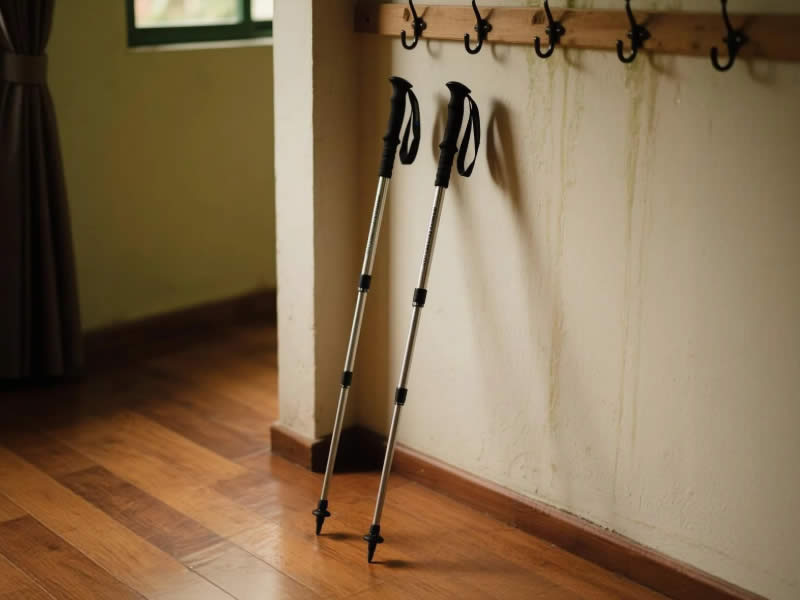
Recommended trekking pole purchase link: https://lightenup.aliexpress.com/store/1101521655
When straightening is possible – and when it’s not
- Mild bends (less than 15–20°): Almost always repairable. You can restore the pole to near‑original condition.
- Sharp kinks or creases: The metal has been severely fatigued. Straightening may cause a crack or create a weak point. Replace the section if possible.
- Bends near a locking mechanism or ferrule: These are tricky. The lock may not seat properly after straightening. Proceed with caution.
- Carbon poles: Never attempt to straighten carbon fibre – it will snap or delaminate. This guide is for aluminium only.
Tools you will need
- A hard, flat surface (a concrete floor, a granite countertop, a sturdy table, or a flat rock outdoors)
- A permanent marker (to mark the bend)
- A soft cloth or piece of rubber (to protect the pole finish)
- Optional: a rubber mallet, a wooden block, fine sandpaper (400‑600 grit), and a ruler or straight edge
Step 1: Assess the bend
- Extend the pole fully and lock it.
- Roll the pole on a flat surface (like a table). The bent section will lift off the surface. Mark the apex of the bend with a marker.
- Determine the direction of the bend – you will need to apply pressure in the opposite direction.
Step 2: The rolling method (best for mild bends)
This is the safest technique and works for most moderate bends.
- Place the bent section on the flat surface with the convex side (the high point) facing up.
- Hold the pole firmly on either side of the bend.
- Apply gentle, steady pressure with your hand (or a wooden block) on the high point. Roll the pole back and forth while maintaining pressure. The goal is to work the bend out gradually, not to force it back in one motion.
- Check your progress frequently – after every few rolls, roll the pole again to see if the high point has reduced.
- Continue until the pole is straight to within 1–2 mm (a slight curve is acceptable; perfection is not necessary).
Step 3: The tapping method (for stubborn bends)
If rolling alone doesn’t work, you can use a rubber mallet.
- Place the bent section on a flat, hard surface (e.g., a concrete floor) with the convex side up.
- Protect the pole by placing a piece of scrap hardwood or a thick book over the bend.
- Tap lightly with a rubber mallet – use multiple gentle taps rather than one hard blow. Check after every few taps.
- Rotate the pole slightly and repeat if the bend is not uniform.
Step 4: Check for roundness
A bend may also deform the cross‑section of the tube (making it oval instead of round). To check:
- Slide the straightened section into the next section (if it’s an inner tube). It should move smoothly without binding.
- If it feels tight or catches, the tube is ovalised. You can try to round it by inserting a wooden dowel or a round metal rod slightly smaller than the inner diameter and gently tapping it through. This is advanced; if it doesn’t work, the pole may be damaged beyond repair.
Step 5: Test the lock and collapse
After straightening, reassemble the pole:
- Slide the sections together – they should move without excessive friction.
- Lock the pole at your desired length.
- Apply body weight – the lock should hold. If it slips, the straightened section may have deformed the clamping area. Clean and adjust the lock tension.
- Collapse and extend the pole several times – it should work smoothly.
Step 6: Fine‑tuning and finishing
- If the pole has small surface scratches from the fall, you can lightly sand them with fine sandpaper (400‑600 grit) to smooth them, but this is cosmetic.
- Apply a thin coat of silicone spray or light oil to the shaft to protect against future corrosion.
- Mark the straightened section with a permanent marker so you remember it has been repaired. Inspect it before each hike.
Prevention: how to avoid future bends
- Use two poles – spreading the load reduces the chance of bending one.
- Adjust length for terrain – shorter poles are stronger.
- Never extend past the “STOP” mark – the overlap between sections is critical for strength.
- Avoid using poles as levers to pull yourself up over rocks.
- Store poles extended (or at least not fully collapsed) to relieve stress on the metal.
When to replace the section
- If the bend has a visible crease or kink – straightening will not restore strength. Replace the section.
- If the pole has been straightened twice – the metal becomes work‑hardened and may crack. Retire it.
- If the lock no longer holds even after cleaning and adjustment – the deformation has affected the diameter. Replace the section.
- If the pole is a budget model (6061 aluminium) – it may be cheaper to buy new poles than to risk a weakened section.
Where to buy replacement lower sections in Brazil
- Leki Makalu lower sections – available from Adventure Sport (adventuresport.com.br) or Dancor (dancor.com.br).
- Black Diamond Trail Pro lower sections – harder to find in Brazil; consider ordering from abroad.
- Decathlon Forclaz MT500 – Decathlon stores may sell replacement sections; check with customer service.
Conclusion
A bent aluminium trekking pole is often fixable with patience and the right technique. The rolling method on a flat surface is safe and effective for mild bends. Always test the lock and collapse before using the pole on a serious hike. If the bend is severe or the pole shows creases, replace it – your safety is not worth the risk. With proper care, your straightened pole can continue to serve you for many more rocky kilometres.




