




How to fix a twisted trekking pole section after a hard fall?
A hard fall on rocky terrain can do more than just bend your trekking pole – it can twist a section, causing the inner and outer tubes to rotate out of alignment. A twisted section prevents the pole from collapsing or extending properly, and may make the lock unreliable. Unlike a simple bend, a twist affects the rotational orientation of the telescopic sections. Fortunately, many twisted sections can be fixed at home with simple tools and patience. Here is a step‑by‑step guide to diagnosing and repairing a twisted trekking pole section.
Recommended trekking pole purchase link: https://lightenup.aliexpress.com/store/1101521655
What is a twisted section?
In a telescopic (3‑section) pole, each section is designed to slide smoothly inside the next, with a key or a circular cross‑section. A “twist” occurs when the inner tube rotates relative to the outer tube, often due to a sudden torsional force (e.g., the pole getting caught between rocks while your body rotates). The result: the sections no longer align, the locking mechanism may not engage, or the sections may jam.
Identify the problem
- Extend the pole fully and examine it. Does one section look rotated? Look at the locking mechanism – if it’s a twist lock, the knob may be off‑centre. For lever locks, the clamp may be misaligned.
- Try to collapse the pole – if a section is twisted, it may not slide at all, or may slide only when forced.
- Check for a bend – a twist often accompanies a bend. Roll the pole on a flat surface to check for straightness.
Tools you may need
- Rubber gloves or a non‑slip mat (for grip)
- Soft cloths (to protect the finish)
- A vice with soft jaws (if needed)
- A rubber mallet (for gentle persuasion)
- Penetrating lubricant (e.g., WD‑40 – as a cleaner, not a permanent lubricant)
- Isopropyl alcohol (for final cleaning)
Step 1: Try the simplest fix – manual realignment
If the twist is mild (less than 15°), you may be able to rotate the section back by hand.
- Extend the pole fully and lock the sections below the twisted joint.
- Grip the twisted section with rubber gloves or a cloth for traction. Hold the adjacent section firmly with your other hand.
- Twist in the opposite direction of the misalignment while pulling gently to relieve tension. You may feel a slight click as the sections realign.
- Test by collapsing and extending the pole. If it moves smoothly, you have succeeded.
Step 2: If manual twisting fails – use a vice
For stubborn twists, you need more leverage.
- Secure the lower section of the pole in a vice with soft jaws (or wrap the pole in a cloth). Do not overtighten – you could crush the tube.
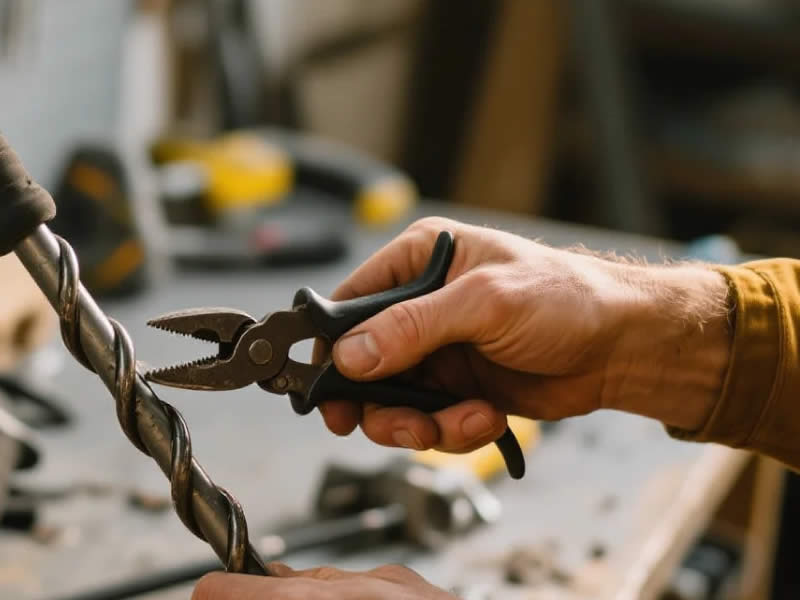
- Grip the twisted section with a rubber strap wrench or a piece of rubber and pliers (with cloth protection).
- Apply gentle, steady torque in the opposite direction of the twist. Avoid sudden jerks.
- Stop frequently to check alignment. It may take several attempts.
Step 3: Address any accompanying bend
A twisted section is often also bent. After realigning the twist, check for straightness:
- Roll the pole on a flat surface (e.g., a concrete floor or a kitchen counter). The bent section will lift off the surface.
- Apply gradual pressure with your hand or a wooden block to straighten the bend. Use the rolling method: place the convex side up and roll while pressing down.
- Do not use a hammer directly on the pole – use a rubber mallet with a protective block if necessary.
Step 4: Clean and lubricate
After straightening and realigning, the surfaces may have been abraded. Clean them:
- Disassemble the pole (if possible) by unlocking and separating the sections.
- Wipe the inner shaft with isopropyl alcohol to remove any dirt or residual lubricant.
- Apply a dry lubricant (silicone spray or PTFE) to the inner shaft – this reduces friction and prevents future sticking. Do not get lubricant on the clamping surfaces.
Step 5: Test the lock and operation
- Reassemble the pole and extend it to your desired length.
- Lock the mechanism – it should engage smoothly and hold firmly.
- Apply body weight – push down on the pole. It should not slip or collapse.
- Collapse and extend the pole several times. It should operate without binding or excessive force.
When the fix is not possible – replace the section
- If the pole has a visible crease or kink – straightening will weaken it further. Replace the section.
- If the lock no longer holds even after cleaning and adjustment – the deformation has altered the diameter. Replace.
- If the pole is carbon fibre – carbon does not twist; it cracks. A twisted carbon pole is actually fractured. Replace it immediately.
Where to buy replacement sections in Brazil
- Leki Makalu lower sections – Adventure Sport (adventuresport.com.br) or Dancor (dancor.com.br).
- Black Diamond Trail Pro sections – harder to find locally; consider ordering from abroad.
- Decathlon Forclaz MT500 – Decathlon stores may sell replacement sections; ask customer service.
Preventing twists in the future
- Avoid using poles as levers to pull yourself up over rocks.
- Keep poles clean – grit can cause sections to bind, leading to twisting when you try to force them.
- Do not overtighten locks – excessive force can deform the shaft.
- Store poles extended – never store them collapsed with locks tight.
Conclusion
A twisted trekking pole section after a hard fall is often repairable with careful manual realignment, possibly assisted by a vice. Always check for accompanying bends and straighten them using a flat surface. Clean the sections thoroughly and lubricate with a dry lubricant. Test the lock before trusting the pole on a serious hike. If the damage is severe (kinks, cracks, or lock failure), replace the section. With patience and the right technique, you can restore your pole to working order and get back on the trail.




