




How to train a senior Brazilian hiker to use trekking poles safely?
Training a senior hiker to use trekking poles requires patience, clear instruction, and an emphasis on safety. In Brazil, where seniors may face uneven cobblestones, humid park paths, or gentle mountain trails, proper technique can prevent falls and reduce joint strain. This guide provides a step‑by‑step training protocol designed for older adults, focusing on correct setup, strap use, walking rhythm, and terrain adaptation.
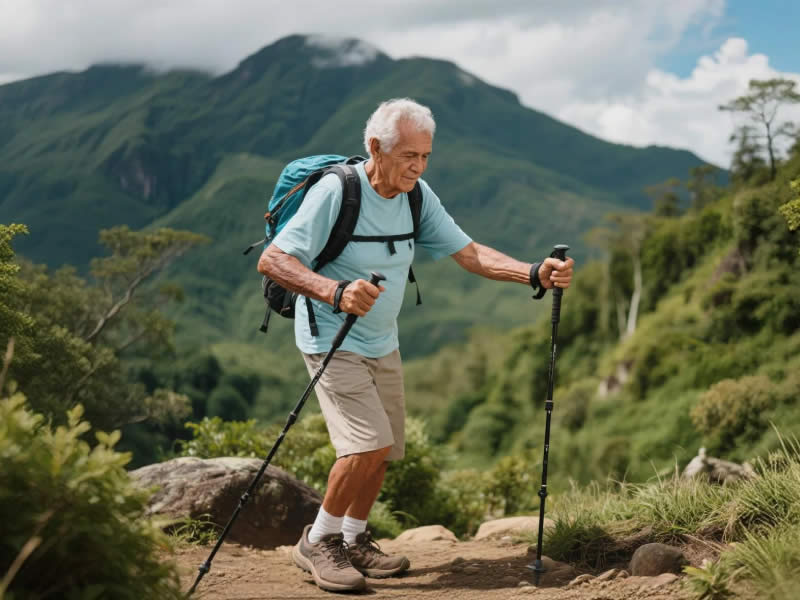
Recommended trekking pole purchase link: https://lightenup.aliexpress.com/store/1101521655
Before you begin: choose the right poles
Ensure the poles are suitable for the senior:
- Lightweight (under 250 g per pole) – aluminium or carbon.
- Lever locks – easier than twist locks for arthritic hands.
- Cork or soft foam grips – comfortable and non‑slip.
- Rubber tips (paw covers) – essential for indoor and pavement practice.
- Adjustable length – to fit the user’s height.
Step 1: Indoor familiarisation (30 minutes)
Start on a flat, non‑slip floor (tiles or wood with rubber tips).
- Set the correct length – Have the senior stand upright in their usual walking shoes. Bend their elbow to 90°. Adjust the pole so the rubber tip touches the floor. Mark this length with tape.
- Explain the wrist strap – Show them the strap and demonstrate the “hand up from below” technique: insert hand through the loop from underneath, then bring hand down onto the grip. The strap should sit between thumb and index finger. Tighten so it is snug but not tight. Key message: “The strap holds your weight – you can relax your fingers.”
- Practice relaxing the grip – Have them open their fingers while the pole is planted. The pole should hang from the strap. This builds trust.
- Walking without poles – First, have them walk a few metres without poles to observe their natural arm swing.
Step 2: Basic walking rhythm (15 minutes)
- Opposite arm‑leg rule – Explain: “When your right foot steps forward, move your left pole forward. When your left foot steps, move your right pole forward.” Demonstrate slowly.
- Walk side by side – Walk beside the senior, gently guiding their arm motion. Use verbal cues: “Right foot – left pole. Left foot – right pole.”
- Keep poles short – The tip should be planted near the heel of the forward foot, not far ahead. Avoid over‑reaching.
- Relaxed grip reminder – Every few steps, remind them to relax their fingers.
Step 3: Introducing gentle slopes (20 minutes)
Move to a shallow ramp or a gentle grassy slope (e.g., a park).
- Uphill: Shorten poles by 5 cm. Use double planting (both poles together) on steeper sections. Coach: “Push down on the poles to help your legs.”
- Downhill: Lengthen poles by 5 cm. Plant both poles ahead, then step. Emphasise: “Keep your chest up, lean back slightly – the poles will brake for you.”
- Side‑hilling (if needed): Adjust uphill pole shorter, downhill pole longer.
Step 4: Progressing to uneven terrain (outdoor park)
Choose a flat, dry park path first, then a slightly uneven surface (grass, packed dirt).
- Watch for obstacles – Teach them to use a pole to probe ahead (e.g., a dip or a root).
- Shorten stride – On uneven ground, take shorter steps for better balance.
- Use two poles always – Reinforce that a single pole is not enough.
Step 5: Brazilian‑specific adaptations
- Rubber tips on pavement – Always use rubber tips on cobblestones, sidewalks, or indoor floors. Show how to swap tips.
- Humidity and sweat – Cork grips help; also recommend lightweight cotton gloves.
- After rain – Practice on a slightly wet surface (if safe) to build confidence. Remind: “Plant firmly – the rubber tip will grip.”
- Mud avoidance – For seniors, avoid deep mud. Stick to drier paths.
Step 6: Safety checklist before each hike
- Poles adjusted to correct length (flat, uphill, downhill marked).
- Rubber tips on for pavement; carbide tips only for dirt/grass.
- Wrist straps snug and correctly positioned.
- Lever locks tight (test by pushing down).
- Both poles used.
Common mistakes and corrections
- Death grip – Remind: “Relax your fingers – let the strap work.” Have them open their hand during walking to reset.
- Same‑side planting (right foot with right pole) – Gently correct by touching their opposite arm.
- Poles too long – Check that elbow is at 90° on flat ground. Adjust if needed.
- Looking down – Encourage looking ahead; the poles provide feedback.
Motivation and progression
- Start with short walks (10‑15 minutes) and gradually increase duration.
- Celebrate small successes – “You crossed that cobblestone section without wobbling!”
- Involve a friend or family member for company and safety.
Emergency stop
Teach them to let go of the poles if they start to fall – do not try to catch with the poles. Practice dropping poles safely.
Final tips for the trainer
- Be patient. Learning a new motor skill takes time for seniors.
- Use positive reinforcement. A smile and a “Good job!” go a long way.
- Ensure the senior wears sturdy, low‑heeled shoes with good grip.
- If the senior has significant balance issues, consult a physiotherapist before starting.
Conclusion
Training a senior Brazilian hiker to use trekking poles safely is a rewarding process. With correct length, proper strap technique, opposite arm‑leg rhythm, and rubber tips for pavement, seniors can enjoy safer, more confident walking on Brazil’s varied surfaces – from city parks to gentle coastal paths. Take it slow, practise regularly, and watch their balance and independence flourish.




