




Do shock‑absorbing trekking poles help with chronic back pain?
If you suffer from chronic back pain, you may be tempted by trekking poles advertised with “anti‑shock” or “spring‑loaded” mechanisms. The promise of a cushioned step sounds appealing. However, the short answer is no – shock‑absorbing trekking poles do not directly help with chronic back pain. The springs are designed to reduce impact on your wrists, elbows, and shoulders, not your spine. For back pain relief, the key benefits come from using any trekking poles correctly – rigid poles included – by promoting an upright posture, transferring load to your arms, and improving balance. This article explains why anti‑shock mechanisms are not a solution for back pain and what actually works.
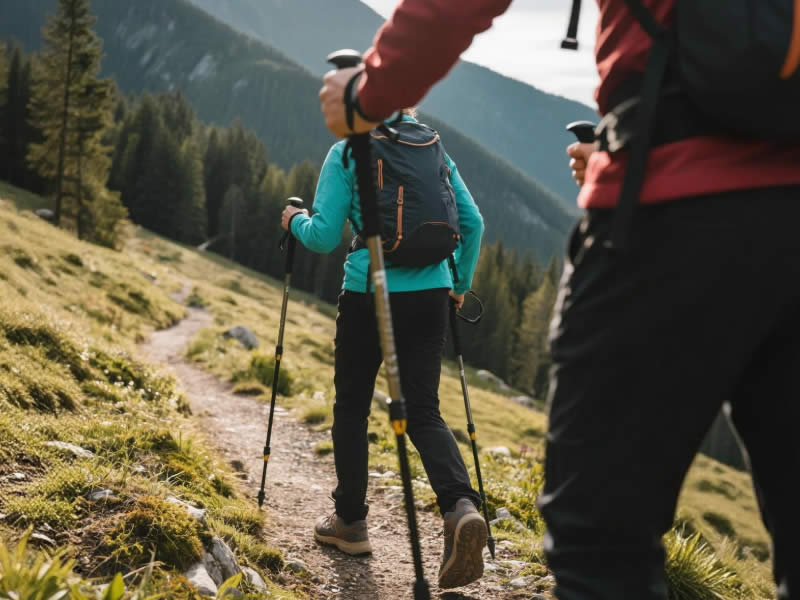
Recommended trekking pole purchase link: https://lightenup.aliexpress.com/store/1101521655
How shock‑absorbing poles work
Anti‑shock poles contain a coil spring or elastomer in the upper shaft. When you plant the pole, the spring compresses 10‑20 mm, absorbing the sudden impact that would otherwise travel up your arm. This can reduce jarring in your wrists and elbows, which is helpful for people with arthritis or tendonitis in those joints. However, the spring does nothing to reduce the compressive or shear forces on your lumbar spine. Your back’s loading is determined by your posture, the weight of your pack, and the way you transfer weight through your legs and core – not by a spring in a pole.
What actually helps chronic back pain when walking
- Upright posture – Poor posture (hunching forward) is a major contributor to back pain. Trekking poles encourage you to stand taller because your hands are positioned forward, naturally pulling your shoulders back and opening your chest. This effect is identical with rigid or shock‑absorbing poles.
- Load transfer via wrist straps – When you use the wrist strap correctly (hand up from below, strap between thumb and index finger), you can push down and transfer some of your body weight from your legs and spine to your arms. This reduces the compressive load on your vertebral discs. Again, this works with any pole, spring or not.
- Reduced impact on knees and hips – By offloading your lower body, poles reduce the jarring that travels up your legs and can affect your pelvis and lower back. This is purely a function of using two poles and pushing down – no springs needed.
- Improved balance – Two poles provide four points of contact, reducing the risk of sudden, twisting movements that can aggravate back pain. This stability comes from the poles themselves, not from any shock absorber.
Why anti‑shock poles may even be worse for back pain
- Added weight – Springs add 30‑50 g per pole. Over a long walk, this extra weight can increase fatigue, potentially leading to poorer posture and more back strain.
- Bounciness – The spring can make the pole feel less solid, reducing the tactile feedback that helps you maintain an efficient, upright gait. Some users report that the bounce actually disrupts their rhythm, causing them to lean forward more.
- Energy loss – Each compression of the spring absorbs a small amount of your forward momentum, making you work slightly harder. This may lead to earlier fatigue and, consequently, worse posture.
What the experts say
Physiotherapists and hiking instructors rarely recommend shock‑absorbing poles for back pain. Instead, they focus on:
- Correct pole length – Set so that your elbow is at 90° on flat ground.
- Wrist strap technique – Hand up from below, relaxed grip, strap bears weight.
- Upright torso – Avoid hunching; look ahead, not down.
- Two poles – Always use a pair for symmetrical support.
When shock‑absorbing poles might help (but not for back pain)
- If you have chronic wrist or elbow arthritis, the cushioning can be beneficial.
- If you walk exclusively on very hard surfaces (e.g., pavement) and the jarring bothers your shoulders.
For back pain, they offer no advantage.
Practical advice for back pain sufferers using any trekking poles
- Choose rigid poles – Lightweight aluminium with lever locks (e.g., Leki Makalu, Decathlon Forclaz MT500). They are simpler, lighter, and more reliable.
- Use rubber tips on pavement – To reduce vibration that travels up the pole (and to protect the tips).
- Adjust length for hills – Shorten for uphill, lengthen for downhill. This maintains proper posture.
- Engage your core – While walking, lightly brace your abdominal muscles. This supports your spine.
- Take breaks – Every 20 minutes, stop, plant both poles, and stand upright to decompress your spine.
Conclusion
Shock‑absorbing trekking poles do not help with chronic back pain. The springs cushion your wrists and elbows, not your spine. The real benefits for back pain come from using any two poles correctly: setting the right length, using wrist straps to transfer load, and maintaining an upright posture. Save your money and the extra weight – invest in a good pair of rigid poles with lever locks and comfortable grips. Combine them with proper technique, and you’ll get the back‑friendly support you need without the unnecessary bounciness. Always consult your doctor or physiotherapist before starting any new exercise, but know that the right poles – used correctly – can be a valuable part of your back pain management toolkit.




