




Do trekking poles help with balance for visually impaired Brazilian walkers?
Yes – trekking poles can significantly improve balance and mobility for visually impaired walkers, but they are not a substitute for a white cane (bengala branca). When used correctly, a pair of trekking poles provides tactile feedback about the ground ahead, widens the base of support, and reduces the risk of falls. In Brazil, where sidewalks are often uneven, streets have cobblestones, and public paths may have sudden drops, trekking poles can be a valuable complement to orientation and mobility training. This article explores how trekking poles help, their limitations, and practical advice for visually impaired users in Brazil.
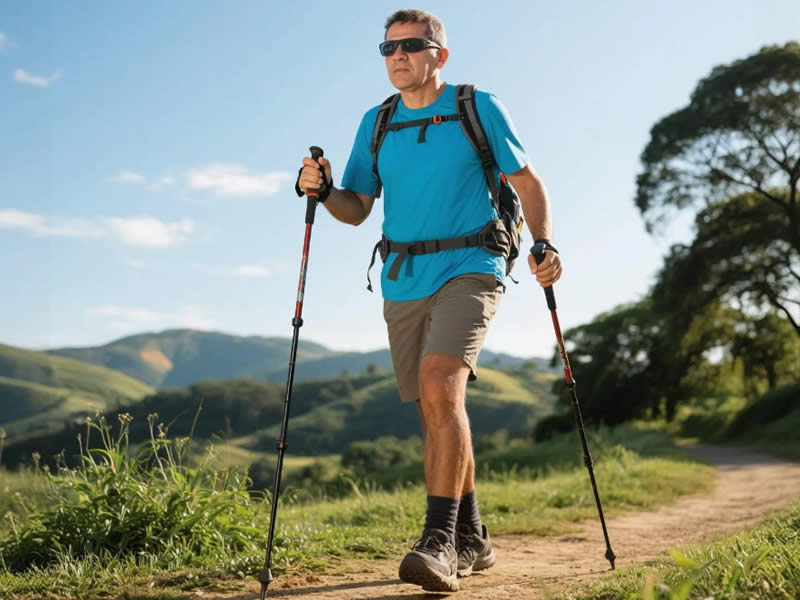
Recommended trekking pole purchase link: https://lightenup.aliexpress.com/store/1101521655
How trekking poles improve balance
- Tactile feedback – As you sweep the pole ahead, the tip (with a rubber cover) contacts the ground. You feel changes in surface texture, elevation, and obstacles (e.g., cracks, loose tiles, kerbs). This sensory information helps you plan your next step. Unlike a white cane (which is used to detect obstacles in a sweeping arc), trekking poles are used in a rhythmic, alternating pattern, providing continuous feedback with each step.
- Widened base of support – Two poles create four points of contact with the ground (feet + poles). This dramatically increases stability, especially on uneven or slippery surfaces. For someone with low vision or no vision, this can prevent falls caused by unexpected shifts in footing.
- Weight transfer – By pushing down on the poles, you transfer some of your body weight from your legs to your arms. This reduces the load on your joints and helps you maintain an upright posture, which is beneficial for balance.
- Confidence – Knowing you have extra support can reduce anxiety about walking outdoors, encouraging more physical activity and social participation.
Key differences between white canes and trekking poles
| Feature | White Cane (bengala branca) | Trekking Poles (pair) |
|---|---|---|
| Primary use | Obstacle detection and identification | Balance, weight support, and terrain feedback |
| Contact with ground | Intermittent (sweeping arc) | Continuous (rhythmic planting) |
| Feedback | Tip vibration, sound | Tip vibration and force feedback through grip |
| Obstacle detection range | 1‑2 metres ahead | 30‑50 cm ahead (limited) |
| Best for | Navigation and safety | Stability and fatigue reduction |
A white cane is essential for detecting obstacles that are not directly underfoot (e.g., a parked car, a low branch). Trekking poles are better for immediate footing and balance. Many visually impaired walkers use both – a white cane in one hand and a trekking pole in the other, or a white cane plus a pair of trekking poles (with the white cane held in the centre). However, this requires advanced mobility training.
Adaptations for visually impaired users in Brazil
- Use rubber tips on pavement – Always fit rubber paw covers over the carbide tips. Carbide tips are designed for dirt; on pavement, they are slippery and can damage surfaces. Rubber tips provide excellent grip and silent operation.
- Consider trekking poles with reflective elements – Some brands offer reflective stickers or bands on the poles, increasing visibility to drivers and cyclists.
- Choose lightweight poles – Carbon fibre or lightweight aluminium reduce arm fatigue. For long walks, this is important.
- Use two poles – One pole may be used as a white cane substitute in a pinch, but two provide far better balance.
- Practice with an orientation and mobility specialist – A trained professional can teach you how to integrate trekking poles into your walking technique without interfering with the white cane’s sweep.
Practical techniques
- Alternating rhythm – Walk with an opposite arm‑leg pattern: right foot forward, left pole down. This provides continuous feedback. Keep the poles close to your body.
- Probing ahead – Extend one pole slightly forward to feel for kerbs, steps, or holes. The pole’s length gives you about 30‑50 cm of warning.
- On cobblestones – Shorten poles slightly and plant them more vertically. Rubber tips grip well on wet or dry stones.
- Indoors – Use rubber tips on tile or wood floors. Trekking poles can help navigate unfamiliar indoor spaces, especially after vision loss.
Limitations to be aware of
- Not a substitute for a white cane – Trekking poles cannot detect overhanging obstacles (branches, signs), low‑hanging barriers, or objects more than a step ahead.
- Requires upper body strength – Users with weak arms may fatigue quickly. Lightweight poles and correct strap technique help.
- Training is essential – Without proper instruction, a user may trip over the poles or fail to integrate them with a white cane.
- Not suitable for all visual impairments – People with hemianopia (half‑field loss) may benefit, but those with severe balance disorders may need a walker.
Where to find training in Brazil
- Instituto Benjamin Constant (Rio de Janeiro) – National reference for visual impairment, offering mobility training.
- Laramara (São Paulo) – Provides orientation and mobility courses.
- Local associations – Many cities have support groups for visually impaired people; they may offer workshops on mobility aids.
Buying trekking poles in Brazil
- Decathlon – Affordable Forclaz MT500 (₿250‑300) with rubber tips included. Try in store.
- Adventure Sport – Leki Makalu (₿600‑800), higher quality.
- Mercado Livre / Amazon Brasil – Search for “bastão de trilha dobrável com ponteira de borracha”.
Conclusion
Trekking poles can be a valuable balance aid for visually impaired Brazilian walkers, especially on uneven surfaces. They provide tactile feedback, widen the base of support, and reduce fall risk. However, they are not a replacement for a white cane, which remains essential for obstacle detection. With proper training, correct equipment (rubber tips, lightweight poles), and possibly using a white cane in one hand and a trekking pole in the other, visually impaired individuals can walk more confidently and safely. Always consult an orientation and mobility specialist to integrate trekking poles into your mobility plan. With the right approach, trekking poles can open up new paths and independence.




