




Do snow baskets help on muddy winter trails in Brazilian national parks?
Yes – snow baskets (also called mud baskets or all‑terrain baskets) can be surprisingly helpful on muddy winter trails in Brazilian national parks. While they are designed for deep snow, their larger surface area also prevents trekking poles from sinking deep into soft, sticky mud. This is especially useful in the winter months (June‑August) when many trails in parks like Chapada Diamantina, Serra dos Órgãos, and the Serra da Mantiqueira become saturated with water and turn into muddy, slippery tracks. This article explains how snow baskets work, when to use them, and when to leave them behind.
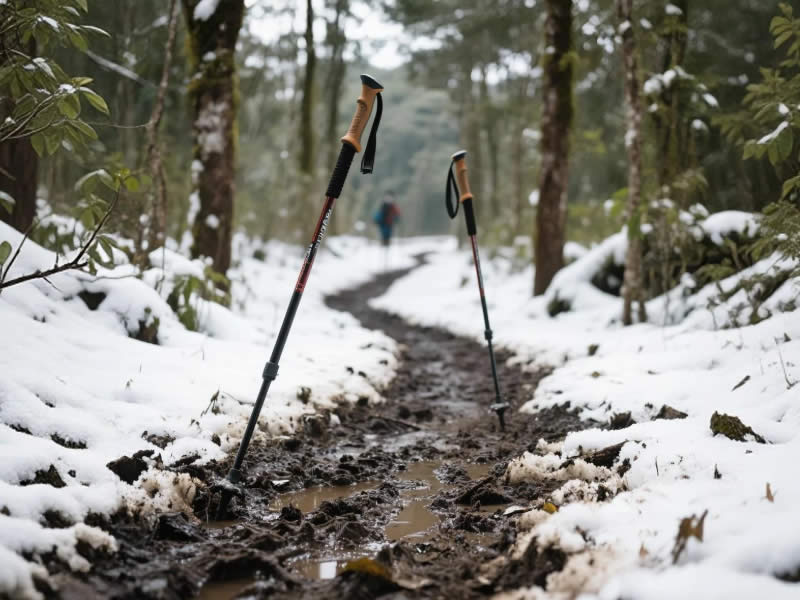
Recommended trekking pole purchase link: https://lightenup.aliexpress.com/store/1101521655
Why mud is a problem for trekking poles
On a muddy trail, a standard small summer basket (4‑5 cm) offers little resistance. Your pole tip punches through the mud, and the shaft sinks deep. Each plant requires extra effort to lift the pole out, tiring your arms and reducing stability. In deep, sticky mud, the pole may even get stuck, forcing you to pull hard. Over a long day, this becomes exhausting.
How snow baskets help in mud
Snow baskets are larger (6‑10 cm) and have a wider surface area. When you plant a pole fitted with a snow basket, the basket sits on top of the mud, preventing the tip from plunging deep. The pole remains near the surface, so you don’t have to fight suction. The basket also helps distribute your weight, providing more support on soft ground.
Are all snow baskets suitable for mud?
Not exactly. There are three sizes:
- Small summer baskets (4‑5 cm) – Useless in deep mud. They sink.
- Medium‑sized snow/mud baskets (6‑7 cm) – Ideal for Brazilian winter mud. They are sometimes sold as “mud baskets” or “all‑terrain baskets”. They prevent sinking without being so large that they collect heavy clods of mud.
- Large powder snow baskets (8‑10 cm) – These are designed for deep, light powder. In sticky, heavy Brazilian mud, they can actually make things worse: the wide basket acts like a scoop, collecting a heavy ball of mud that adds weight and makes the pole hard to lift. For most mud, medium baskets (6‑7 cm) are best.
Where to find mud baskets in Brazil
- Decathlon – Sells universal medium baskets (often labelled “aros para lama”) for ~10‑20 BRL per pair. Fits most 8‑10 mm tip ferrules.
- Adventure Sport – For Leki and Black Diamond specific mud baskets.
- Mercado Livre / Amazon Brasil – Search for “aro para lama bastão de trilha”.
When to use snow/mud baskets on muddy winter trails
- After heavy rain – Many Brazilian national parks have wet winters (especially in the Serra do Mar and Mantiqueira). Mud can be deep and sticky.
- On lowland muddy sections – For example, the approach trails to peaks like Pedra do Sino or the lower parts of Chapada Diamantina’s valleys.
- For hikers carrying heavy packs – The extra weight increases sinking; baskets help.
When NOT to use them
- On rocky sections – Baskets can catch on rocks, causing the pole to twist or jerk. Remove them when you reach scree or boulder fields.
- On hardpack or dry trails – Unnecessary.
- On very deep, sticky clay – Even medium baskets may collect mud. In that case, remove baskets and accept some sinking; it’s often easier than lifting a heavy mud‑balled pole.
How to use poles with mud baskets effectively
- Plant vertically – The basket works best when the pole is straight. Angled plants may cause the basket to tilt and lose flotation.
- Lift the pole cleanly – After planting, pull the pole straight up. Do not drag it sideways, which can scoop more mud.
- Clean baskets regularly – Knock off accumulated mud by tapping the pole against a rock or tree. A heavy clump of mud defeats the purpose.
- Swap back to small baskets when you leave muddy sections – they are lighter and less likely to snag.
Alternatives to snow baskets for mud
If you don’t have medium baskets, you can:
- Use no baskets – The pole will sink deeper, but some hikers prefer this to dealing with mud‑clogged baskets.
- Make temporary baskets – Cut a plastic bottle cap or a piece of thick foam, punch a hole, and slide it over the tip. Not durable, but works in a pinch.
- Use larger snow baskets (if you already have them) – They will work, but expect them to collect mud. Tap them frequently.
Real‑world experience from Brazilian hikers
On the Vale do Pati trek in Chapada Diamantina, the trails can be extremely muddy after rain. Hikers who use medium‑sized baskets report far less arm fatigue and better stability than those using small baskets or no baskets. The baskets help the poles float on the mud, preventing deep sinking. Many local guides recommend keeping a pair of mud baskets in your pack during the wet season.
Conclusion
Yes, snow baskets (specifically medium‑sized mud baskets) are very helpful on muddy winter trails in Brazilian national parks. They prevent poles from sinking, reduce arm fatigue, and improve stability. However, avoid using very large powder snow baskets, as they can collect heavy mud. Choose medium baskets (6‑7 cm) for the best balance of flotation and easy cleaning. Use them on muddy sections, remove them on rock, and keep your poles clean. With the right baskets, you’ll glide through mud and enjoy the winter beauty of Brazil’s national parks without the struggle.




