




Are trekking poles useful for beach walking on Brazilian sandy shores?
Brazil is famous for its stunning beaches—from Copacabana and Ipanema in Rio to the pristine shores of Fernando de Noronha and the endless sands of the Lençóis Maranhenses. Walking on sand is excellent low‑impact exercise, but should you bring trekking poles? The short answer is generally no, but there are a few specific scenarios where they can help. Let’s break it down.
Recommended trekking pole purchase link: https://lightenup.aliexpress.com/store/1101521655
Why trekking poles usually don’t work on dry sand
Dry, loose sand is the enemy of trekking poles. Here’s why:
- They sink – A carbide tip or even a rubber tip will penetrate deep into soft sand with every plant. You’ll waste energy lifting the pole out of a hole rather than propelling yourself forward.
- They drag – Even with wide mud baskets, sand flows around the basket, creating significant resistance. You’ll feel like you’re pulling a plow.
- No solid purchase – Unlike dirt or rock, sand shifts. The pole tip doesn’t provide a stable fulcrum for pushing.
For a casual stroll on dry sand (e.g., the upper part of Copacabana beach), poles are more nuisance than help.
When poles might be useful on Brazilian beaches
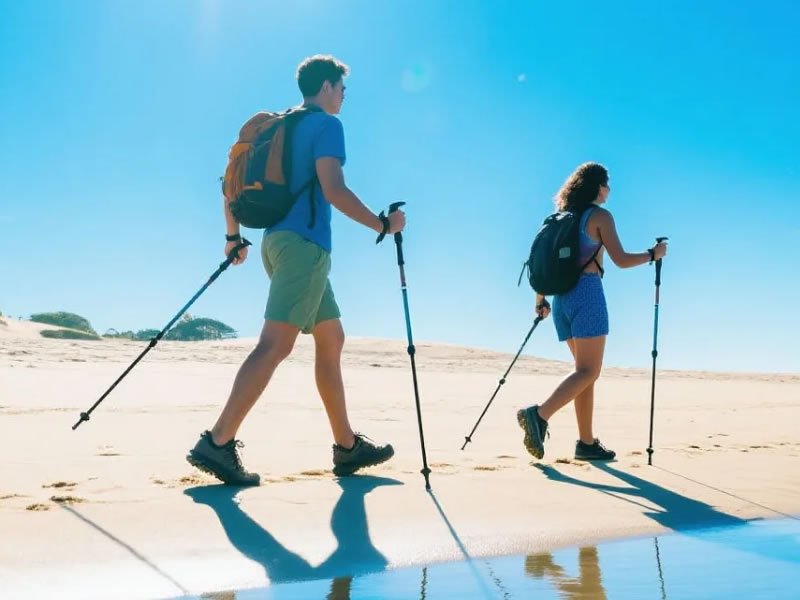
- Wet, compact sand near the waterline – Where waves have packed the sand hard, poles behave much like on a dirt trail. They can provide balance, especially if you have joint issues or are recovering from an injury.
- Long beach walks with elevation changes – Some Brazilian beaches have rocky headlands or dunes (e.g., Praia do Sancho in Fernando de Noronha). On the short, steep ascents between coves, poles help with stability.
- Beach‑to‑trail transitions – If you’re hiking a coastal trail that alternates between forest paths and beach sections (common in Ilha Grande or Jericoacoara), carrying poles is worth it for the trail parts. Just collapse and strap them to your pack while on sand.
- Walking on wet sand during low tide – The vast tidal flats in places like Maranhão or Bahia can be firm. Poles act as pace setters and reduce fatigue on very long walks (5+ km).
Better alternatives for beach walking in Brazil
- Barefoot or minimalist shoes – Let your feet adapt naturally. Sand strengthens foot muscles.
- A single wooden staff – Lightweight, floats, and won’t rust. Many beach vendors sell simple bamboo poles.
- No poles – For most beach exercise, your legs are enough. Use arm swing to increase calorie burn.
Special case: Lençóis Maranhenses
This national park features giant sand dunes with freshwater lagoons. Trekking poles are not recommended – they sink deeply. Instead, use your hands to scramble up dunes. Guides use no poles.
What about Nordic walking on the beach?
Nordic walking requires firm, even surfaces. Wet, compact sand can work, but the constant slight slope of the beach (camber) may strain one side of your body. Stick to flat promenades for Nordic walking.
Practical tips if you insist on using poles
- Use extra‑wide sand baskets (sold as powder baskets for snow) – they help a little, but not completely.
- Shorten poles by 5–10 cm – this reduces the lever arm and makes lifting easier.
- Accept that you’ll tire faster – consider it a strength workout.
Final verdict
For the vast majority of Brazilian beach walking—especially on dry, soft sand—trekking poles are not useful. They sink, drag, and add frustration. Save them for the trails. On wet, compact sand or short rocky sections between beaches, they can provide balance, but they’re rarely essential. If you’re doing a beach‑to‑forest hike, carry poles for the forest and stash them on sand. Otherwise, enjoy the sand between your toes and leave the poles at home.




