




What trekking pole length is ideal for descending loose volcanic soil in Trindade?
Trindade, the remote volcanic island off the coast of Espírito Santo, Brazil, offers hikers a unique and challenging terrain. The soil here is composed of loose, crumbly volcanic ash and cinders – a surface that shifts underfoot and provides little traction. Descending slopes covered in this material requires careful technique, and one of the most critical factors is setting your trekking poles to the correct length. Getting it wrong can lead to slips, falls, or unnecessary knee strain. Here’s exactly how long your poles should be for a safe and efficient descent.
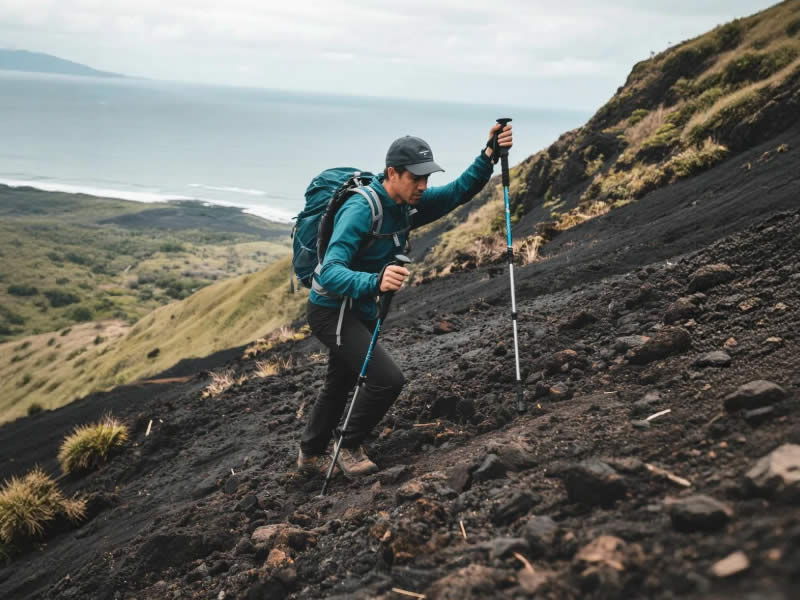
Recommended trekking pole purchase link: https://lightenup.aliexpress.com/store/1101521655
The neutral length rule (flat ground)
On flat, firm terrain, the ideal trekking pole length allows your elbow to bend at a 90‑degree angle when the tip is on the ground next to your foot. For most people, this means a length roughly equal to 0.66 times your height in centimeters. For example, a 1.70 m (170 cm) person would use poles around 112 cm on flat ground.
Why descents require longer poles
When you walk downhill, your body leans forward. If you keep your poles at the neutral (flat‑ground) length, they will be too short to plant effectively ahead of your body. You’ll end up hunching over, losing balance, and placing excessive stress on your wrists. Longer poles allow you to:
- Plant below your feet – On a descent, you want the pole tip to contact the ground several steps ahead, downhill from your current foot. A longer pole reaches that point without forcing you to lean forward.
- Brake effectively – By pushing down on a longer pole, you transfer force to the ground, slowing your momentum and reducing impact on your knees.
- Improve stability – A longer pole creates a wider base of support, which is essential on loose, shifting volcanic soil where your feet can slide.
The ideal length adjustment: add 5–10 cm
For descending loose volcanic soil, increase your neutral length by 5 to 10 centimeters (2–4 inches). For a 1.70 m hiker with a neutral length of 112 cm, that means setting poles to 117–122 cm. The exact amount depends on the steepness:
- Gentle slope (10–20°): Add 5 cm.
- Moderate slope (20–30°): Add 7–8 cm.
- Steep slope (30°+): Add 10 cm or more.
If the descent is extremely steep and long, some hikers even extend poles to the maximum length (typically 135–140 cm). However, poles that are too long will cause you to lift your shoulders and become unstable. Experiment on a safe section first.
How to find your exact downhill length
- Stand on a section of the slope, facing downhill.
- Hold your pole as you normally would (strap over wrist).
- Extend the pole until the tip rests on the ground about one step in front of your leading foot.
- Your elbow should be slightly above 90° – not fully straight, but bent around 100–110°. This is your descent length.
- Note the marking on the pole (many have centimeter scales) and set the second pole identically.
Why volcanic soil needs extra attention
Loose volcanic cinders (called tephra or lapilli) behave like ball bearings. Your foot can slide backward without warning. A longer pole gives you a forward anchor. However, be aware that a long pole may sink deeper into the soft soil. To counteract this, use wide baskets (mud or sand baskets) to prevent the tip from plunging too far. Without baskets, a long pole can stick deep and become difficult to extract.
Technique for descending with long poles
- Plant ahead, not beside – On loose soil, plant the pole a full stride ahead (30–50 cm in front of your leading foot).
- Use a firm, vertical push – Push straight down (not back) to create a braking effect.
- Keep both poles in contact with the ground – Alternate planting in rhythm with your steps, but always have at least one pole down.
- Shorten your stride – Smaller steps reduce the risk of sliding and give you more control.
What about ascending?
For steep ascents, you do the opposite: shorten your poles by 5–10 cm from neutral. This allows you to plant close to your body and push upward efficiently. Many adjustable poles have length markings – memorize your settings for flat, uphill, and downhill.
Adjusting on the fly
The best poles for Trindade’s varied terrain have flick locks (external levers) that allow tool‑free adjustment. When you transition from a flat section to a steep descent, stop for 10 seconds and lengthen both poles. Don’t be lazy – your knees will thank you.
Final safety note
Loose volcanic soil can hide rocks or roots. Always test your plant with a gentle tap before committing your full weight. And if the slope is extremely steep (over 35°), consider using your poles as outriggers – plant them wide to the sides, not straight ahead. With the correct pole length and proper technique, descending Trindade’s volcanic slopes becomes a controlled, confident, and knee‑friendly experience. Enjoy the unique landscape, but respect the terrain.




