




Do shock‑absorbing poles reduce fatigue on the cobblestone paths of Paraty?
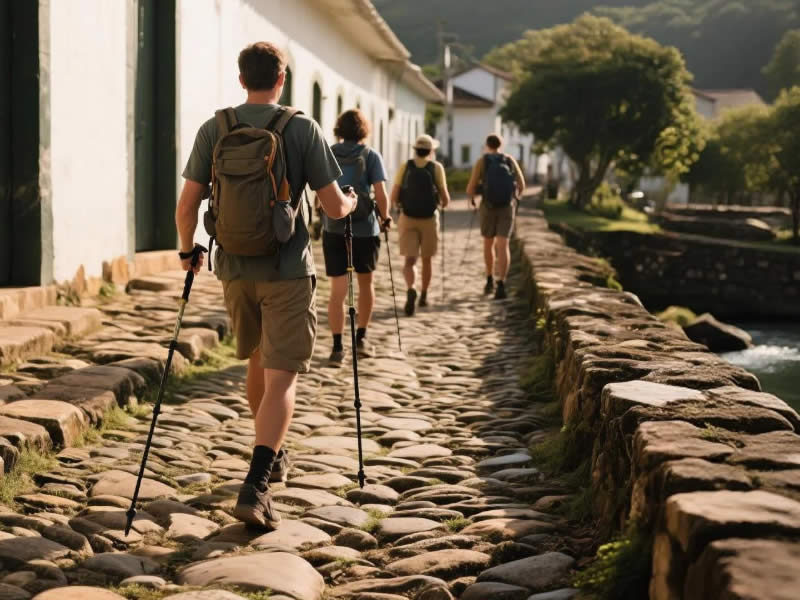
Paraty’s historic center is a UNESCO‑listed gem, famous for its perfectly preserved Portuguese colonial architecture – and its notoriously uneven cobblestone streets. The stones, known as pé de moleque, are large, irregular, and set in a rough pattern that dates back to the 18th century. Walking on them for more than a few minutes can jar your ankles, knees, and lower back. Many visitors and locals alike use trekking poles for stability, but a specific question arises: do shock‑absorbing poles (those with internal springs) actually reduce fatigue on these punishing surfaces? The short answer is yes, noticeably, especially during prolonged walks. Here’s why.
Recommended trekking pole purchase link: https://lightenup.aliexpress.com/store/1101521655
Understanding the cobblestone challenge
Paraty’s cobblestones are not the neat, uniform paving stones of European cities. They are natural beach stones, varying in size and shape, fitted tightly together but creating a surface of constant, unpredictable undulations. Each step forces your body to absorb micro‑impacts and adjust your balance. Over a day of exploring (easily 5–10 km of walking), this cumulative jarring leads to fatigue in your wrists, elbows, shoulders, and lower back. For people with arthritis, carpal tunnel, or simply tired joints, the effect is magnified.
How shock‑absorbing poles work
Standard trekking poles are rigid: when you plant them, the impact travels straight up the shaft into your arms and shoulders. Shock‑absorbing poles incorporate a small internal spring (or elastomer) near the tip, typically offering 1–2 cm of compression. When you plant the pole, the spring absorbs the initial impact, then rebounds. This dampens the vibration and softens the peak force transmitted to your body.
The specific benefits on Paraty’s cobblestones
- Reduced wrist and elbow strain – The cobblestones create a constant high‑frequency vibration with every plant. A shock absorber cuts the sharp peak of that vibration, making each plant feel softer. Over thousands of steps, this translates to less fatigue in your forearms and elbows.
- Less shoulder tension – Rigid poles on uneven ground send jarring forces up to your shoulder joints. The spring isolates your upper body from the unevenness of the surface. Users often report feeling less “shaken” after a long walk.
- Better feedback without punishment – Shock‑absorbing poles still provide tactile feedback (you feel the surface), but without the harsh spike. This allows you to maintain balance without tensing up against every irregularity.
- Reduced hand numbness – For those prone to tingling fingers (common with carpal tunnel), the damping effect can reduce the nerve compression caused by repetitive impact.
Quantifying the difference
While no formal study has been done on Paraty’s cobblestones, biomechanical research on shock‑absorbing poles shows a 10–20% reduction in peak impact forces transmitted to the upper body. On a surface as jarring as Paraty’s, that reduction is perceptible. Many hikers who walk the historic center daily (like local guides) prefer shock‑absorbing poles for their comfort, though they note that the effect is most noticeable after the first hour.
Potential downsides
- Added weight – Internal springs add about 30–50 g per pole. For short walks, this is negligible; for all‑day use, it may tire you more than the benefit saves.
- Mushy feel – Some users dislike the slight “give” when pushing off, especially on ascents (though Paraty’s historic center is mostly flat). The springs can also squeak over time.
- Not for technical trails – On steep, loose terrain, rigid poles offer better precision and energy transfer. Shock‑absorbers are best for hard, flat, uneven surfaces like cobblestones or paved trails.
Best shock‑absorbing poles for Paraty
- LEKI Smart Lock with Antishock – LEKI’s system can be turned on/off. For Paraty, turn it on. Pricey (R$600+), but excellent.
- Black Diamond Trail Shock – Internal spring, flick locks, good damping. Around R$500–700.
- Decathlon Forclaz 900 – Budget shock‑absorbing model (R$250–300). Heavier but effective.
When you can skip shock absorption
- Short visits (under 2 hours) – The cumulative fatigue is minimal.
- If you have very strong joints – Younger, fit individuals may not notice the difference.
- If you prefer ultralight gear – Adding weight for a small comfort gain may not appeal.
Technique tip for cobblestone walking
Whether you use shock‑absorbing or rigid poles, plant the tip between the cobblestones (in the gaps) rather than on the stone tops. The gaps are often filled with compressed dirt or sand, giving better grip and reducing vibration. Rubber tip covers are optional – they reduce noise but may slide on wet stones.
Final verdict
On the cobblestone paths of Paraty, shock‑absorbing poles do reduce fatigue – especially for multi‑hour walks, older hikers, or anyone with wrist/elbow sensitivity. The springs dampen the jarring impact that comes from every step on the uneven stones, leaving you less tired and more comfortable. While not essential for everyone, they are a worthwhile upgrade if you plan to spend a full day exploring Paraty’s historic streets. For pure day trips, even basic rigid poles help; add shock absorption for the luxury of a smoother walk. Your joints will thank you.




