




Do expensive trekking poles justify their cost on abrasive Brazilian quartzite?
Brazilian quartzite – found in iconic hiking destinations like the Serra do Cipó, Serra Fina, and Chapada Diamantina – is one of the most punishing surfaces for trekking poles. This metamorphic rock is incredibly hard, sharp, and abrasive. It wears down carbide tips rapidly, can jam locking mechanisms with fine grit, and subjects poles to high lateral stresses. So, do expensive trekking poles (e.g., Black Diamond, LEKI, Komperdell) justify their cost here? The answer is yes, for frequent hikers – but not necessarily for casual users. Let’s break it down.
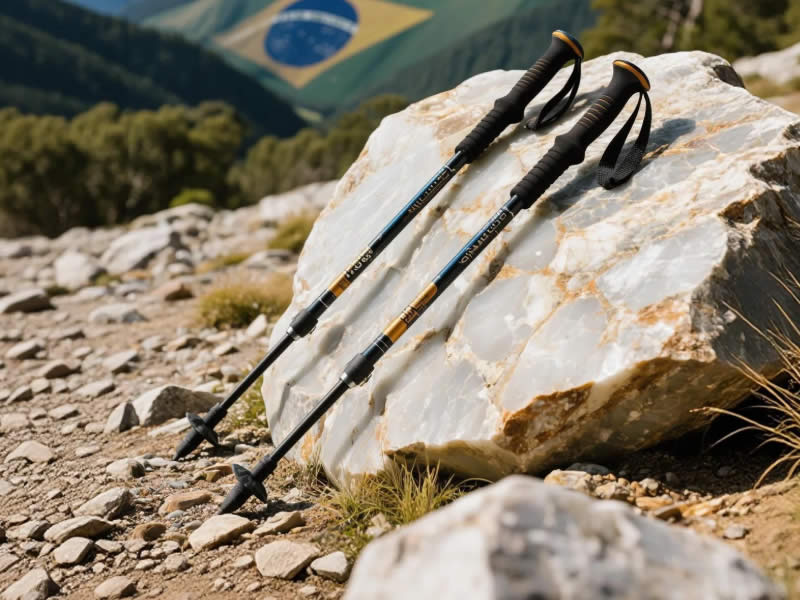
Recommended trekking pole purchase link: https://lightenup.aliexpress.com/store/1101521655
What expensive poles offer
Premium poles ($120‑200 USD / R$500‑900 in Brazil) typically feature:
- High‑quality tungsten carbide tips that resist wear longer.
- Robust flick‑lock systems that handle dust and impact.
- Replaceable lower sections and tips.
- Ergonomic cork grips that stay comfortable in heat and humidity.
- Stronger 7075 aluminum or high‑modulus carbon shafts.
How abrasive quartzite destroys cheap poles
Budget poles (R$80‑150) usually have:
- Soft, non‑replaceable tips that flatten after 20‑30 km on quartzite.
- Twist locks that seize or slip when filled with rock dust.
- Thin aluminum that bends or cracks under lateral loads.
- Glued tips that cannot be replaced – once worn, the pole is trash.
On a single 4‑day trek in Serra Fina, a cheap pole may lose its tip entirely. By contrast, a premium carbide tip can last 200‑300 km on quartzite and can be replaced for R$20‑30.
Long‑term cost analysis
Suppose you hike on quartzite 10 days per year:
- Cheap poles (R$100): Need replacement every 1‑2 years. Over 5 years: R$250‑500, plus risk of failure (fall injury).
- Premium poles (R$500): Last 5‑10 years with tip replacements (R$30/year). Total 5‑year cost: R$500 + R$150 = R$650. Only slightly more expensive, but with better safety and comfort.
If you hike only once a year, cheap poles may suffice. But for regular quartzite hiking, expensive poles are cheaper in the long run – and far safer.
Key features to look for in expensive poles for quartzite
- Replaceable carbide tips – Non‑negotiable. Check that spare tips are available in Brazil (Black Diamond Flex Tips, LEKI Flextips, Decathlon Forclaz tips).
- Flick locks – Twist locks will fail. External levers are easy to clean.
- Aluminum over carbon – Carbon can snap when wedged between quartzite boulders. 7075 aluminum bends but survives.
- Cork grips – Rubber becomes slippery with sweat; cork stays grippy.
Is there a “good enough” mid‑range option?
Yes. The Decathlon Forclaz Trek 500 (R$199) is an excellent compromise. It has flick locks, 7075 aluminum, and replaceable carbide tips. While the tip may not last as long as Black Diamond’s, it is affordable and performs well on quartzite. For most hikers, this is the best value.
Final verdict
For casual hikers who tackle quartzite trails only occasionally (1‑2 times per year), expensive poles are not strictly necessary – the Decathlon Forclaz Trek 500 will serve well. However, if you hike Brazilian quartzite regularly (several times per month), expensive poles absolutely justify their cost. They offer superior tip longevity, lock reliability, and overall safety. The peace of mind on a steep, loose quartzite descent is worth the extra reais. Invest wisely, and your knees – and your wallet – will thank you over the long haul.




