




How to teach a child to use trekking poles correctly on Brazilian mountain trails?
Introducing your child to trekking poles on Brazil’s mountain trails – from the granite slabs of Serra dos Órgãos to the muddy paths of Serra do Mar – can transform a hesitant hiker into a confident explorer. But teaching a child to use poles correctly requires patience, clear instruction, and an understanding of how children’s bodies move. Here’s a step‑by‑step guide to making your child a safe, effective pole user.
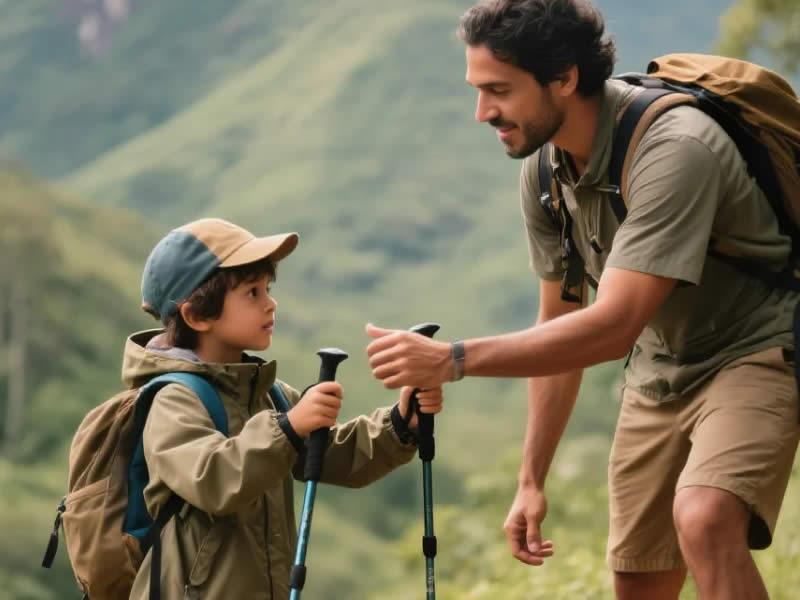
Recommended trekking pole purchase link: https://lightenup.aliexpress.com/store/1101521655
Step 1: Choose the right poles
Before teaching, ensure the poles fit the child.
- Weight: Under 180 g per pole (e.g., Decathlon Quechua MH500 Kids). Heavy poles tire little arms.
- Length: Adjustable, with a minimum of 65–70 cm. The child’s elbow should bend 90° when the tip is on the ground.
- Locks: Flick locks are easier for small hands than twist locks.
- Tips: Always use rubber tip covers when not on dirt or rock – they prevent accidental injuries.
Step 2: Start on flat, soft ground
Do not begin on a steep mountain trail. Find a grassy field or a flat dirt path in a local park.
- Practice without poles first: have the child walk normally, swinging arms opposite to legs.
- Introduce one pole at a time. Let them hold a single pole and walk beside you, copying your arm swing.
- Then add the second pole. The rhythm is: left foot + right pole, right foot + left pole.
Step 3: Teach the basic plant
Explain: “The pole goes down next to your opposite foot, not ahead.”
- Have the child stand still and plant the right pole next to their left foot. Then step forward with the right foot.
- Repeat slowly. Use a rhyme: “Opposite foot, opposite hand – that’s the rule across the land.”
Step 4: Adjust for Brazilian terrain
Brazil’s mountains have three common surfaces, each needing a small adjustment:
- Flat or gentle uphill: Use the neutral length (elbow 90°). Plant the pole beside the opposite foot.
- Steep uphill: Shorten poles by 5–10 cm. The child should plant close to their body and push upward.
- Steep downhill: Lengthen poles by 5–10 cm. Plant the pole below the downhill foot, before stepping down. This acts as a brake.
Practice each on a small slope near your home before the real hike.
Step 5: Teach safety rules
Children are prone to excitement and forgetfulness. Go over these rules every time:
- “No swinging” – Poles stay pointed down, never up or sideways. Swinging can poke a sibling or yourself.
- “Plant then step” – Always put the pole down before shifting weight onto it.
- “Don’t pull” – Poles are for balance, not for pulling yourself up steep rocks. Use hands for that.
- “Covers on when not on dirt” – On pavement, boardwalks, or in the car, rubber covers go on.
Step 6: Use games to build muscle memory
Children learn through play. Try these drills:
- “Shadow walking” – You walk ahead with your own poles; the child mirrors your movements.
- “Obstacle course” – Place sticks or small rocks on the ground. The child must plant a pole on each side while stepping over.
- “One‑pole race” – Have the child use one pole for 20 meters, then switch to the other. This reinforces the opposite‑arm, opposite‑leg pattern.
Step 7: Apply on a real Brazilian mountain trail
Choose a short, easy trail first – for example, the lower part of the Morro da Urca access path in Rio or the flat section of the Poço das Antas trail. Walk slowly, with you ahead or beside the child. Give verbal cues: “Right pole now… good. Left pole… yes.” Praise every correct plant.
Step 8: Address common mistakes
- Dragging poles behind – Stop the child, have them lift the poles and plant deliberately.
- Planting too far ahead – This overextends the shoulder. Remind: “Pole next to your foot, not in front.”
- Gripping too tight – Show them how to use the wrist strap: hand goes up through the loop, then down. The strap carries weight; the hand stays relaxed.
- Forgetting to adjust for slope – Carry a marker (tape on the pole) for neutral length. At a slope, stop, say “let’s make the poles longer/shorter,” and help them adjust.
Step 9: Know when to take a break
If the child is tired, frustrated, or the trail becomes too technical (e.g., a hands‑on scramble), stow the poles. Attach them to your pack or theirs. Forcing pole use when it’s no longer helpful can lead to bad habits or accidents.
Step 10: Celebrate progress
After the hike, talk about what went well: “You remembered to plant opposite feet three times in a row!” Positive reinforcement builds confidence. Soon your child will reach for their poles eagerly, and you’ll both enjoy Brazilian mountain trails more safely and happily.
Final checklist for parents
- Poles fit correctly (elbow 90° on flat ground).
- Rubber tip covers are used off‑trail.
- Child knows “opposite foot, opposite pole.”
- You practiced on flat grass before the mountain.
- You adjusted lengths for uphill/downhill.
- You reviewed safety rules.
With patience and practice, your child will learn to use trekking poles as natural extensions of their arms. The reward? Fewer falls, less fatigue, and a young hiker who looks forward to the next Brazilian mountain adventure.




