




Do trekking poles help with traction on icy steps in Pico da Bandeira during July?
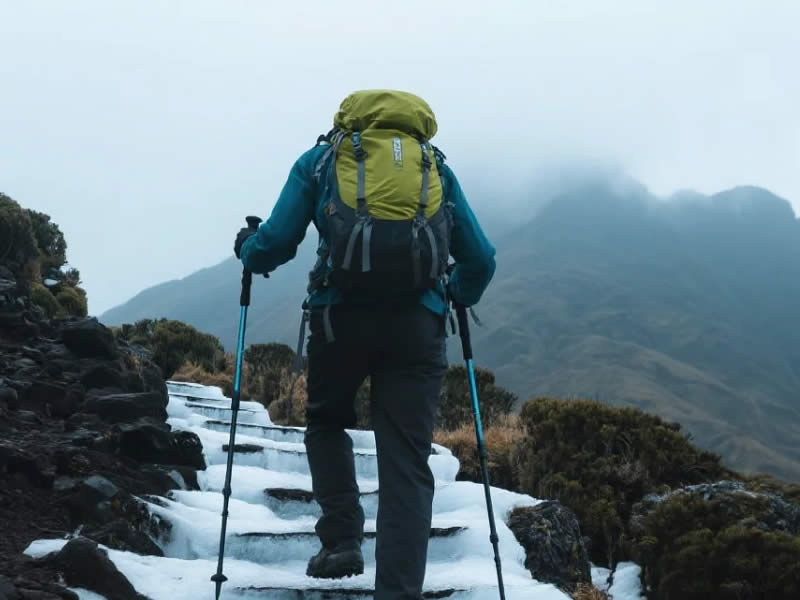
Pico da Bandeira, at 2,891 m (9,485 ft), is Brazil’s third‑highest peak, straddling the border of Minas Gerais and Espírito Santo. July is the heart of the Brazilian winter, and the upper slopes of the mountain are often coated with a hard layer of ice – especially the famous “ice steps” near the summit, where water seeps from rocks and freezes into glassy, treacherous staircases. If you’re planning a winter ascent, a critical question arises: do trekking poles actually help with traction on those icy steps? The short answer is yes, they can help significantly – but with important limitations and proper technique. Let’s explore how, when, and what you need to know.
Recommended trekking pole purchase link: https://lightenup.aliexpress.com/store/1101521655
How trekking poles improve traction on ice
- Carbide tips bite – A sharp, pyramid‑shaped tungsten carbide tip can scratch into hard ice, creating micro‑fractures that provide grip. When you plant the pole firmly, it acts as a temporary anchor, reducing the chance of your feet sliding.
- Weight transfer – By leaning on two poles, you reduce the vertical load on your feet. Lighter feet are less likely to slip sideways.
- Four points of contact – With two poles and two feet (or crampons/micro‑spikes), you quadruple your stability. If one foot skates, the poles can arrest your fall.
The reality check: poles alone are not enough on steep ice
On gentle slopes or shallow ice, poles can provide adequate traction. But on the steep (sometimes 30‑40°) icy steps of Pico da Bandeira in July, poles alone are insufficient for safety. The carbide tip can slide if the ice is polished or if the pole is planted at an angle. You need dedicated traction on your footwear.
What experienced climbers use on Pico da Bandeira in winter
- Micro‑spikes or crampons – These are essential. Micro‑spikes (e.g., Kahtoola) fit over hiking boots and provide tungsten carbide spikes underfoot. Crampons are for more technical ice. Without them, you risk a potentially fatal fall.
- Trekking poles – Used as secondary support, not primary traction. They help with balance and can prevent a fall if one spike slips, but they will not save you from a full slide on a steep icy pitch.
Best pole technique for icy steps
- Shorten poles by 5‑10 cm – A shorter pole keeps your center of gravity lower and allows you to plant closer to your body, applying more vertical force.
- Plant vertically, not angled – Place the tip directly under your shoulder, pressing straight down. An angled plant will skid.
- Test each plant – Before committing your weight, tap the pole firmly. If it slides, find another spot (look for small cracks or rough ice patches).
- Use both poles simultaneously – On very steep sections, plant both poles ahead of you, then step up. This distributes your weight evenly.
- Avoid rubber tips – Remove any rubber covers. They have zero grip on ice.
What about using poles as ice daggers?
Some hikers attempt to use the carbide tip as a makeshift ice dagger, stabbing it into the ice and pulling themselves up. This is risky – the pole can snap (especially carbon) or the tip can break. Only do this with sturdy aluminium poles and only in an emergency.
Pre‑hike preparation
- Check your tips – Worn, rounded carbide tips will not grip. Replace them before the trip. Spare tips are sold at Decathlon and outdoor shops.
- Consider adding a “micro‑spike” for your pole – Some brands sell carbide spikes that screw onto the pole tip for extra ice grip. Rare in Brazil, but you can order online.
- Carry a third pole – Not necessary, but having a spare can be useful if one tip breaks.
When poles are less effective
- Polished, blue ice – Hard, smooth ice like a frozen waterfall offers little texture for the tip. Even sharp carbide may slide. In such cases, you should not be on that slope without crampons and an ice axe.
- Very steep sections (>35°) – At this angle, poles become awkward. You are better off using an ice axe in one hand and a pole (or nothing) in the other. For Pico da Bandeira’s summit ice steps, the slope is steep but short; poles can help if you move slowly.
Real‑world experience from Brazilian mountaineers
Online reports (e.g., “Montanhismo Brasil” forum) indicate that during July, many climbers use trekking poles in combination with micro‑spikes. One climber wrote: “The poles gave me confidence on the lower icy sections, but near the top I wished I had an ice axe. The poles kept me from falling backwards when my spike slipped.” Others note that aluminium poles with flick locks are much more reliable than carbon or twist‑lock models in sub‑zero temperatures.
Alternative: an ice axe
For serious winter ascents of Pico da Bandeira, an ice axe is superior for self‑arrest and traction on steep ice. However, an axe is heavier and requires training. For most hikers (those with good fitness but not technical mountaineering experience), micro‑spikes + two trekking poles is the standard recommendation.
Final verdict
Yes, trekking poles do help with traction on icy steps on Pico da Bandeira in July – but they are not a replacement for proper footwear traction. Always use micro‑spikes or crampons on your boots. Choose aluminium flick‑lock poles with sharp carbide tips. Shorten the poles, plant vertically, and test each plant. Avoid carbon poles (cold makes them brittle) and rubber tips. With the right combination of gear and technique, you’ll navigate the icy steps more safely and enjoy the stunning views from Brazil’s third‑highest peak.




