




What trekking pole features help with sciatica pain on long descents?
Sciatica pain – often caused by compression of the sciatic nerve in the lower back – can make long descents excruciating. Every jarring step sends shock up through the spine, aggravating the nerve. Trekking poles, when chosen and used correctly, can dramatically reduce this pain by redistributing impact, improving posture, and transferring load from the spine to the arms. Here are the specific features that make the biggest difference for sciatica sufferers on steep, lengthy downhills.
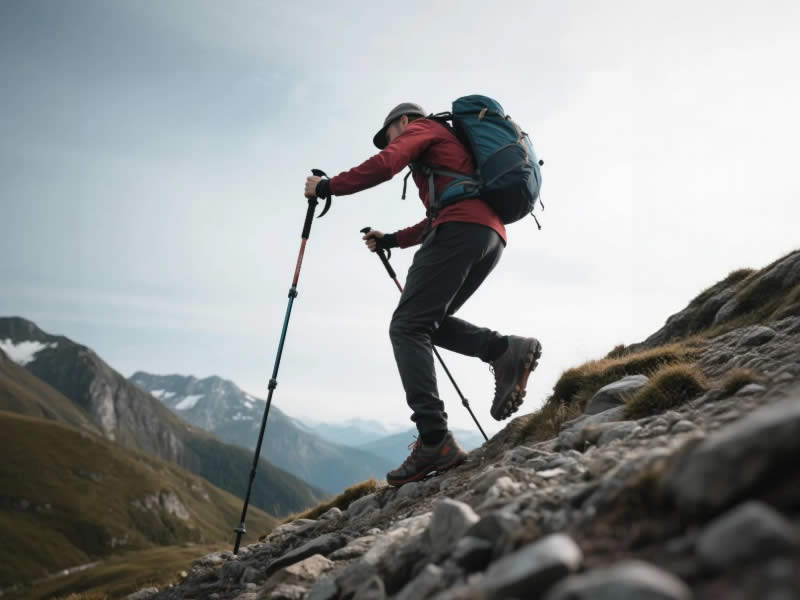
Recommended trekking pole purchase link: https://lightenup.aliexpress.com/store/1101521655
1. Shock absorption (anti‑shock mechanism)
Descending creates repetitive impact that travels from your heels to your lower back. An internal spring or elastomer in the pole’s lower section absorbs a portion of that impact before it reaches your hands and spine. Look for poles with an on/off switch for the anti‑shock (e.g., LEKI’s system) – you can disable it on flat sections for better feedback and enable it on descents for cushioning.
2. Extended length adjustment range
On a descent, you should lengthen your poles by 5‑10 cm compared to your neutral flat‑ground length. This allows you to plant the pole further downhill, keeping your torso upright and preventing the forward hunch that compresses the lumbar spine. Poles with a wide adjustment range (e.g., 100‑140 cm) are ideal. Flick locks (external levers) make changing length quick and tool‑free.
3. Ergonomic, shock‑dampening grips
Sciatica often causes muscle tension that radiates to the arms. A grip that reduces hand fatigue helps maintain proper form. Cork grips absorb sweat, conform to your hand, and are slightly resilient – they dampen vibration. Foam grips are lightweight and also absorb shock. Avoid hard rubber grips, which transmit full impact and can cause you to grip tighter, increasing upper body tension.
4. Efficient wrist straps
Proper strap use is critical for sciatica. When the strap is correctly adjusted (hand goes up through the loop, then down to grip), you can relax your fingers while the strap transfers your weight to the pole. This offloads the spine more effectively than gripping tightly. Look for wide, padded, and easily adjustable straps. Avoid thin nylon straps that cut into your wrist.
5. Lightweight construction (aluminium or carbon)
Heavy poles tire your arms, causing you to lean forward onto your feet – which increases spinal compression. Lightweight poles (under 250 g per pole) reduce arm fatigue, allowing you to maintain an upright posture longer. Carbon is lighter but more brittle; high‑grade aluminium (7075) offers a good balance of weight and durability for rocky Brazilian trails.
6. Rubber tip covers (for hard surfaces)
On paved or compacted trail sections (common near trailheads), carbide tips create a sharp, jarring impact. Slip on rubber tip covers to soften the contact and reduce vibration transmitted up the pole. Remove them on soft dirt or rock for better grip.
7. Flick locks vs. twist locks
On long descents, you will want to adjust pole length frequently (e.g., to match the steepness). Flick locks (external levers) are quick, easy to operate even with sweaty hands, and they hold securely under load. Twist locks can slip or be hard to adjust when you’re tired. Reliable locking prevents sudden collapses that could twist your back and worsen sciatica.
8. Baskets (optional but helpful)
While not directly related to sciatica, baskets prevent the pole from sinking too deep into soft ground, which can cause an unexpected lurch and strain your back. For most Brazilian trails (mud, sand, light snow), small mud baskets are sufficient.
Proper technique for descents with sciatica
Even the best poles won’t help if used incorrectly:
- Lengthen poles 5‑10 cm from your flat‑ground setting. Your elbows should be slightly above 90° when the tip is planted downhill.
- Plant the pole before your foot – Place the tip firmly on the ground, then step down. This creates a braking effect and reduces the load on your spine.
- Keep your torso upright – Do not lean forward. Imagine a string pulling your head up. The longer poles help maintain this posture.
- Alternate poles with opposite feet – Right pole with left foot, left pole with right foot. This distributes forces symmetrically.
- Use the wrist straps – Let your hand rest on the strap; do not death‑grip the handle.
- Take shorter steps – Smaller, controlled steps reduce the peak impact on each foot.
Additional tips for sciatica on Brazilian trails
- Warm up before descending – Gentle stretches for the hamstrings and lower back can reduce nerve irritation.
- Use a lumbar support belt – Some hikers find that a soft brace provides extra stability.
- Take frequent breaks – Every 20‑30 minutes, stand upright and lean on the poles to decompress your spine.
- Strengthen your core – Off‑trail, exercises that strengthen abdominal and back muscles reduce sciatica flare‑ups.
Top pole recommendations for sciatica in Brazil
| Model | Key features for sciatica | Approx. price (BRL) |
|---|---|---|
| LEKI Makalu Lite Anti‑Shock | Internal spring, cork grip, flick locks, wide adjustment | R$550‑700 |
| Black Diamond Trail Pro Shock | Adjustable shock absorption, foam grip, durable | R$500‑650 |
| Decathlon Forclaz 900 Anti‑Shock | Budget anti‑shock, flick locks, foam grip | R$250‑350 |
| Komperdell C3 Contour Anti‑Shock | Power lock, ergonomic cork/foam grip | R$450‑600 |
Final verdict
For sciatica pain on long descents, the most helpful trekking pole features are shock absorption, easy length adjustability (to lengthen poles for downhills), ergonomic cork/foam grips, and lightweight construction. Using two poles correctly – with extended length and an upright posture – can transfer up to 30% of your body weight from your spine to your arms, dramatically reducing nerve compression. Combine these features with proper technique, and you’ll be able to enjoy Brazil’s beautiful mountain descents with significantly less pain. Always consult your doctor or physiotherapist before hiking with sciatica, and listen to your body – if pain worsens, rest and seek medical advice.




