




Can trekking poles be used as a support after leg injury in urban Rio?
Recovering from a leg injury – a fracture, sprain, or post‑surgical weakness – often requires temporary mobility aids. While crutches and canes are standard, many people wonder if trekking poles can serve the same purpose, especially in a city like Rio de Janeiro, with its mix of flat promenades, hilly streets, and uneven sidewalks. The short answer is yes, trekking poles can be an excellent support for walking after a leg injury, provided you choose the right poles, adjust them correctly, and follow medical advice. Here’s a detailed guide for urban Rio.
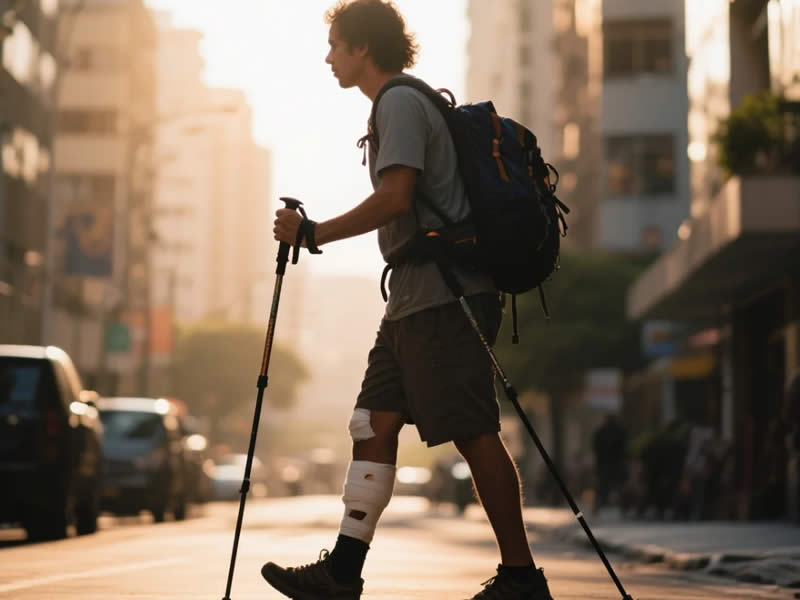
Why trekking poles work for leg injury recovery
- Weight offloading – Using two poles can transfer 20‑30% of your body weight from your injured leg to your arms, reducing pain and stress on healing tissues.
- Improved balance – Two poles create a wider base of support, crucial on Rio’s unpredictable surfaces (cracked pavements, cobblestones, slippery tiles after rain).
- Adjustable height – Unlike a fixed cane, trekking poles can be lengthened or shortened to maintain an upright posture, which is important for proper gait and spine alignment.
- Shock absorption – Some poles have internal springs (anti‑shock) that cushion each step, beneficial on hard urban surfaces.
Choosing the right poles for urban use in Rio
- Rubber tip covers (paw tips) – Absolutely essential. Carbide tips will scratch pavement and slide on smooth surfaces. Rubber provides grip and reduces noise. Most poles come with them, but buy spares if lost.
- Flick locks over twist locks – You’ll want to adjust height often (e.g., for sitting on a bench, walking up a ramp). Flick locks are easy to use with one hand; twist locks can be difficult with reduced mobility.
- Lightweight aluminium – Carbon is lighter but can snap if caught in a crack. Aluminium is durable and affordable. Look for 7075 grade.
- Cork or foam grips – Sweaty hands are common in Rio’s climate. Cork stays grippy and reduces hand fatigue.
- Two poles, not one – Using two poles symmetrically offloads both legs and prevents you from listing to one side, which could cause hip or back strain.
How to set up your poles for walking after injury
- Stand upright with your shoes on (the ones you’ll walk in).
- Set the pole height so that when the tip is on the ground, your elbow bends at 90 degrees. This is your neutral length.
- For added stability, you can lengthen poles by 2‑3 cm – this shifts more weight to your arms.
- Always use two poles, even if only one leg is injured. Symmetrical support protects your healthy leg from overuse.
Walking technique for urban Rio
- Place the poles slightly ahead of your body – about one foot’s length. This allows you to push off the poles as you step forward.
- Keep poles close to your body – wide planting reduces stability.
- Use a “tripod” gait – move one pole and the opposite foot together, then the other pole and foot.
- On stairs – shorten poles by 10 cm. Go up with your strong leg first, down with the injured leg first, always keeping both poles on the step above or below as needed.
Best urban routes in Rio for pole‑assisted recovery
- Parque do Flamengo – Flat, wide, paved paths with benches. Ideal for early rehabilitation.
- Aterro do Flamengo – Seafront promenade, smooth surface, little traffic.
- Parque Lage (lower gardens) – Flat areas, beautiful setting, but avoid the steeper trails.
- Lagoa Rodrigo de Freitas – The full loop is 7.8 km of mostly flat, paved bike/walk path. Benches every few hundred meters.
- Copacabana and Ipanema boardwalks – Very flat, but can be crowded. Go early morning.
Precautions and when not to use poles
- Acute phase – Immediately after injury or surgery, follow your doctor’s orders. You may need crutches that offload 100% of weight.
- Partial weight‑bearing – Poles are excellent for partial weight‑bearing (e.g., after a stress fracture or mild sprain).
- Avoid steep hills – Even with poles, the steep streets of Santa Teresa or Lapa may be too risky. Stick to flat areas until cleared.
- Consult a physiotherapist – They can teach you the correct gait pattern and adjust pole height. Incorrect use can lead to shoulder or back pain.
Advantages over standard medical canes
- Lightweight – Many canes are heavy steel; trekking poles are much lighter.
- Adjustable – Canes are typically fixed height; poles adapt to different shoes or terrain.
- Two points of support – A single cane offloads only one side; two poles distribute load evenly.
- Collapsible – When you sit on a bus or enter a restaurant, poles fold or collapse smaller than canes.
Where to buy in Rio
- Decathlon (Barra, Carioca, Bangu) – Sells rubber tips, flick‑lock poles, and anti‑shock models. Forclaz Trek 500 (R$199) is a great choice.
- Adventure Sports (Flamengo) – Premium brands, but also stocks basic poles.
- Mercado Livre – Search “bastão de trekking com ponteira de borracha”. Ensure the seller includes rubber tips.
Final recommendation
Trekking poles are a safe, effective, and affordable support for walking after a leg injury in urban Rio – provided you use two poles, fit rubber tips, and set the correct height. They are not a substitute for crutches when full weight‑offloading is needed, but for partial weight‑bearing and gait rehabilitation, they often outperform standard canes. Always consult your doctor or physiotherapist before starting. With proper use, you can enjoy Rio’s beautiful parks and beaches while recovering, staying active and positive.




