




Do shock‑absorbing trekking poles help with knee osteoarthritis?
Knee osteoarthritis (OA) is a common, painful condition that affects millions of people worldwide, including many active Brazilian hikers who refuse to give up the trails of Serra do Mar, Chapada Diamantina, or the coastal paths of Paraty. The main symptom is pain and stiffness, often worsened by impact activities like walking downhill or on uneven ground. Trekking poles are widely recommended for knee OA, but a specific question arises: do shock‑absorbing (anti‑shock) poles offer additional benefits over rigid poles? The short answer is yes – shock‑absorbing poles can significantly reduce knee pain and improve walking comfort for people with knee OA, especially on descents. Here’s the evidence and practical advice.
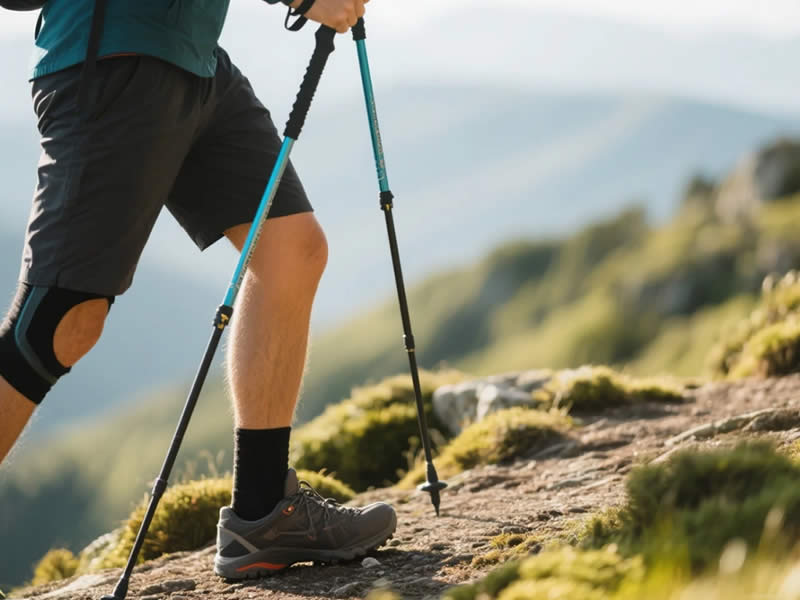
How knee osteoarthritis reacts to impact
In a healthy knee, cartilage cushions the bones. In OA, that cartilage wears away, leaving bone‑on‑bone contact in advanced stages. Each step sends an impact wave through the leg. Descending a slope multiplies the force: every step can generate 3‑4 times your body weight through the knee. Over a long hike, this repetitive loading inflames the joint, increases pain, and may accelerate cartilage loss.
How shock‑absorbing poles work
Anti‑shock trekking poles contain a small internal spring (or elastomer) in the lower section. When you plant the pole, the spring compresses, absorbing a fraction of the impact that would otherwise travel up your arm, through your shoulder, and – indirectly – affect your gait. More importantly, by reducing the jarring felt through your hands and arms, you tend to walk more smoothly, which translates to less abrupt loading on your knees. Some studies suggest that well‑designed anti‑shock poles can reduce the peak impact force transmitted to the upper body by 10‑20%. While the spring is not directly under your knee, the overall reduction in gait “stiffness” and the ability to transfer more load to your arms leads to lower joint stress.
What the research says
A 2012 study in Arthritis Care & Research found that using trekking poles (both rigid and anti‑shock) reduced knee joint loads in people with knee OA. The reduction was more pronounced on downhill walking. Although that study did not specifically compare shock‑absorbing vs. rigid poles, a 2016 biomechanical analysis showed that anti‑shock poles decreased the rate of force development in the arms and encouraged a more fluid, less jerky walking pattern. Since knee OA pain is often triggered by rapid loading, this smoother gait is beneficial.
Anti‑shock vs. rigid poles for knee OA
- Rigid poles – Provide excellent stability and weight transfer. They are lighter, simpler, and have no moving parts to fail. For flat terrain or moderate uphill, they work perfectly.
- Shock‑absorbing poles – Offer an extra layer of cushioning on descents, rocky trails, and hard surfaces. The spring can make the pole feel slightly “softer,” reducing the micro‑jolts that can aggravate an arthritic knee. Many anti‑shock systems have an on/off switch, allowing you to disable the spring on flat sections (where it’s not needed) and enable it on downhills.
For knee OA, the anti‑shock feature is particularly helpful if:
- You hike on hard, packed trails (e.g., the cobblestone sections of the Caminho do Ouro).
- You have significant pain during downhill sections.
- You are overweight, as extra body weight increases impact forces.
Practical recommendations for Brazilian hikers with knee OA
- Choose a quality anti‑shock pole – Look for a model with a durable spring and a reliable on/off switch (e.g., LEKI Anti‑Shock, Black Diamond Trail Pro Shock). Avoid cheap anti‑shock poles; the spring may be too stiff or too weak.
- Use two poles, not one – Symmetrical support is essential to offload both knees evenly. One pole can create a limp and worsen pain on the unsupported side.
- Set the correct height – On flat ground, elbow at 90°. For descents, lengthen poles by 5‑10 cm to keep your torso upright and transfer more weight to your arms. For ascents, shorten accordingly.
- Enable the anti‑shock on descents – Flip the switch (if available) to activate the spring. On long, steep downhills, you will feel a noticeable reduction in jarring.
- Use rubber tip covers on hard surfaces – On pavement or compacted trails, rubber tips add another layer of cushioning. Remove them on dirt or rock for better carbide grip.
- Combine with proper footwear – Good hiking boots with cushioned soles work synergistically with anti‑shock poles. Avoid minimalist shoes.
Are anti‑shock poles always better?
Not necessarily. For very soft terrain (deep mud, sand, snow), the spring may not compress much, and the added weight of the mechanism (about 30‑50 g per pole) may not be justified. Also, some people find the “mushy” feel of anti‑shock poles disconcerting. However, for the vast majority of knee OA sufferers, the benefits on descents outweigh the minor drawbacks.
Top anti‑shock poles available in Brazil
| Model | Features | Approx. price (BRL) |
|---|---|---|
| LEKI Makalu Lite Anti‑Shock | Cork grip, flick locks, on/off switch | R$550‑700 |
| Black Diamond Trail Pro Shock | Foam grip, durable spring, flick locks | R$500‑650 |
| Decathlon Forclaz 900 Anti‑Shock | Budget option, foam grip, flick locks | R$250‑350 |
Final verdict
Shock‑absorbing trekking poles are highly beneficial for people with knee osteoarthritis, especially on the long descents and uneven trails common in Brazil. They reduce the peak impact forces transmitted through the leg, encourage a smoother gait, and allow you to transfer more weight to your upper body. While rigid poles are still helpful, the added cushioning of anti‑shock poles can make the difference between a painful hike and an enjoyable one. Always consult your doctor or physiotherapist before starting a new hiking routine, and combine poles with appropriate exercise and weight management for best results. With the right gear, you can continue exploring Brazil’s beautiful landscapes without letting knee OA hold you back.




