




Do ultralight carbon trekking poles bend under tent pressure in heavy rain?
Ultralight carbon fiber trekking poles are a favorite among weight‑conscious backpackers. When paired with a trekking‑pole tent, they support your shelter night after night. But a common concern, especially in rainy climates like Brazil’s Atlantic Forest or the Amazon, is whether heavy rain can cause these slender poles to bend or fail. So, do ultralight carbon trekking poles bend under tent pressure in heavy rain?
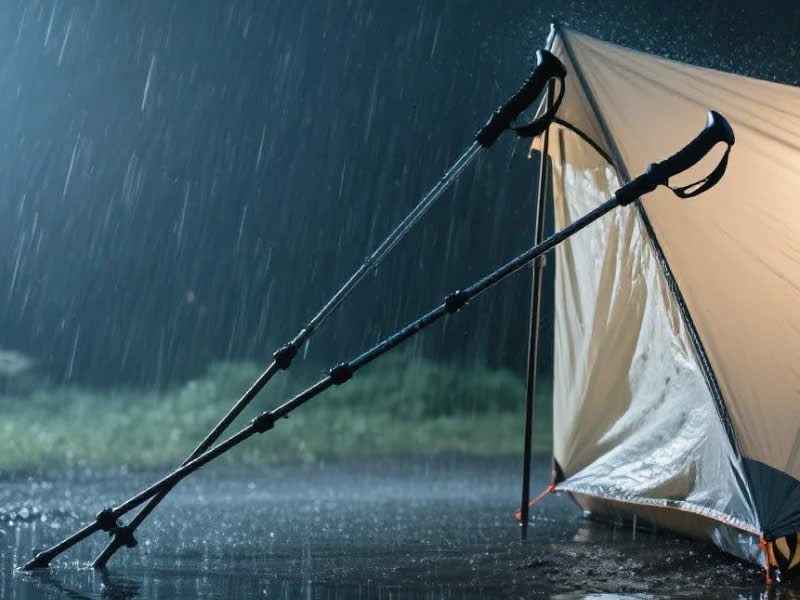
The short answer is: No, not from vertical tent pressure alone. But rain introduces other factors that can lead to bending or breakage. Let’s separate myth from mechanical reality.
How carbon fiber handles vertical loads
Carbon fiber composites are extraordinarily strong in compression (pushing along the length of the pole). A typical 12‑14 mm diameter carbon trekking pole can support over 100 kg of vertical force without bending. Your tent, even when soaking wet, exerts only a few kilograms of downward pressure at the peak. Under normal conditions, the pole does not bend from the tent’s weight or from rain adding a few hundred grams of water to the fabric.
So why do people report bent carbon poles in rainy conditions?
The culprit is not the rain itself, but fabric shrinkage and lateral forces. Here’s what happens:
- Nylon tent shrinkage – Many lightweight tents use nylon (e.g., silnylon). When nylon gets wet, it can shrink by 2‑5% along the weave. A tent pitched taut on a dry afternoon may become extremely tight once a tropical downpour soaks the fabric. This shrinkage increases tension across the entire shelter, including the peak. If the tent was already pitched at its maximum tension, the added shrink force can overload the pole’s lateral (sideways) strength.
- Lateral vs. vertical forces – Carbon poles are strong vertically but weaker when force is applied from the side (bending moment). Rain often comes with wind. Wind pushes the tent sideways, creating a bending force at the pole’s mid‑section. If the guylines are not properly adjusted, the pole can flex—and if the carbon has any micro‑crack, it can snap or permanently deform.
- Soft ground sinking – Rain softens soil. The pole tip may sink a few centimeters, effectively shortening the pole. The tent fabric then pulls the top of the pole sideways, creating a bending load. Over hours, this can cause the pole to take a set bend.
What “bending” actually looks like
Carbon fiber rarely bends plastically (like aluminium). Instead, it either:
- Elastically flexes (returns to straight when unloaded) – this is normal and safe.
- Splinters or snaps (catastrophic failure) – this happens if the pole is overloaded or has a defect.
- Delaminates (layers separate) – visible as white cracks; the pole is then weak.
So a “bent” carbon pole is usually broken or delaminated, not curved like a bent aluminium pole.
How to prevent carbon pole failure in heavy rain
- Don’t over‑tension your tent – Pitch with moderate tension, leaving a little slack for nylon shrinkage. After rain starts, check peak height; if fabric feels drum‑tight, shorten the pole by 1‑2 cm.
- Use all guylines – Side guylines transfer wind forces away from the pole, reducing bending moment.
- Place a rock or stick under the tip – Prevents sinking into soft mud, which can tilt the pole.
- Avoid carbon poles for stormy exposed camps – On windy Brazilian ridgelines, use aluminium poles for peace of mind.
Real‑world experience in Brazil
Many hikers in Chapada Diamantina use quality carbon poles (e.g., Black Diamond Distance Carbon Z) successfully through rainstorms. Failures happen with cheap, unbranded carbon poles or with poles that have prior damage (small nicks from rocks). One guide’s rule: “Carbon is fine for rain, not for wind. If you hear the tent flapping, lower the pole or add guylines.”
Final verdict
Ultralight carbon trekking poles do not bend under tent pressure from heavy rain alone. However, rain often brings wind, fabric shrinkage, and soft ground—conditions that can create lateral forces strong enough to damage carbon poles. Use quality poles, pitch with care, and add guylines. For extreme weather, aluminium is more forgiving. But for 90% of Brazilian rainy camps, good carbon poles will keep your tent standing straight.




