




Do I need trekking poles for the Frade Hill trail in Angra dos Reis?
The Frade Hill trail—known locally as Pico do Frade or Pedra do Frade—is one of Angra dos Reis’s most demanding and rewarding hikes. Rising from sea level to 1,561 m, this climb is not for the casual walker. With practically the entire route uphill, dense Atlantic Forest, slippery roots, muddy sections, loose stones, and an exposed summit, many hikers ask a crucial question before setting out: Do I need trekking poles for the Frade Hill trail in Angra dos Reis?
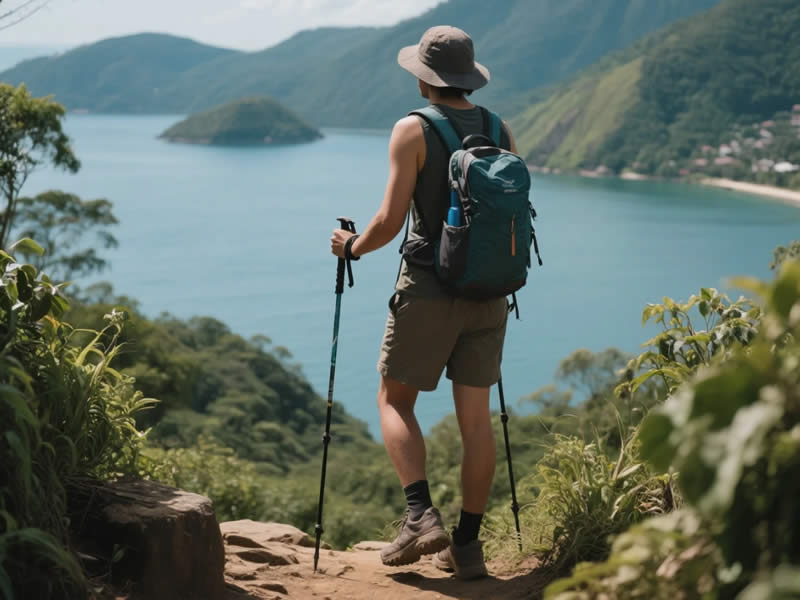
The short answer is yes—trekking poles are strongly recommended for this hike, particularly if you are not an experienced mountaineer. But let’s dive deeper into the trail’s conditions, the science behind pole benefits, and how to choose the right equipment for Brazil’s coastal rainforest terrain.
Understanding the Frade Hill Trail
The Frade Hill trail is brutal in its simplicity: it goes up, relentlessly. Starting at practically sea level in the Frade neighbourhood (Sertãozinho do Frade), the path climbs almost continuously-11. Over a distance of roughly 8.5 km one way, you gain around 1,500 m in elevation, giving an average gradient above 15%. Several recorded logs note that 96% of the path is uphill-1. The final stretches include rope sections and wooden ladders—the true crux of the ascent-4.
The terrain varies:
- Lower sections: well‑trodden forest path, but with fallen trees and mud, especially after rain-11.
- Mid‑mountain: slippery roots, loose stones, and dense vegetation.
- Upper slopes: exposed, windy, with large rock slabs and boulder fields.
- Final push: short scrambling sections with ropes and ladders.
The trail is often described as the most difficult in Angra dos Reis, recommended only for hikers with good physical conditioning and previous experience-. On clear days, the summit offers panoramic views of mountains like Pedra da Mina and Agulhas Negras, but the effort to get there is substantial-1.
Why trekking poles become essential on this hike
On a trail this steep, poles are not a luxury; they are a safety and performance tool. Here’s why:
1. Knee protection on the descent
The descent of Frade Hill is arguably more punishing than the ascent. Stepping down from 1,500 m over short, steep sections places enormous stress on your knees. Research shows that using poles can reduce load on the knee joints by 15–20%, especially during downhill travel, by transferring some of the impact to your upper body-. For a trek with over 1,600 m of elevation gain and loss, this cumulative reduction can mean the difference between hiking out comfortably or nursing sore knees for days.
2. Stability on loose, slippery, and muddy ground
The Atlantic Forest is humid. Rain is common, and after a storm, the trail becomes treacherous. Mud, wet roots, and leaf litter create unstable footing. Trekking poles add two extra points of contact, turning a two‑legged balance challenge into a stable four‑point support system-. When you step on a hidden loose rock or a slick root, poles can catch you before a fall.
3. Assistance on steep ascents
On the long, grinding climbs—especially after the last water source at “Alemão’s Grotto”—every bit of upper‑body help counts. By planting both poles ahead of you and pulling, you can offload some work from your quadriceps and glutes to your arms, shoulders, and back. This technique reduces leg fatigue, helps maintain a steady rhythm, and can even increase your uphill speed.
4. Safety on exposed rock and scrambling sections
The upper part of the hike includes brief Class 2–3 scrambling moments with ropes and ladders. While you won’t use poles for the ladder itself, they are invaluable for the approach—navigating narrow, exposed rocky ledges before the ladder. The additional stability prevents missteps with serious consequences.
5. Stream crossings and unpredictable footing
Several water sources cross the trail, including a suspension bridge in poor condition and various small streams-1. Poles allow you to test water depth, find solid footing, and maintain balance on wet, uneven rocks.
What kind of trekking poles work best for this trail?
Given the specific challenges of Frade Hill, not just any poles will do. Here are key features to look for, based on Brazilian hiking experts’ advice:
- Aluminium over carbon fibre – Carbon poles may be lighter, but the risk of splintering on Frade’s sharp quartzite rocks is real. 7075 aluminium offers far better durability for this terrain. As one source notes, for Brazilian conditions, aluminium poles are generally preferred-46.
- Lever (flick) locks, not twist locks – Mud and grit clog twist locks, causing them to slip at dangerous moments. Lever locks are field‑cleanable and far more reliable in wet, muddy Atlantic Forest conditions-.
- Carbide tips with optional mud baskets – A sharp tip grips on rock and hardpack, while a small mud basket prevents the pole from sinking too deep into soft soil after rain-.
- Cork or foam grips – Humidity is high on this trail. Cork handles wick sweat and stay grippy when wet, unlike some rubber or plastic grips.
- Adjustable length – The ability to shorten poles (by 5–10 cm) for steep uphills and lengthen them for descents is critical on a trail with such varied gradient-.
Do you absolutely need poles? Who might skip them?
Very experienced hikers with excellent balance, strong knees, and light packs might choose to go without. Some trail runners prefer unencumbered hands for scrambling. However, for the vast majority of hikers—and especially for anyone carrying a daypack with water, food, and layers—the benefits outweigh the negligible weight penalty (about 500 g for a pair).
If you are uncertain, consider renting or borrowing a pair before buying. After one descent on the slippery, rocky upper slopes of Frade, most people become converts.
Practical tips for using poles on this hike
- Set them correctly – On flat ground, your elbow should form a roughly 90° angle. Shorten by 5–10 cm for long uphill stretches; lengthen by the same for downhill-.
- Use the wrist straps properly – Push your hand up through the strap and rest the strap across the base of your palm. Most of the downward force should transfer through the strap, not your grip.
- Plant diagonally on steep sections – On very steep slopes, plant both poles together ahead of you to push off, rather than alternating left–right.
- Descend with extended arms – Lengthen the poles and reach forward, planting each pole before your foot lands. This provides the braking effect that protects your knees.
- Keep poles handy for rope sections – Collapse them and attach to your pack (many poles have elastic shock cords or foldable designs) for the final ladder and rope zone.
- Rinse and dry after the hike – Salt, mud, and moisture can corrode locks and tips. A quick freshwater rinse extends their life.
Final verdict
The Frade Hill trail is a serious, steep, and physically demanding hike. The terrain—mud, roots, loose rocks, exposed slabs, and significant elevation change—makes trekking poles a highly recommended piece of gear for most hikers. They reduce knee impact, improve balance on slippery sections, assist on long climbs, and provide critical stability on exposed approaches. While not strictly mandatory for elite athletes, poles turn a punishing trek into a safer, more controlled, and more enjoyable experience. Pack them. Your knees will thank you at the bottom.






