




What trekking pole length for the steep Pico do Itambé in Minas?
Pico do Itambé, standing at 2,062 meters in the heart of Minas Gerais, is one of Brazil’s most challenging and rewarding mountain hikes. The peak is known for its dramatic, steep slopes, loose rocks, and sudden weather changes. Whether you’re climbing from the base near the town of Santo Antônio do Itambé or approaching from the traditional trailhead, you’ll face relentless gradients that demand good technique – and the right trekking pole length.
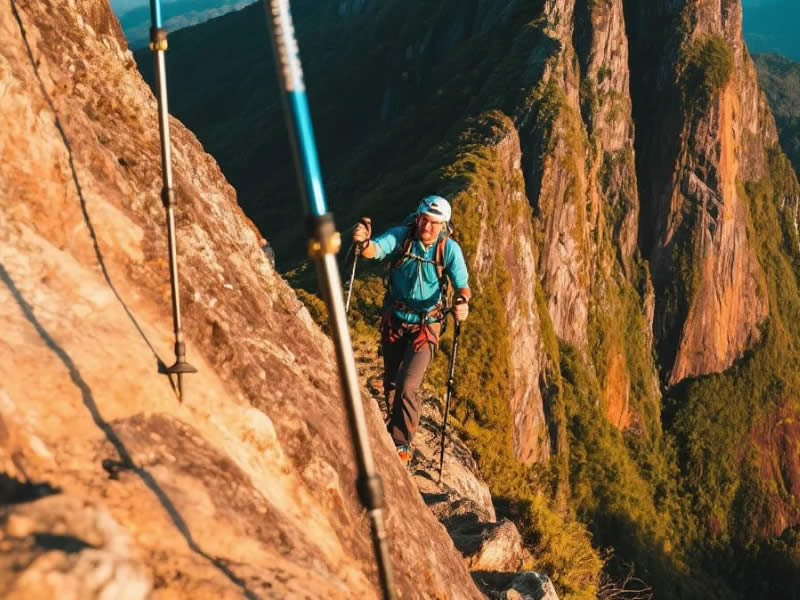
So, what trekking pole length should you use for the steep Pico do Itambé? The short answer: adjustable poles that span from about 110 cm to 130 cm, with frequent changes depending on the slope. Let’s break down why length matters, how to set your poles for different sections, and what works best for this particular mountain.
Why pole length is critical on steep terrain
On a flat trail, your poles should be set so your elbows form a 90‑degree angle when the tips touch the ground. That’s usually around 120‑125 cm for an average‑height hiker (170‑180 cm). But on a steep climb or descent, that neutral length becomes inefficient and even dangerous.
- Climbing: When you step uphill, your hands naturally move lower relative to your body. A pole that is too long forces you to lift your arms awkwardly, wasting energy and reducing stability. Shortening the pole by 5‑10 cm keeps your elbows close to your body and allows you to push down effectively.
- Descending: Going downhill, your hands want to reach farther forward. A longer pole lets you plant ahead of your feet, creating a braking effect that takes load off your knees and prevents overstriding. Lengthening the pole by 5‑10 cm is the standard practice.
The Pico do Itambé terrain profile
The standard route to Pico do Itambé begins at the Alto da Capelinha (around 1,400 m) and climbs steadily through campo rupestre (rocky fields). The final kilometer is exceptionally steep, with sections approaching 35‑40% gradient. There are loose quartzite scree fields, polished rock slabs, and narrow ridges. The descent is equally punishing.
Because the slope angle changes constantly – from moderate inclines in the forested lower part to very steep open rock – you’ll want to adjust your pole length several times during the ascent and descent.
Recommended length ranges for different phases
| Phase of hike | Recommended pole length | Notes |
|---|---|---|
| Approach (gentle to moderate incline) | 120‑125 cm | Neutral walking position |
| Steep climb (25‑40% gradient) | 110‑115 cm | Shorten significantly; keep elbows bent |
| Very steep / scrambling sections | 105‑110 cm (or stow poles) | Some sections may require hands‑on rock; collapse and attach to pack |
| Moderate downhill | 125‑130 cm | Lengthen for braking |
| Very steep downhill (loose scree) | 120‑125 cm (caution) | Too long can lift your center of gravity; use a moderate length and plant firmly |
Does height affect the numbers?
Yes. The above ranges assume a hiker of average height (170‑180 cm). If you are shorter (150‑165 cm), reduce each number by about 5 cm. If you are taller (185‑195 cm), add 5 cm. Always use the 90‑degree rule on flat ground as your baseline, then adjust up or down based on slope.
Fixed‑length poles: a compromise
If you use non‑adjustable (fixed‑length) poles, choose a length that splits the difference – typically 120 cm for average height. On steep climbs you will have to grip lower on the pole (below the handle), which is less ergonomic but possible for short sections. On descents, you will not get the full braking advantage. Adjustable poles are strongly recommended for Pico do Itambé.
Specific recommendations for this mountain
- Use aluminium, not carbon – The sharp rocks on Itambé’s upper slopes can splinter carbon shafts. 7075 aluminium bends but survives. Pair with lever locks (not twist locks) because fine grit from the caminho will jam twist mechanisms.
- Mark your settings – Before the hike, extend your poles to your preferred climb length (e.g., 112 cm) and descent length (e.g., 127 cm). Use a permanent marker to draw a line on the lower section. During the hike, you can quickly match the line to the upper section without measuring.
- Shorten for the scree – The loose rock fields near the summit require short, quick steps. Poles that are too long will cause you to over‑reach and lose balance. Set them to your climb length or even 5 cm shorter.
- Don’t be afraid to stow – On the final push to the summit, some hikers prefer to collapse poles entirely and use hands for scrambling. That’s fine – just attach them to your pack.
Field test from local climbers
Experienced guides from Belo Horizonte who regularly lead trips to Itambé recommend starting with poles at 115 cm for the initial climb. As the slope steepens above 2,000 m, they drop to 108‑110 cm. For the descent, they extend to 125 cm and then reduce slightly if the gravel becomes too loose. One guide notes: “The hikers who complain of knee pain are always those who never adjust their poles. On Itambé, you should be changing length four or five times per day.”
Final answer
For the steep Pico do Itambé, use adjustable trekking poles with a range of at least 110‑130 cm. Set them to 110‑115 cm for the steepest climbs, 125‑130 cm for descents, and around 120 cm for moderate sections. If you have only fixed‑length poles, choose 120 cm and prepare to grip lower. But for safety, comfort, and knee protection, adjustable poles are a worthwhile investment for this Minas Gerais classic. Adjust often, plant deliberately, and you’ll conquer Itambé without injury.




