




How to double‑pole plant for steep Brazilian mountain jumps?
Brazil’s mountainous terrain—from the granite domes of Rio’s Serra dos Órgãos to the quartzite ridges of Chapada Diamantina—often requires more than just walking. On very steep descents, hikers sometimes need to make controlled “jumps” down from rock ledges or over gaps. The double‑pole plant is a technique used to absorb impact, maintain balance, and protect your knees during such moves. When executed correctly, it transforms a jarring drop into a smooth, three‑point landing. Here’s how to master it for Brazil’s steep mountain trails.
What is the double‑pole plant?
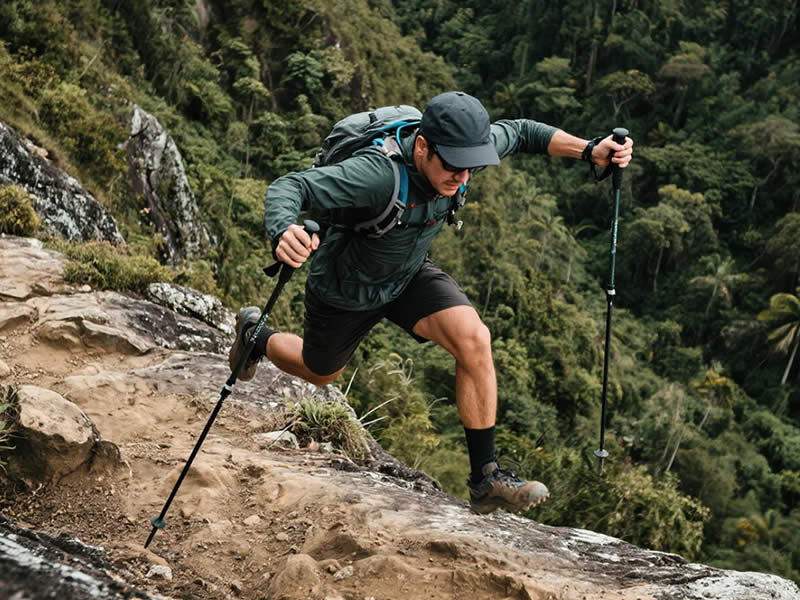
The double‑pole plant is a dynamic braking and shock‑absorption maneuver. As you prepare to drop off a rock step or launch into a short jump, you plant both trekking poles firmly on the lower ground before your feet leave the upper ledge. The poles act as extra legs, sharing your body weight and reducing the force transmitted to your knees, hips, and ankles. It is widely used by alpine mountaineers and has been adopted by Brazilian hikers on exposed descents like Pedra do Sino, Pico dos Marins, and the paredões of Vale do Pati.
When to use it
Use the double‑pole plant when:
- Dropping from a rock ledge between 0.5 and 1.2 metres high.
- The landing zone is stable (not loose scree or slippery mud).
- You are wearing a heavy backpack (the extra weight increases impact).
- You feel uncertain about balance on the landing.
Do not use it on extremely steep, loose terrain where planting both poles could cause a forward somersault. Also avoid if your poles are carbon fibre (they may snap under sudden impact) or if the tips are worn.
Step‑by‑step technique
- Approach the edge – Walk to the lip of the drop. Face downhill. Keep your knees slightly bent and your weight centered.
- Extend your poles – Lengthen your poles by 5‑10 cm more than your usual downhill setting. This gives you extra reach to the lower ground. Ensure both lever locks are tight.
- Plant the poles – From the upper ledge, reach down and plant both carbide tips firmly on the lower ground, about shoulder‑width apart. The poles should be angled slightly downhill, not vertical. Push down so that the tips bite into the soil or rock.
- Load the poles – Before you jump, shift part of your weight onto the poles. Your arms should be straight, shoulders engaged. You will feel the poles compress slightly (especially if they have shock‑absorbing springs, though most trekking poles are rigid).
- Execute the jump – Keeping your poles planted, push off with your legs. As you descend, let your arms flex to absorb the initial impact. Your feet should land between or slightly behind the pole tips. Do not let go of the poles.
- Land and stabilize – Your feet touch down, then immediately your poles take residual load. Keep your knees soft. After landing, recover the poles and continue walking.
Common mistakes
- Planting too close to your body – The poles should reach the lower ground ahead of you. If you plant them directly below your chest, you will not gain any braking effect.
- Letting the poles slide – On wet or polished granite (common in Brazil’s Serra do Mar), carbide tips may skid. Test the grip before committing your weight.
- Jumping too far – The double‑pole plant is for controlled drops, not long horizontal leaps. Maximum effective drop height is about 1.2 metres for an average hiker. Higher drops risk pole breakage or shoulder injury.
- Using carbon poles – Carbon shafts are brittle. A hard landing can cause them to splinter. Aluminium is much safer for this technique.
Training the movement
Practice on a low kerb or a small boulder (30‑50 cm) before trying bigger drops. Focus on synchronising the pole plant with your leg push‑off. With repetition, the motion becomes automatic. Brazilian mountaineering clubs often include double‑pole plant drills in their basic technical workshops.
Gear considerations
- Pole length – Adjustable poles (110‑135 cm) are essential. Mark your “jump” length with a pen on the lower shaft so you can quickly extend before a descent.
- Tip type – Sharp carbide tips only. Rubber boots will slide on rock. Replace worn tips before a technical trek.
- Wrist straps – Use them correctly (hand up through the strap). The strap should take the downward force, not your grip. This prevents wrist strain during impact.
When one pole is better
On very narrow passages or where you need a free hand to brace against a rock, a single‑pole plant (planting only the downhill pole) may be sufficient. But for maximum stability and shock absorption on a dedicated jump, two poles are superior.
Final safety reminder
The double‑pole plant is an advanced technique. Never attempt it on loose scree, wet leaves, or other unstable surfaces. Always inspect your poles for cracks before a steep descent. And if you have any shoulder or wrist injuries, avoid this technique altogether – the impact forces transfer directly to your upper body.
Conclusion
For Brazilian hikers facing the steep, rocky descents of mountains like Pedra do Sino, Pico dos Marins, and the paredões of Chapada, the double‑pole plant is a valuable skill. It protects your knees, improves balance, and turns a jarring jump into a controlled movement. With the right aluminium poles, proper technique, and practice on low ledges, you can safely navigate Brazil’s most dramatic drops. So next time you stand at the edge of a granite step, plant both poles, breathe, and drop – your knees will thank you.




