




How to use trekking poles to propel yourself up steep steps in Petrópolis?
Petrópolis, nestled in the Serra dos Órgãos mountains of Rio de Janeiro state, is famous for its steep, historic stone staircases. Trails like the Caminho do Imperador (Emperor’s Path) or the ascent to Pedra do Jacó are lined with hundreds of uneven, mossy steps that can leave your thighs burning and your lungs gasping. Trekking poles, when used correctly, transform these punishing climbs into a more efficient, full‑body workout. The key is learning to propel yourself upward, not just to lean on the poles. Here is a detailed guide for conquering Petrópolis’s steep steps with proper technique.
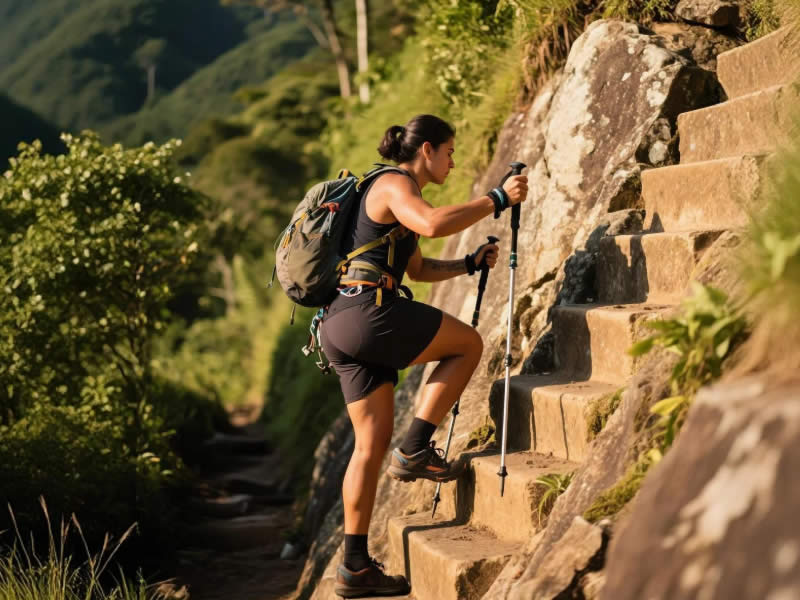
Why standard pole technique fails on steep steps
On flat ground, you plant a pole as your opposite foot lands, creating a gentle forward push. On very steep steps (gradients exceeding 25‑30%), that rhythm breaks down. Reaching forward with a pole at its normal length forces you to lean excessively, and the alternating plant becomes awkward. Instead, you need a simultaneous double‑plant technique—using both poles together to boost your body upward.
Step 1: Shorten your poles dramatically
Before you start climbing the stair section, shorten both poles by 5 to 10 centimetres below your usual flat‑ground setting. For an average‑height hiker (170‑180 cm), flat length is about 120‑125 cm. For steep steps, reduce to 110‑115 cm (or even 105 cm on extremely high steps). Why? A shorter pole keeps your elbows bent and your hands low, allowing you to push down vertically rather than forward. This engages your triceps and latissimus dorsi effectively, taking load off your quadriceps.
Test the length: Stand on a step. Plant both poles on the next step above you (about 20‑30 cm higher). Your elbows should be at a 70‑80 degree angle, not fully extended. Adjust until it feels powerful.
Step 2: Adopt a forward lean, but keep your back straight
Stand facing the stairs. Lean your torso slightly forward from the hips – not from the waist. Your back should remain straight, shoulders relaxed. This forward lean aligns your body so that when you push on the poles, the force goes directly into lifting you upward, not backward.
Step 3: The double‑plant push sequence
- Place both poles – Plant the two carbide tips firmly on the second or third step ahead of you, about shoulder‑width apart. The poles should be vertical or slightly angled backward (toward you). Avoid planting too close to your feet; you need room to step up.
- Engage the straps – Slide your hands up through the wrist straps so the strap lies across the base of your palm, not your fingers. The strap should bear your weight, not your grip.
- Step up with one foot – Lift your right foot onto the first step (or the next step if the risers are tall). As you do this, keep your poles planted.
- Push down hard – Simultaneously push down through both straps, straightening your arms. This upward thrust lifts your body weight, making the step feel much lighter. Your left foot then follows onto the same step or the next one.
- Recover and repeat – Once both feet are on the new level, lift the poles, advance them two or three steps ahead, and repeat. The rhythm is: plant poles → step up with one foot → push → bring the other foot up → recover poles.
Step 4: Adjust for very high or irregular steps
Petrópolis’s historical stone steps often vary in height. Some may be 30‑40 cm tall. On such steps, you may need to:
- Shorten poles even more – Go down to 100‑105 cm so you can push from a lower hand position.
- Use a staggered plant – On narrow stairs, plant both poles on the same step (one slightly ahead of the other) to keep them stable.
- Push with one pole temporarily – If the stairs are so steep that using both poles feels unstable, switch to a single‑pole push (using the pole on the same side as your trailing foot). But for most hikers, two poles are superior.
Common mistakes to avoid on Petrópolis stairs
- Poles too long – This forces you to push forward rather than upward, wasting energy and straining your shoulders.
- Gripping the handles like a lifeline – You should hold the grip gently; the strap does the work. White‑knuckle gripping tires your forearms.
- Looking down constantly – Keep your eyes scanning two or three steps ahead to plan your pole placement, but maintain a neutral neck position.
- Rushing the rhythm – Take one step at a time, with a deliberate push. Speed will come with practice, not by skipping the push phase.
How much benefit can you expect?
Biomechanics studies show that using a double‑plant push on steep slopes can reduce the force on your quadriceps by 15‑25%. Heart rate often remains slightly lower for the same pace because the upper body shares the load. Many hikers report feeling less tired after a long stair climb when using this technique correctly.
Training the movement on easier terrain
Before tackling Petrópolis’s famous staircases, practice on a steep staircase in a park or even a tall curb. Start with a single step, then progress to flights of 20‑30 steps. Focus on synchronising the pole push with your leg lift. Within an hour, the motion becomes natural.
When to switch back to alternating rhythm
Once the slope eases to less than 15‑20%, return to the normal alternating diagonal stride. On very steep steps, the double plant is king; on moderate inclines, the alternating rhythm is more efficient.
Final takeaway for Petrópolis hikers
Petrópolis’s steep stone steps are a rite of passage for Brazilian hikers. With the right pole technique—shortened shafts, double plant, strap push—you can ascend them with less knee strain, greater speed, and a feeling of flying up the mountain. Practice on a low staircase first, then challenge yourself on the Caminho do Imperador or the climb to Pedra do Jacó. Your legs will thank you, and you’ll reach the summit fresher for the view. Just remember: poles are not crutches; they are propellers. Push down, step up, and enjoy the climb.




