




Can trekking poles be used for upper body resistance training while walking?
Yes, absolutely. Trekking poles are not only for balance and knee protection—they can also transform a simple walk into an effective upper body resistance workout. By intentionally pushing against the poles with each stride, you engage your triceps, shoulders, chest, and back muscles. This is particularly valuable for sedentary office workers, older adults, or anyone looking to add low‑impact strength training to their daily walking routine. Let’s explore how to do it correctly, the muscle groups involved, and practical tips for Brazilian walkers.
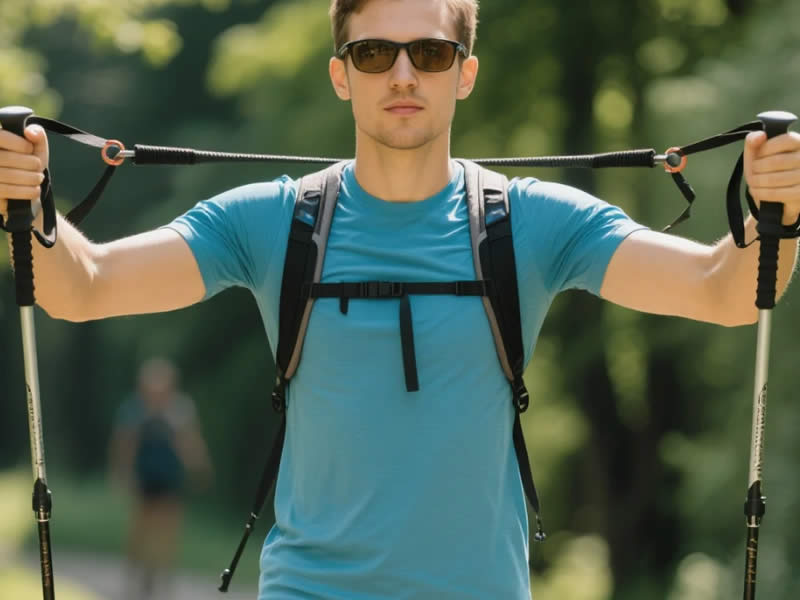
The concept: active vs. passive pole use
Most hikers use trekking poles passively—they plant the poles and let them support some body weight, but little active force is applied. To turn walking into resistance training, you must change your intent. Instead of letting the poles “catch” you, you push down and backward against them with each stride. This transforms the poles into resistance tools similar to light dumbbells or resistance bands.
Which muscles get trained?
When you actively push through the poles, you recruit:
- Triceps brachii – The primary muscle for elbow extension. Each push straightens your arm against the pole.
- Deltoids (shoulders) – Especially the anterior deltoid, which raises your arm forward.
- Pectoralis major (chest) – Engaged when you push the pole downward and slightly inward.
- Latissimus dorsi (back) – Activated during the pulling phase (if you use the strap to pull the pole backward).
- Core stabilisers – Your abdominal and oblique muscles work to maintain a rigid torso during the pushing motion.
How to set up for resistance training
- Pole length – Lengthen your poles 5‑10 cm longer than your normal walking height. For flat ground, a typical “fitness” length is when your elbow forms a 100‑110° angle (slightly straighter than 90°). This gives you more leverage to push down.
- Wrist straps – Essential. Insert your hand upward through the strap so the strap lies across the base of your palm. You will push against the strap, not the grip. This transfers force to your triceps and lats.
- Technique – the active pushAs your right foot steps forward, plant the left pole firmly.Immediately push down and slightly backward through the strap, straightening your arm.Feel your triceps and shoulder contract.Release the push as you lift the pole for the next stride.Repeat on the opposite side (right pole with left foot).
- Increase intensity – To make it harder, plant the pole further back (near your rear foot) so you push against it for a longer range of motion. Or, use a stiffer wrist strap to increase resistance. Some hikers even add small ankle weights to the poles (not recommended due to balance risks).
Benefits for specific populations
- Sedentary office workers – Walking with active pole use counteracts “computer posture” (rounded shoulders, forward head). The pushing motion opens the chest and strengthens the upper back, improving posture.
- Older adults – Low‑impact resistance training helps maintain muscle mass and bone density. Poles also reduce fall risk.
- Rehabilitation – After shoulder or elbow injuries (with medical clearance), light resistance from poles can aid recovery without heavy weights.
- Weight management – Active pole walking burns up to 20‑30% more calories than normal walking because it engages more muscle mass.
How to progress your training
- Beginner – 15 minutes of active pushing, 2‑3 times per week. Focus on form.
- Intermediate – Alternate 5 minutes of active pushing with 5 minutes of normal walking. Increase to 30‑40 minutes total.
- Advanced – Use weighted poles (some brands offer adjustable weights inside the shaft) or add rubber resistance bands between the poles.
Common mistakes and how to fix them
- Gripping too tightly – Your hand should be relaxed; the strap does the work. A death grip tires your forearm muscles without adding resistance.
- Planting poles too far ahead – This reduces the pushing force. Keep the plant point near your front foot or even slightly behind it.
- Leaning forward excessively – Maintain an upright posture. The push comes from your arms, not from falling onto the poles.
- Using carbon poles – Carbon shafts are stiff but can be damaged by aggressive side forces. Aluminium poles are more durable for resistance training, especially on rough ground.
Adding variety
- Double push – Plant both poles together and push down simultaneously as you step forward with either foot. This emphasises chest and triceps.
- Backward walking – Walk backward while pushing against the poles. This challenges different stabiliser muscles and improves proprioception (do this only on flat, obstacle‑free ground).
- One‑armed training – Use only one pole for part of the walk to isolate one side. Switch arms halfway.
Safety precautions
- Start gently – If you are new to resistance training, begin with light pressure. Soreness in the triceps and shoulders is normal; sharp joint pain is not.
- Warm up – Do arm circles and shoulder rolls for 2‑3 minutes before starting.
- Avoid on steep downhills – On descents, switch back to normal braking technique. Active pushing on a downhill can over‑extend your elbows.
- Check locks – The extra force from pushing may loosen lever locks. Tighten them before each session.
Real‑world example: Brazilian office worker routine
Imagine a professional in São Paulo who sits 8 hours a day. After work, they walk 30 minutes in Ibirapuera Park. By using active pushing with trekking poles for 20 of those minutes, they strengthen their triceps, open their chest, and improve posture—all while getting cardiovascular benefits. Within a month, they notice less shoulder tension and a more upright stance at their desk.
Conclusion
Yes, trekking poles can be an excellent tool for upper body resistance training while walking. By consciously pushing through the straps, adjusting pole length, and maintaining proper form, you turn a routine walk into a full‑body, low‑impact workout. For sedentary office workers, older adults, or anyone looking to add strength training without a gym, active pole walking is a simple, effective, and accessible solution. Just remember to start slowly, prioritise technique, and listen to your body. Your triceps and shoulders will thank you.




