




How to use trekking poles to measure avalanche risk (not relevant for Brazil)?
While Brazil’s tropical climate means you will never encounter avalanche terrain on its trails—no snow, no glaciers, no cornices—the technique of using trekking poles to assess avalanche risk is valuable for Brazilian mountaineers traveling abroad to the Andes, Patagonia, or the European Alps. Understanding this skill can save lives. Here’s how trekking poles can serve as a simple, emergency snowpack probe.
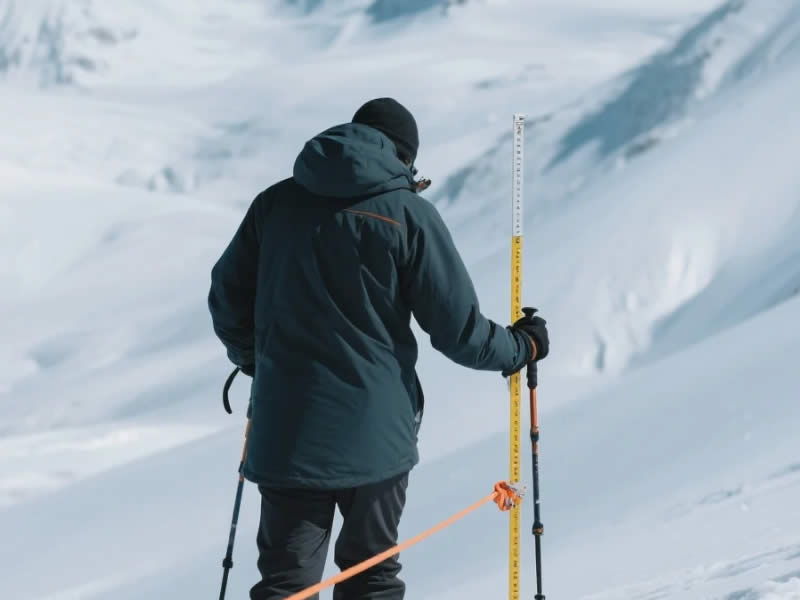
Why use trekking poles for avalanche assessment?
Professional avalanche safety gear includes a collapsible probe (2‑3 metres long) and a transceiver. However, a trekking pole (typically 110‑140 cm) is not a substitute for a dedicated probe. It is too short to reach deep weak layers and lacks the stiffness for precise feel. Nevertheless, in a survival situation or for a quick, shallow check (e.g., on a small slope), your pole can give basic information about the snowpack’s layering.
The pole probe technique
- Remove the basket – Large snow baskets are useless here; small trekking baskets may also interfere. Remove them if possible.
- Extend the pole fully – Lock all sections securely. Lever locks hold better than twist locks in cold.
- Hold the pole vertically – Grip the handle, not the shaft. Push the carbide tip straight down into the snow.
- Feel for layers – As you push, note resistance. A uniform snowpack (e.g., soft powder) will offer steady, mild resistance. A hard crust will stop the tip abruptly. A weak, faceted layer will feel like a sudden collapse or “whoomph” – a sign of instability.
- Pull out and inspect – Withdraw the pole. Look at the snow adhering to the tip. A layer of sugary, loose crystals is a red flag.
- Repeat at multiple points – Avalanche risk varies across a slope. Probe at least 5‑10 locations.
What a pole can and cannot tell you
- Can detect: Surface hoar, thin crusts, the top 50‑80 cm of the snowpack, changes in hardness in the upper layer.
- Cannot detect: Deep persistent weak layers (e.g., depth hoar at 1.5 m), full slab thickness, exact bonding strength.
Limitations compared to a real probe
- A dedicated avalanche probe is 2‑3 m long, has centimetre markings, and is designed to penetrate hard crusts. A trekking pole is shorter and may bend or break under extreme force.
- Professional probes have a smooth, non‑stick coating that allows you to feel subtle changes. Trekking pole tips are carbide and can get stuck.
The correct protocol: never rely solely on a pole
If you are in avalanche terrain (slopes 30‑45°, enough snow accumulation, and a trigger), a trekking pole probe is not sufficient. You must have:
- A certified avalanche transceiver (beacon).
- A proper 240‑300 cm probe.
- A shovel.
- Formal avalanche training (AST 1 or equivalent).
- Up‑to‑date avalanche forecasts for the region.
Use the pole only as a supplementary tool or when you have forgotten your probe and must make a quick, shallow check on a very small slope.
A practical example for Brazilian climbers
Imagine you are a Brazilian mountaineer climbing Aconcagua (Argentina) or heading to Patagonia. You have all your professional gear, but you want to check a small test slope near camp. You can use your trekking pole to feel the top 50 cm. If you find a hard melt‑freeze crust with loose snow underneath, you know to avoid even that small slope. But if you cannot penetrate the crust easily, the slab may be thicker than your pole – stay away.
Brazil‑specific note
Again, this technique is completely irrelevant for Brazil’s own trails (Serra do Mar, Chapada Diamantina, Amazon, Pantanal). No snow, no avalanches. However, many Brazilian hikers travel internationally. Knowing the basics of snow safety – even the limited use of a trekking pole – can make you a more aware and prepared globetrotter.
Final safety reminder
Using a trekking pole to assess avalanche risk is an emergency or rough‑estimation method, not a substitute for proper training and gear. If you plan to travel to snowy mountains, take a formal avalanche course and carry a real probe. Your life depends on it. And when you return to Brazil, you can leave the snow safety knowledge packed away – but never forget that mountains elsewhere demand respect and proper preparation.




