




How to flick trekking poles to remove mud without stopping?
Mud is an unavoidable companion on many Brazilian trails—from the red clay of Serra do Mar to the black sludge of the Amazon’s flooded forests. Every few steps, thick mud accumulates on your trekking pole tips and baskets, turning your lightweight poles into heavy, clumsy clubs. Stopping to scrape or wipe them breaks your rhythm, wastes energy, and lets mosquitoes catch up. The solution is a simple, elegant technique: the flick. Learning to flick mud off your poles without breaking stride keeps you moving efficiently and keeps your gear clean. Here’s how to master it.
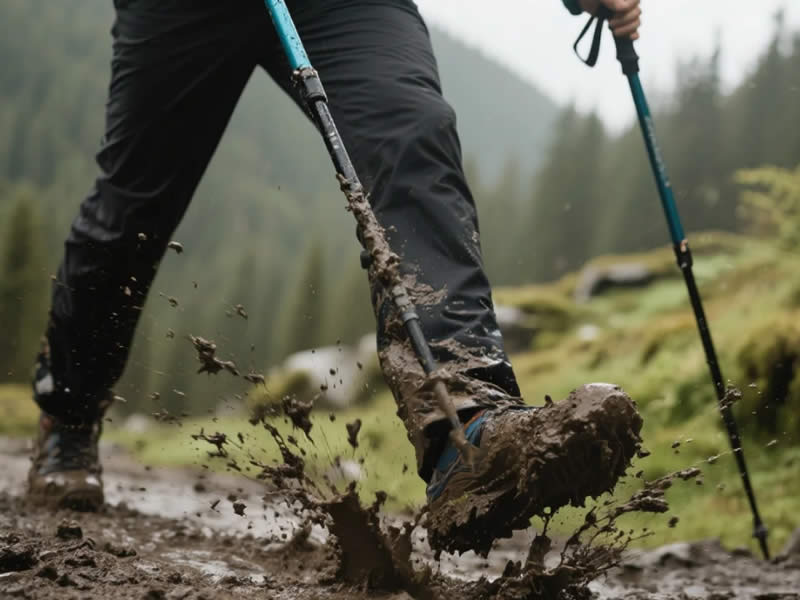
Why mud buildup is a problem
When mud cakes on the carbide tip and fills the small trekking basket (if fitted), several things happen:
- The pole becomes heavier, increasing arm fatigue.
- The tip loses its ability to bite into rock or hard ground, becoming slippery.
- Mud can jam the locking mechanism when you collapse the pole.
- Excess mud gets flicked onto your pants, backpack, or face when you swing the pole.
Cleaning poles by stopping to scrape them against a rock or tree takes 10‑15 seconds every few minutes. Over a 5‑hour hike, that adds up to 20‑30 minutes of lost time – plus the frustration of constant interruption.
The flick technique – step by step
The flick uses centrifugal force to throw mud off the tip. It requires a quick, sharp wrist movement at the top of the pole’s backswing. Here is the breakdown:
- Normal forward plant – Walk as usual, planting the pole at an appropriate angle.
- Lift and swing back – After the plant, lift the pole and swing it backward, as you normally would when recovering for the next stride.
- Accelerate the wrist – Just as the pole reaches the rearmost point (tip pointing behind you, handle near your hip), snap your wrist downward and slightly outward. The motion is similar to cracking a whip or shaking water off a paintbrush.
- Let centrifugal force work – The sudden deceleration of the pole tip (while the handle still moves) flings mud radially outward. Most of the mud leaves the tip and basket as a spray.
- Continue forward – Immediately bring the pole forward for the next plant. The entire flick adds less than 0.2 seconds to your stride.
Key points for success
- Do not flick sideways – A sideways flick can throw mud onto your legs or hiking partner. Flick backward (toward the trail behind you) or slightly downward.
- Adjust force to mud consistency – Wet, sticky clay needs a harder snap; dry, crumbly mud needs less.
- Practice first without a load – On a grassy field, walk with poles and intentionally collect mud (or simulate with a wet sponge on the tip). Practice the flick until it becomes reflexive.
- Use both poles independently – Flick each pole during its own recovery phase. Do not try to flick both together.
When to flick
- After every plant in heavy mud – If the trail is extremely muddy, flick after each step. The mud has not had time to dry or harden, so it comes off easily.
- When you feel extra weight – A mud‑caked tip feels noticeably heavier. That is your cue to flick.
- Before collapsing poles – Always flick both poles clean before shortening or folding them. Dry mud inside the joints can damage locks.
Common mistakes and how to fix them
- Flicking too late – If you flick when the pole is already moving forward, you may hit your own leg. Keep the flick in the backswing.
- Flicking with a straight arm – The wrist snap is lost if your arm is rigid. Keep your elbow slightly bent and wrist loose.
- Over‑flicking – Too much force can bend the lower shaft (especially on carbon poles) or send the tip flying (if not properly secured). Use only the necessary force.
- Forgetting baskets – Mud often accumulates inside the basket cage. A strong flick usually clears it, but occasionally a large clump will stick. If that happens, a quick tap on the side of your boot (while walking) dislodges it.
Advanced variant: the double flick
For extremely sticky clay (common in parts of the Atlantic Forest after rain), a single flick may not remove all mud. Use the double flick: flick once at the top of the backswing, then again at the bottom of the forward swing (just before planting). The second flick shakes off residual mud that was loosened by the first. This requires more coordination but is highly effective.
Why this technique is especially useful in Brazil
Brazilian trails offer a perfect storm for mud accumulation:
- High humidity prevents mud from drying quickly.
- Iron‑rich soils (terra roxa) produce sticky, red clay.
- Frequent afternoon rains keep trails perpetually wet.
- Dense vegetation limits space for swinging poles, making a controlled flick more valuable than a wide swing.
Local guides in Petrópolis and the Serra do Mar rely on the flick to maintain pace. Watching an experienced guide, you will see them flicking almost invisibly with every stride – their poles stay clean, their rhythm never falters.
Gear considerations for muddy conditions
- Remove baskets – Baskets act like tiny buckets, collecting mud. For muddy trails, take off the baskets entirely. The bare tip picks up less mud and cleans more easily.
- Use carbide tips – Rubber tips are useless in mud; they also collect muck. Sharp carbide penetrates mud to reach firm ground.
- Lever locks over twist locks – Mud can jam twist‑lock threads. Lever locks are easier to clean mid‑trail.
- Aluminium poles – Carbon poles are fine, but the flick technique creates sudden stress. Aluminium is more forgiving if you accidentally strike a rock during the flick.
Environmental courtesy
When you flick mud, aim it to the side of the trail, not directly behind you. The hiker following may not appreciate a face full of clay. Also, avoid flicking onto vegetation – mud is natural, but excessive buildup can smother small plants.
Conclusion
The flick is a simple, low‑skill technique that pays high dividends in muddy conditions. By incorporating a quick wrist snap into the backswing of each pole, you remove mud without stopping, maintain your walking rhythm, and keep your gear lighter and cleaner. Practice on a short, muddy section until the motion becomes automatic. Then, on your next wet Brazilian trail – whether in the Amazon, the Atlantic Forest, or the muddy caminhos of Chapada – you will glide past others who are constantly stopping to scrape their poles. Keep moving, keep flicking, and enjoy the mud as part of the adventure.




