




What is the “tripod method” for stream crossings in Brazilian rivers?
Crossing rivers is a common challenge on Brazilian trails—from the clear, fast‑flowing streams of Chapada Diamantina to the tannin‑stained currents of the Amazon. Slippery rocks, uneven bottoms, and unexpected deep spots make falls a real risk. The tripod method is a simple, effective technique that uses two trekking poles plus your two feet to create three stable points of contact with the riverbed. Here’s how it works, why it’s ideal for Brazilian rivers, and how to do it safely.
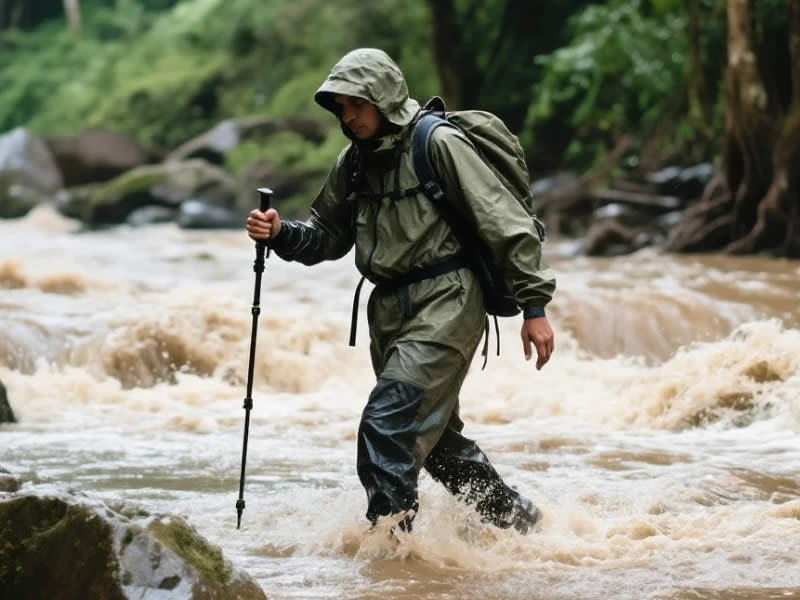
What is the tripod method?
The name comes from photography: a tripod has three legs for maximum stability. When wading across a river, your “tripod” consists of:
- Your two feet (one planted, one moving)
- Two trekking poles (used as mobile supports)
But mathematically, two feet + two poles = four points. The technique reduces this to three points of contact at any moment: you always keep three of the four points firmly on the riverbed while moving the fourth. This triangular base prevents tipping, even in strong currents.
Why Brazilian rivers need this method
Brazil’s rivers present unique hazards:
- Polished granite or quartzite – Many riverbeds are smooth rock, extremely slippery when wet.
- Variable depth – You might step from ankle‑deep into a waist‑deep hole without warning.
- Strong currents – During the rainy season, even small streams can push you off balance.
- Murky water – In the Amazon and Pantanal, you cannot see the bottom, making each step a gamble.
The tripod method addresses all these by giving you constant feedback and a wide, stable base.
Step‑by‑step technique
- Prepare your poles – Extend them to their maximum length (or slightly longer than your normal flat setting). Lock the sections securely. Remove any rubber tips – you need carbide to grip on rock. Keep your wrist straps on.
- Face upstream – Always face the direction from which the water is flowing. This reduces the surface area the current can push against and allows you to lean into the flow.
- Plant both poles upstream – Place the two poles firmly on the riverbed, shoulder‑width apart, about 1–2 feet in front of your feet. Angle them slightly downstream (toward you) so the current pushes them into the bottom, not away.
- Tripod movement –Start with both feet planted.Move your left foot a small step downstream (or to the side). Keep both poles planted. Your tripod now consists of: left foot (new position), right foot (still planted), and two poles (both planted). Actually that’s four points, but you are moving one foot at a time. The key is never lift more than one limb at a time.After planting the left foot, move your right foot a similar step. Both poles remain in place.Then, move the left pole downstream, replanting it ahead. Your right foot and both feet remain planted – so you still have three points (two feet + the right pole) while the left pole lifts.Then move the right pole similarly.In practice, the rhythm is: move a foot, then move a pole, then the other foot, then the other pole. This keeps three solid contacts at all times.
- Shuffle, don’t step – Lift your feet as little as possible. Shuffle them along the bottom to avoid tripping on submerged rocks.
- Use the poles as feelers – Before committing your weight, probe ahead with a pole to test depth and stability. If the pole sinks deeper than expected, adjust your path.
Common mistakes
- Planting poles too far apart – Shoulder width is ideal; wider than that strains your shoulders and reduces control.
- Facing downstream – The current pushes against your back, making you unstable and likely to topple forward.
- Lifting both poles at once – This leaves you on just two feet, vulnerable to any push. Always move one pole at a time.
- Using rubber tips – Rubber slips on wet rock. Remove them.
- Crossing alone – For deep or fast rivers, cross with a partner. Link arms or hold each other’s packs for extra stability.
Gear tips for Brazilian rivers
- Aluminium poles – Carbon can snap if wedged between rocks. Aluminium bends but survives. Lever locks are more reliable than twist locks when wet.
- Wide baskets – Not needed; remove baskets to avoid catching on rocks.
- Trekking pole straps – Keep them on, but do not loop your wrist through if the current could sweep the pole away and drag your arm. Use the strap correctly (hand up through the strap, then hold the grip). If the pole gets stuck, you can release your hand.
- Water shoes – If you expect many crossings, wear quick‑drying shoes with good grip. Hiking boots become waterlogged and heavy.
When not to use the tripod method
- Water above mid‑thigh – The force of the current increases dramatically with depth. If the water reaches your upper thighs, find a different crossing or turn back.
- Very fast, white water – The tripod method is for wading, not for swimming. Do not attempt dangerous rapids.
- Broken or missing poles – If you only have one pole, use a “quadripod” with a sturdy stick, but it’s less stable.
Practise before you need it
Find a shallow, slow stream (ankle‑deep) and practise the tripod shuffle. Focus on the rhythm of moving one limb at a time. Then try a slightly faster section. The muscle memory will save you when you encounter a real, slippery crossing on a Brazilian trail.
Final takeaway
The tripod method turns your trekking poles into river‑crossing tools that rival a third leg. By maintaining three points of contact with the riverbed – using two poles and two feet in sequence – you dramatically reduce the risk of slipping or being swept away. For Brazilian rivers, with their hidden rocks, strong currents, and unpredictable depths, this technique is essential knowledge. Master it at home, trust it on the trail, and cross safely.




