




How to store poles quickly when encountering a wild animal in Brazil?
Brazil’s wilderness is home to an astonishing variety of wildlife—from the elusive jaguar in the Pantanal to the aggressive peccaries in the Amazon, and from venomous snakes like the jararaca to curious capybaras. While most animals avoid humans, sudden encounters can happen on narrow trails. Your trekking poles, normally essential for balance, can become a liability if they trigger an animal’s defensive response or prevent you from retreating calmly. Knowing how to store your poles quickly and quietly can be a lifesaver. Here’s a practical guide for Brazilian hikers.
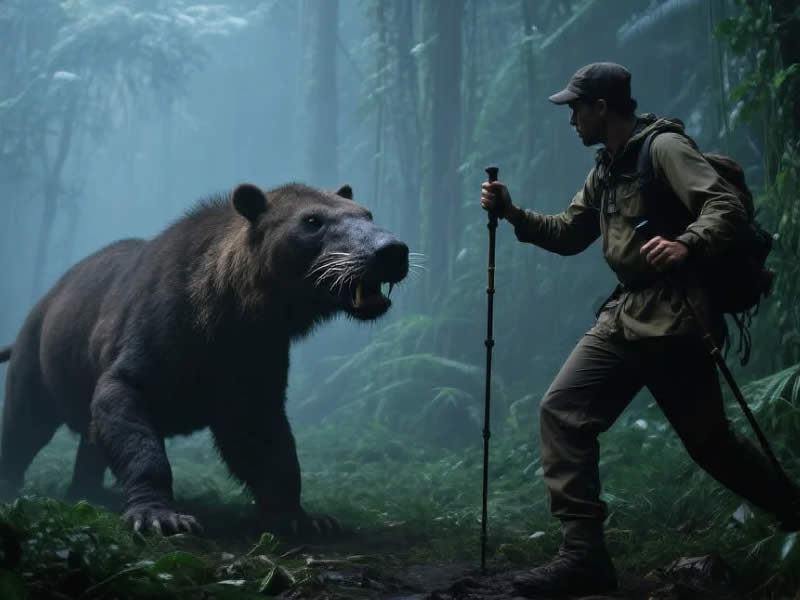
Why storing poles matters during an animal encounter
- Avoid appearing threatening – Waving or pointing poles may be perceived as an attack by some animals (e.g., peccaries, wild boars, or even a defensive tapir).
- Free your hands – You may need to protect your face, climb a tree, or handle a safety device (like bear spray – though bears are not in Brazil, other deterrents exist).
- Reduce noise – Clicking pole sections or scraping tips on rocks can attract curious or aggressive animals.
- Move more naturally – Backing away slowly without long sticks avoids tripping and allows smoother motion.
The four‑second stow – step‑by‑step
Practice this until it becomes muscle memory. You should be able to collapse and stow your poles in under 5 seconds using one hand (the other hand stays free).
- Release both lever locks – With your dominant hand, flip open the two (or three) lever locks on one pole. Lever locks (cam locks) are much faster than twist locks. If you have twist locks, you may need both hands – a strong reason to prefer lever locks for Brazilian trails.
- Collapse the sections – Push the upper section down into the lower section, then collapse the remaining sections. The pole should now be about 30‑50 cm long.
- Secure the collapsed pole – Slide it into a side pocket of your backpack, or use the trekking pole elastic loop (many packs have one) to hold it vertically. Alternatively, hold both collapsed poles together in one hand as a single bundle.
- Repeat for the second pole – If you have time, collapse the second pole using the same motion. If the animal is very close, drop the second pole (you can retrieve it later) and focus on retreating.
One‑handed technique for lever locks
- Place the pole vertically, tip on the ground.
- Press the top of the pole against your thigh to hold it steady.
- Use your thumb and index finger to flip all lever locks open in sequence.
- Then use your palm to push the sections down.
- This takes practice. Drill it at home 20 times until it’s automatic.
Dealing with twist‑lock poles
Twist locks are slower and prone to jamming when you are nervous. If you have twist locks, consider upgrading. In an emergency, you can simply drop the poles and back away. Your life is worth more than gear.
When not to stow – using poles as a deterrent
In rare cases, a pole can be used to deter an animal. For example:
- Feral dogs (common in some Brazilian rural areas) – Waving a pole may keep them at a distance.
- Snakes – A pole can gently move a snake off the trail (never strike it).
- Peccaries – If a herd charges, making yourself large and shouting may be more effective than collapsing poles. Some experts advise keeping poles high and wide to appear bigger.
Use your judgment. If the animal is not aggressive and you can simply retreat, stowing poles is best.
Specific animals in Brazil and recommended response
- Jaguar or puma (extremely rare encounter) – Do not run. Do not crouch. Make eye contact, raise your arms to appear larger, and back away slowly. Collapsing poles could be seen as a submissive posture; instead, hold them together as a single long object above your head. Do not stow.
- Peccary (queixada or caititu) – These can attack in herds. If they show aggression (teeth clicking, hair bristling), climb a tree quickly. You need free hands – drop your poles if necessary. Storing poles is secondary.
- Capybara – Generally harmless. No need to stow; just walk past calmly.
- Snakes (jararaca, coral, surucucu) – Stop moving, identify the snake. Most will flee. If it blocks the trail, use a pole (extended) to gently tap the ground near it to encourage movement. Do not stow the pole; it is your tool.
- Spiders (armadeira, tarantula) – Not a threat if you avoid contact. Poles can be used to brush webs away. No stow needed.
Practical drills
Before your next Brazilian trek, practice the four‑second collapse:
- Stand with both poles extended and locked.
- Set a timer for 5 seconds.
- Using one hand, collapse both poles and tuck them under your armpit or into a pack pocket.
- Repeat 10 times.
Also practice dropping the poles instantly (no collapse) and backing away. In some scenarios, dropping is faster.
Gear considerations for quick stowing
- Lever locks – Absolutely essential for speed. Decathlon Forclaz MT900, Black Diamond Trail Back, and Leki SpeedLock poles are ideal.
- Elastic pole holders on backpacks – Many backpacks have loops or bungees on the front or sides. Adjust them so you can insert a collapsed pole without looking.
- Magnetic or clip‑style pole holders – Some aftermarket accessories let you snap collapsed poles to your shoulder strap. Very fast.
- Avoid wrist straps – In a sudden encounter, your hand may be tangled. Remove wrist straps or use them loosely so you can free your hand instantly.
After the encounter
- Once the animal has moved away or you are at a safe distance, retrieve any dropped poles.
- Check for damage (bent sections, loosened locks).
- Rinse poles if you dropped them in mud or water.
- Reflect on the encounter – what triggered it? How can you avoid it next time? (e.g., making more noise on the trail to alert animals).
Final takeaway
Quickly storing trekking poles when encountering a wild animal in Brazil is a skill that combines gear choice, muscle memory, and situational judgment. Lever‑lock poles allow one‑handed collapse in seconds. Practice the four‑second stow. Remember that sometimes dropping poles is safer than collapsing them. And always prioritize your safety over gear. Brazil’s wildlife is part of the adventure; respecting them and being prepared makes every encounter a story, not an accident.




