




What is the optimal pole angle for maximum energy efficiency?
If you use trekking poles but still feel tired after long flat sections or gentle climbs, your technique may be the culprit. Many hikers plant their poles too far ahead or too vertically, wasting energy and even creating a braking effect. The secret to effortless, efficient walking lies in a simple adjustment: the pole angle at the moment of push‑off. Research and biomechanical analysis show that the optimal pole angle for maximum energy efficiency is 30–45 degrees behind your body during the propulsive phase. Let’s break down why this works and how to achieve it.
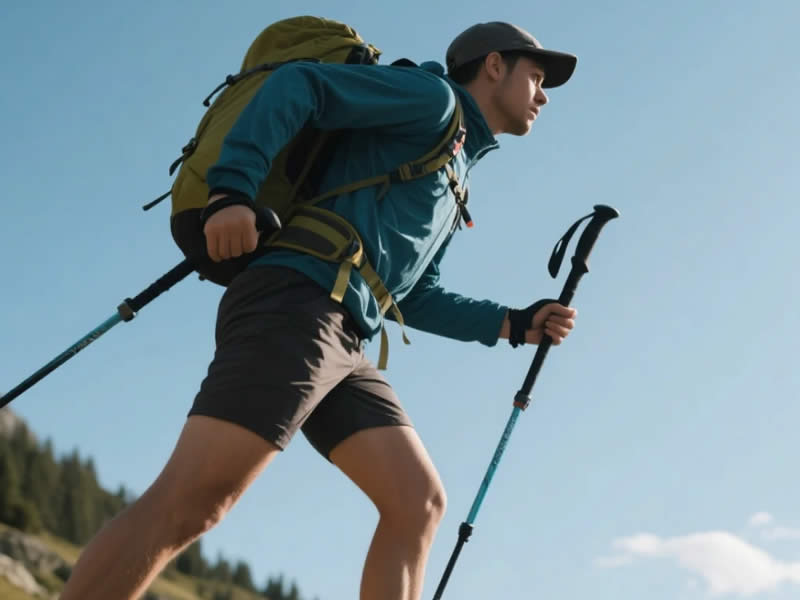
The two phases of a pole plant
Every stride with a trekking pole consists of two phases:
- Planting – The tip touches the ground.
- Push‑off – You apply force to propel yourself forward.
Most hikers focus only on planting, but the push‑off angle determines whether you gain energy (efficiency) or lose it (braking).
Why a forward plant is inefficient
If you plant the pole ahead of your body (e.g., tip in front of your lead foot), the pole is angled forward. When you push down, the ground reaction force points backward and upward. That backward component acts as a brake – it slows you down. You then have to use extra leg strength to overcome that braking. This is the most common mistake, especially among beginners or those transitioning from downhill technique.
In contrast, if you plant the pole near your body (or slightly behind your trailing foot) and push backward, the pole angle is behind you. The ground reaction force now has a forward component, propelling you ahead. This is the essence of efficient Nordic walking and trekking.
The optimal angle: 30–45° behind vertical
The ideal push‑off occurs when your arm is straight and the pole makes an angle of 30 to 45 degrees measured from vertical, leaning backward. In other words, the handle is ahead of the tip (relative to your direction of travel). At this angle, the force vector splits into:
- A large forward horizontal component (propulsion).
- A smaller vertical component (unloading your legs).
If the angle is less than 30° (almost vertical), the forward thrust is minimal – you are just pushing down, not forward. If the angle exceeds 45°, the pole may slip or you lose leverage because your arm is too far behind.
How to feel the correct angle
- Set your poles to the correct length – On flat ground, your elbow should be at 90° when the tip is on the ground.
- Focus on the push – As your hand passes your hip, push down and back through the wrist strap. Your elbow will straighten.
- Check the finish position – At the end of the push, your arm should be extended behind you, with the pole tip still on the ground. The shaft should form a 30‑45° angle leaning backward.
- Do not overreach – The pole tip should plant close to your front foot, not far ahead. Some coaches say “plant by your heel, push from your hip”.
The role of the wrist strap
Correct use of the wrist strap is essential. Insert your hand upward through the strap, then hold the grip. The strap should lie across the base of your palm. When you push, the strap transfers force from your arm to the pole – your grip can be relaxed. This allows a smooth, powerful push without straining your fingers.
Energy efficiency quantified
Biomechanical studies on Nordic walking (which uses the same pole technique) show that with correct backward‑angle pushing, oxygen consumption decreases by up to 20% compared to walking without poles, at the same speed. Heart rate also drops by 5–10 beats per minute. The forward thrust from poles reduces the workload on quadriceps and glutes, distributing effort to the upper body.
In contrast, planting poles too far ahead increases energy cost by up to 15% because of the braking effect. That means you would tire faster and walk slower.
Applying the optimal angle on different terrain
- Flat ground – Use the classic 30‑45° backward push. This is where efficiency gains are largest.
- Uphill – Shorten your poles (climbing mode) and accept a more vertical angle (20‑30°). The slope changes the geometry; you still want to push backward along the slope, but the absolute angle relative to horizontal is smaller.
- Downhill – Lengthen poles and plant them ahead for braking. Efficiency is not the goal; safety is. Do not try to maintain a backward angle on descents.
Common errors that ruin efficiency
- Planting too far forward – Creates a braking force. Keep the plant point near your front foot.
- Pushing down vertically – Wastes energy; you get no forward thrust.
- Gripping the handle tightly – Restricts wrist motion and reduces the natural backward swing.
- Using poles that are too long – Forces you to plant ahead. Shorten them until you can comfortably push backward.
How to practice
Find a flat, straight section of trail (or a park). Walk with your poles and deliberately over‑emphasize the backward push. At the end of each push, pause for a split second with your arm extended behind you. Check the pole angle – it should be visibly leaning backward. After 10 minutes, the correct motion will start to feel natural. Then, gradually increase your walking speed; the optimal angle will automatically become smaller as you go faster, but the backward lean remains.
Final verdict
The optimal pole angle for maximum energy efficiency is 30–45 degrees behind your body during the push‑off. To achieve this, plant the pole close to your feet, push down and back through the wrist strap, and allow your arm to fully extend behind you. This technique converts your upper body strength into forward propulsion, saving your legs and reducing overall fatigue. Avoid the common mistake of planting ahead, which acts as a brake. With practice, the backward push will become second nature, and you will glide across flat terrain with less effort and more speed. Your trekking poles will finally work with you, not against you.




