




How to choose a trekking pole bag for air travel from Brazil to Chile?
If you're planning a hiking trip from Brazil to Chile, whether it's to trek the famous Torres del Paine, explore the Atacama Desert, or hike in the Andes around Santiago, you'll likely need to bring your trekking poles. While they are essential for stability and knee protection, getting them safely and legally onto a plane requires careful planning. The wrong bag can lead to damaged poles, unexpected baggage fees, or even confiscation at security. Here's a comprehensive guide for Brazilian travellers on how to choose the right trekking pole bag for air travel to Chile.
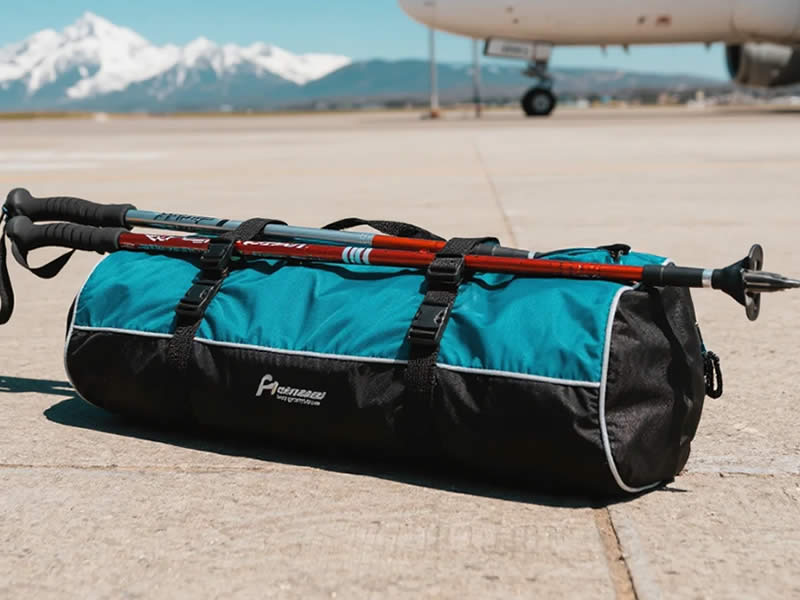
The core challenge: carry‑on vs. checked luggage
The first thing you must know is that trekking poles are almost always prohibited in carry‑on luggage on commercial flights, both in Brazil (under ANAC regulations) and in Chile (under DGAC). They are considered potential weapons, and even with rubber tips, security agents will confiscate them at the checkpoint. Therefore, you must check them in the hold. Your trekking pole bag must be designed to protect your poles during baggage handling, which can be rough.
Key factors to consider when choosing a bag
- Protection level
There are three main types of pole bags:
- Padded soft bags – These are made of nylon or polyester with a thin foam layer (about 5‑10 mm). They protect against scratches and minor impacts. Brands like Decathlon Forclaz and Adventure Sport's own brand offer these. They are lightweight, collapsible, and affordable (R$100‑200). They are sufficient for most travellers, especially if your poles are aluminium (which bends) rather than carbon (which can shatter under impact).
- Hard‑shell cases – These are made of rigid plastic or metal and offer maximum protection. They are heavier and bulkier, but they can survive being thrown onto conveyor belts. They are overkill for most hikers but recommended if you have expensive carbon poles or are checking them on multiple connecting flights. However, they are harder to find in Brazil and can cost over R$500.
- DIY solutions – Some travellers use a PVC pipe tube, capped at both ends. This is cheap, provides excellent protection, and can be cut to the exact length of your collapsed poles. The downside: it's rigid, takes up extra space in your luggage, and can be a hassle at customs. It is a good option if you are on a budget.
- Size and fit
The bag must accommodate your poles when fully collapsed.
- Collapsed length – Measure your poles from tip to the top of the handle when fully shortened. Most telescoping poles collapse to about 60‑75 cm. Folding poles collapse to around 35‑45 cm. Choose a bag that is at least 5‑10 cm longer than your longest pole. Common sizes: 70 cm, 75 cm, 85 cm.
- Capacity – Most bags hold one pair of poles. Some larger ones can hold two pairs. If you and your travel partner both have poles, a double bag saves space.
- Weight and packability
Consider the weight of the empty bag. You will have to carry it during your trip (either in your main backpack or as a separate item). Soft bags typically weigh 200‑500 g. Hard‑shell cases can weigh over 1 kg. For travel convenience, a soft, collapsible bag that you can fold and stow inside your backpack is ideal.
- Additional features
- Padded ends – The ends of the bag should be reinforced with extra padding or rubberized material, as these take the most impact.
- Secure closure – A full‑length zipper with a lockable slider is essential. Some bags have a drawstring closure with a flap, but zippers are more secure.
- Carrying handle – A sturdy handle makes it easier to carry the bag through the airport. Some have shoulder straps.
- External pocket – Useful for carrying rubber tip protectors or spare parts.
- Identification tag – A clear window for your name and contact details is a good safety feature.
- Airline compatibility and baggage fees
Check the specific policies of the airline you're flying (e.g., LATAM, Gol, Sky Airlines). Most airlines treat trekking poles in a bag as standard checked luggage, as long as the total dimensions (length + width + height) do not exceed 158 cm (the standard limit for one checked bag). A 75 cm long, 15 cm wide bag is well within this limit. However, some low‑cost airlines like JetSmart or Sky may charge extra for "sports equipment" or "oversized baggage" if the bag exceeds certain dimensions. Always confirm before booking.
- Protecting the tips and locks
Before packing, always cover the carbide tips with rubber protectors to prevent them from piercing the bag. Also, loosen all lever or twist locks by 1‑2 turns. Cabin pressure changes can cause locks to bind, and loosening them prevents damage.
Where to buy in Brazil
- Decathlon – The Forclaz trekking pole bag (approx. R$130) is the most popular. It is padded, 75 cm long, fits most poles, and is lightweight. Available in physical stores and online.
- Adventure Sport – Offers branded soft and hard cases from Black Diamond and Leki. These are higher quality but more expensive (R$250‑500).
- Mercado Livre / Shopee – Search for "mala para bastão de trilha". Many Chinese generic options are available from R$60‑120. Check reviews carefully for durability and size accuracy.
- DIY – Purchase a 75‑100 cm length of PVC pipe (100 mm diameter) and two end caps. Total cost around R$30. Cut to fit, insert poles, and tape the caps. This is a cheap, protective option for a single trip.
Recommendation for Brazilian travellers
For most hikers flying from Brazil to Chile, the Decathlon Forclaz padded pole bag is the best balance of price, protection, and convenience. It is compact enough to fold into a backpack, offers adequate padding for aluminium poles, and meets airline size requirements. If you have carbon poles or are taking multiple flights with long layovers, consider a hard‑shell case for peace of mind.
Final tips
- Pack the bag inside your backpack – If you have extra space, put the folded empty bag inside your main backpack for the return trip. This saves you from carrying it separately.
- Arrive early – Even with a proper bag, airport staff may want to inspect the contents. Allow extra time for potential security checks.
- Use a luggage strap – For extra security, wrap a luggage strap around the bag to prevent the zipper from bursting open if the bag is dropped.
- Carry spare parts – Place a small pouch with spare carbide tips and lock parts inside the pole bag. They are unlikely to be opened by customs.
Conclusion
Choosing the right trekking pole bag for air travel from Brazil to Chile is about balancing protection, weight, and cost. A padded soft bag like the Decathlon Forclaz model is ideal for most hikers. It protects your poles from scratches and minor impacts, fits easily within airline baggage limits, and is lightweight enough to carry comfortably. Always check your airline's specific policies on checked luggage dimensions, cover your tips, and loosen the locks before packing. With the r




