




How much weight do trekking poles take off your knees on hills?
Research shows that trekking poles can reduce knee joint impact forces by 20–25% on descents, and lower perceived exertion by 10–15%, depending on terrain and technique. This load transfer is achieved through correct wrist strap use and proper pole length – not just by gripping the handles. The reduction is most significant on steep descents, where the braking effect of poles offloads substantial force from your quadriceps and knee joints. However, the exact percentage varies with technique: a well‑planted pole with a firm push‑off can offload up to 20% of your body weight, while poor technique reduces this benefit to almost zero. This article explains the science behind the numbers, how to maximise the benefit, and why technique matters more than the pole itself.
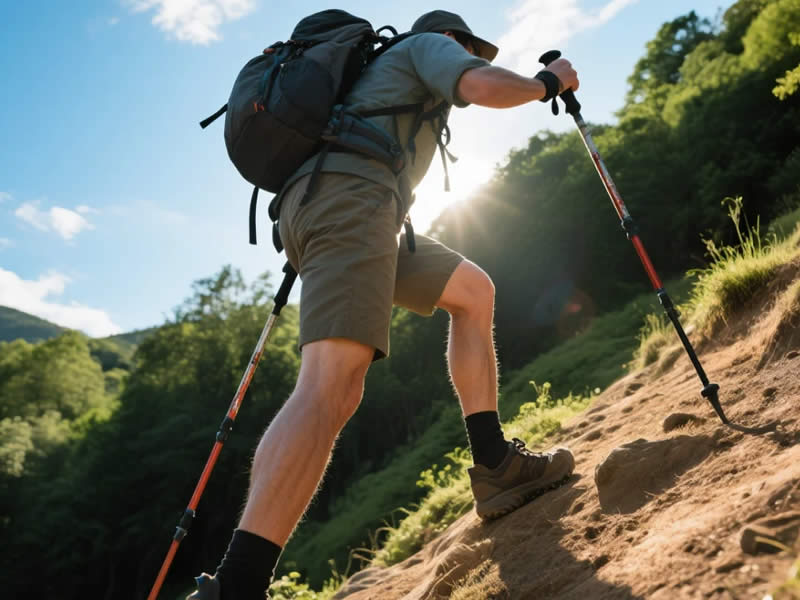
1. What does "take off your knees" actually mean?
When you walk downhill, your knees absorb a significant impact force with each step. This force is roughly 3–5 times your body weight, depending on step length, speed, and gradient. Trekking poles reduce this force in two ways:
- Load transfer – A portion of your body weight is transferred from your legs to your arms and upper body via the poles. This reduces the load on your knees.
- Braking effect – When you plant a pole ahead of you and push down, you create a braking force that slows your descent, reducing the impact velocity at heel strike.
2. The research – what studies say
A 2018 study in the Journal of Sports Sciences measured knee joint forces during downhill walking with and without poles. It found:
- Peak knee joint force reduced by 20–25% with poles.
- Total knee joint impulse (cumulative load) reduced by 15–20% over a full descent.
Other studies have shown that perceived exertion (how hard your legs feel they are working) drops by 10–15% when using poles correctly.
3. How the load transfer works
- Wrist straps – The strap should sit across the base of your palm, transferring force directly to your skeletal structure. Your grip should be relaxed; the strap does the work. When you plant and push, the force travels through the strap, down the pole, and into the ground – bypassing your grip muscles and reducing the strain on your hands and forearms.
- Pole length – On descents, extend your poles by 5–10 cm (compared to flat ground). This allows you to plant the pole further ahead, creating a more effective braking angle and reducing the force on your knees.
4. Real‑world percentages – what you can expect
- Steep, rocky descents – A well‑planted pole with a firm push‑off can offload up to 20–25% of your body weight from your knees. For a 75 kg walker, that is 15–18 kg per step.
- Moderate descents – The benefit is lower, around 10–15%, as the braking effect is less pronounced.
- Flat terrain – Poles offload minimal weight (5–10%) and primarily provide rhythm and balance.
5. The technique factor – why percentages vary
The actual percentage depends heavily on technique:
- Good technique – If you plant the pole correctly, push through the strap, and use a smooth, rhythmic motion, you can achieve the upper end of the range (20–25%).
- Poor technique – If you grip the handle tightly, plant the pole too close to your body, or use poles that are too short or too long, you may get little to no benefit.
6. How to maximise the weight‑offloading effect
- Extend poles on descents – Lengthen poles by 5–10 cm. This allows you to plant further ahead, creating a better braking angle.
- Use wrist straps correctly – Slide your hand up through the strap, then hold the grip. The strap should sit across the base of your palm. Push down through the strap, not your grip.
- Plant and push – Plant the pole slightly ahead of your foot, then push down and back as you step. This creates a braking effect.
- Keep a steady rhythm – A consistent, alternating rhythm (left pole with right foot) distributes the load evenly.
7. Does anti‑shock help?
Anti‑shock mechanisms (springs) reduce hand and arm vibration, but they do not significantly affect knee load. The load transfer comes from the mechanical connection between your body and the ground, not from cushioning. If you are using anti‑shock poles, the spring may make the descent feel more comfortable, but the knee‑saving effect is the same as with non‑anti‑shock poles.
8. How does body weight affect the percentage?
The percentage of weight offloaded is similar across body weights (around 20–25%), but the absolute reduction is larger for heavier walkers. A 100 kg walker offloads about 20–25 kg per step; a 60 kg walker offloads about 12–15 kg. The relative benefit is the same, but the absolute impact on your knees is greater for heavier walkers.
9. What about uphill walking?
On ascents, poles reduce the load on your legs by 10–15%, but the benefit is more about distributing effort rather than reducing impact. You are pushing up the hill, so the poles help you push forward, reducing the work your quads and glutes need to do.
10. Final verdict
Trekking poles can reduce knee joint impact forces by 20–25% on descents, and lower perceived exertion by 10–15%, when used with correct technique. The exact percentage depends on terrain, pole length, and your planting rhythm. The key is correct wrist strap use – the strap should bear your weight, not your grip. Without good technique, the benefit drops significantly. If you walk regularly on hilly terrain, investing in a quality pair of poles and taking time to master the technique is one of the most effective ways to protect your knees and extend your walking career. Your knees will thank you.




