




Are spring-loaded shock absorbers reliable on long distance trails?
Spring‑loaded shock absorbers are not essential and can be unreliable on long‑distance trails. The internal springs add weight, complexity, and a potential failure point – mud and grit can jam them, or they can weaken over thousands of planting cycles. For most UK trails, the ground is soft enough that a well‑designed pole without shock absorption performs perfectly adequately. The majority of experienced long‑distance walkers (Pennine Way, West Highland Way, Coast to Coast) prefer solid, reliable lever‑lock poles without springs. If you do have anti‑shock, ensure it can be locked out to prevent the spring from compressing when you don't want it to. In short: fewer moving parts means fewer things to go wrong. This article explains why shock absorbers are not recommended for long‑distance reliability.
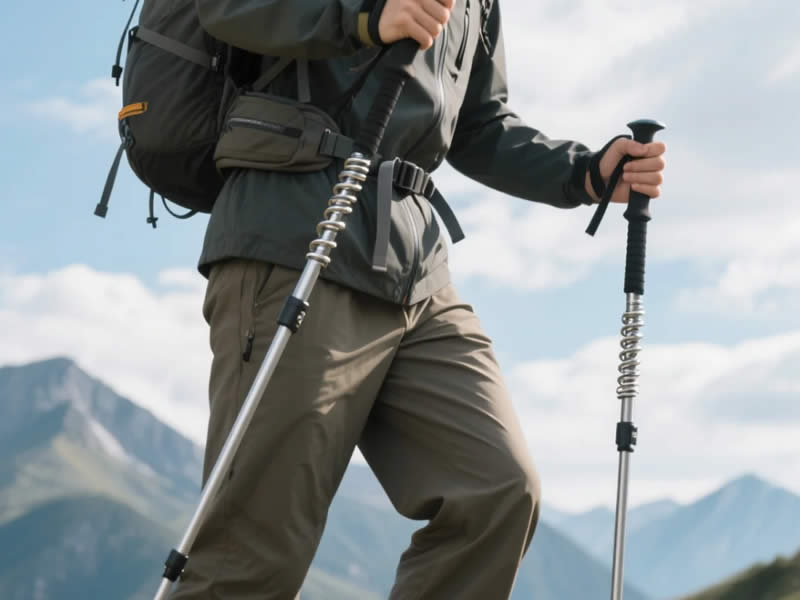
1. How anti‑shock systems work
Anti‑shock mechanisms typically consist of a coil spring or elastomer insert inside the lower section of the pole. When you plant the pole and apply downward force, the spring compresses slightly, absorbing a fraction of the impact energy. The theory is that this reduces jarring on hard surfaces.
2. Why they are problematic on long‑distance trails
a. Mud and grit ingress – On muddy UK trails, mud and grit can get into the spring mechanism. This can cause the spring to jam, making the pole stick in a compressed or extended position. Cleaning it on the trail is difficult.
b. Spring fatigue – Over thousands of planting cycles (typical on a multi‑day trek), the spring can weaken. This reduces the shock‑absorbing effect and can cause the pole to feel "spongy" or inconsistent.
c. Added weight – The spring and housing add around 30–50 g per pole. On a long‑distance trail, every gram counts – and this weight offers little benefit on soft ground.
d. Unnecessary on soft ground – The majority of UK trails are muddy, grassy, or peaty – not hard surfaces. On soft ground, the ground itself absorbs the impact. The spring is effectively redundant.
e. Lack of feel – A springy pole reduces the tactile feedback you get from the ground, making it harder to assess terrain. This can affect balance and reaction time.
3. What experienced long‑distance walkers use
A survey of UK long‑distance walkers on forums like UKClimbing and the Long Distance Walkers Association shows that the vast majority prefer:
- No anti‑shock – Simpler, lighter, more reliable.
- Lever locks – Leki SpeedLock, Black Diamond FlickLock, or Decathlon cam locks.
- 7075 aluminium – Durable and repairable.
Quotes from long‑distance walkers:
- "My anti‑shock jammed on day 2 of the Pennine Way. I locked it out and never used it again."
- "Less to go wrong is better. I walk with solid poles and my hands are fine."
4. When anti‑shock might be useful
- Hard, rocky surfaces – On well‑maintained, rocky trails (e.g., some sections of the South Downs Way or coastal paths), the spring can reduce hand fatigue.
- Joint issues – If you have arthritis or sensitive joints, the cushioning may be beneficial.
- Short walks – On day walks, the risk of spring failure is lower.
5. If you have anti‑shock, use the lock‑out feature
Many anti‑shock poles have a lock‑out mechanism – a switch that prevents the spring from compressing. On long‑distance trails, lock out the spring. This gives you a solid, reliable pole without the spring as a failure point. You can unlock it for specific sections if you wish, but most walkers leave it locked.
6. Maintenance for anti‑shock poles
- Rinse after muddy walks – Flush out grit and mud from the spring housing.
- Lubricate sparingly – A tiny drop of silicone spray can keep the spring moving smoothly.
- Check for wear – If the spring feels weak or uneven, consider replacing the pole.
7. Solid poles – the reliable alternative
Solid, non‑shock poles are simpler, lighter, and more reliable. They offer:
- No spring to fail – Fewer moving parts.
- Lighter weight – Saving 30–50 g per pole.
- Better feel – You can feel the ground through the pole, which aids balance.
- Lower cost – Non‑shock poles are often cheaper.
8. Final verdict
Spring‑loaded shock absorbers are not essential and can be unreliable on long‑distance trails. The springs can jam with mud, weaken over time, and add unnecessary weight. For the majority of UK trails (mud, grass, peat), the ground is soft enough that shock absorption is not needed. Experienced long‑distance walkers overwhelmingly prefer solid, lever‑lock poles without anti‑shock. If you already own anti‑shock poles, use the lock‑out feature to disable the spring. For a new purchase, choose




