




Do trekking poles make walking uphill more or less tiring?
Yes – walking uphill is less tiring with trekking poles when used correctly. They engage your arms and shoulders, reducing leg muscle fatigue and taking load off your quads and glutes. The push‑off and pull‑up motion shares work between upper and lower body, lowering perceived exertion by 10–15% on steep, sustained climbs. However, this benefit depends entirely on good technique: shortening poles for ascents, using wrist straps correctly to transfer load, and maintaining a steady rhythm. Without proper use, poles can actually increase energy cost by disrupting your natural gait. For most walkers, with correct technique, poles make steep ascents significantly easier and less tiring. This article explains the science, technique, and practical tips for efficient uphill pole use.
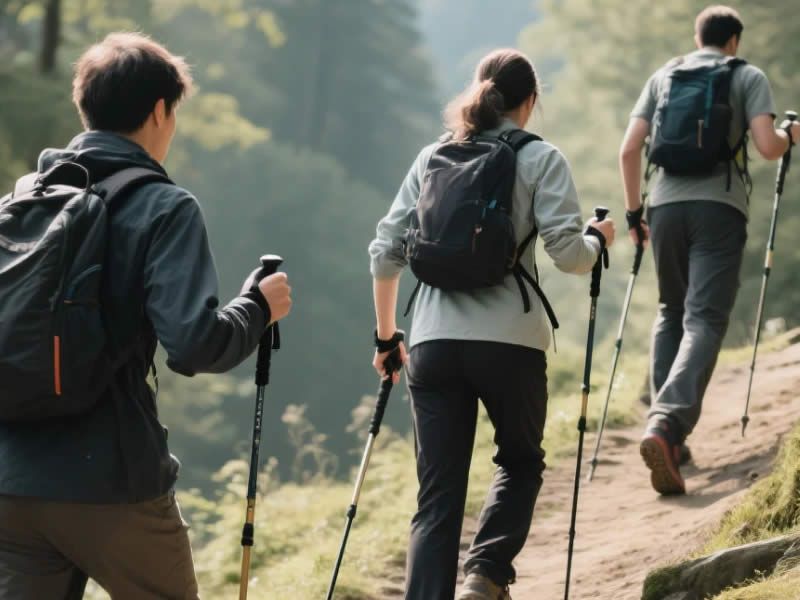
1. The biomechanics – why poles help
Walking uphill requires your quadriceps, glutes, and calves to work against gravity. The work is largely concentric (muscles shortening) as you push yourself up each step. Trekking poles introduce an upper body component to the work:
- Push‑off – As you step up, you push down on the pole, transferring some of your body weight to your arms and shoulders. This reduces the load on your leg muscles.
- Pull‑up – On very steep sections, you can pull on the poles to help lift your body upward, engaging your lats and biceps.
2. The research – what studies show
- A study in the Journal of Sports Sciences found that using poles on a 15% incline reduced the force on the knee and hip joints by 10–15%.
- Another study measured perceived exertion (RPE) and found that walkers felt 10–15% less fatigued when using poles on the same uphill route.
- Heart rate was also slightly lower (5–8 beats per minute) for the same pace when using poles, indicating a reduction in overall cardiovascular load.
3. Key technique for uphill efficiency
- Shorten your poles – On ascents, shorten your poles by 5–10 cm (compared to flat‑ground length). This keeps your arms lower and allows you to push down more effectively. A shorter pole lets you plant directly below your shoulder, maximising leverage.
- Use the wrist strap – The strap should sit across the base of your palm, not your wrist. Push down through the strap, not your grip. This transfers load directly to your skeletal structure, reducing grip fatigue.
- Plant close to your body – On steep terrain, plant the pole close to your feet, not far ahead. This maintains a vertical push, which is more efficient than a forward reach.
- Maintain rhythm – A steady, alternating rhythm (left pole with right foot) keeps the load evenly distributed and prevents you from overworking one side.
- Double‑plant on very steep sections – On extremely steep steps or scree, plant both poles together and push down simultaneously. This gives you a powerful upward boost.
4. How much easier is it?
For a typical ascent on a UK hill (e.g., a 300‑m climb on the Pennine Way), using poles can reduce perceived leg effort by 10–15%. This means you can walk at the same pace with less fatigue, or walk slightly faster for the same effort. The effect is most noticeable on sustained climbs, where the cumulative benefit over 30–60 minutes is significant.
5. Common mistakes that make poles less effective
- Poles too long – If your poles are not shortened for the ascent, your arms will be too high, reducing leverage and increasing shoulder strain.
- Gripping too tightly – A death grip tires your forearms and reduces the efficiency of the load transfer.
- Planting too far ahead – Reaching forward reduces the vertical push component and can actually increase the energy cost.
- Irregular rhythm – An inconsistent plant rhythm disrupts your natural gait, wasting energy.
6. When poles are less beneficial
- Short, steep steps – On steps or very short, steep sections, the rhythm of pole planting can be disrupted. You may find it more efficient to use your hands on a rock.
- Very loose scree – On loose, sliding ground, the pole may not give you a reliable push‑off.
- Flat or gentle slopes – The benefit is smaller on gentle inclines (under 10%).
7. Do they ever make uphill harder?
Yes, if used incorrectly. Poles that are too long, planted too far ahead, or not used with wrist straps can disrupt your rhythm and increase energy cost. However, with correct technique, they are a net benefit.
8. Practical tips for UK hillwalking
- Shorten before the climb – Set your pole length before the ascent begins. You can adjust again if the slope steepens.
- Use rubber tips on rocky steps – Save your carbide tips and reduce wear.
- Carry spare tips – Ascent puts additional wear on tips; replace when blunt.
- Practice – Good technique takes a few walks to master; practice on a gentle hill before tackling a steep climb.
9. Final verdict
Walking uphill is less tiring with trekking poles when used correctly. They engage your upper body, reduce leg muscle fatigue, and lower perceived exertion by 10–15%. The key is to shorten your poles, use wrist straps effectively, and maintain a steady rhythm. For most UK hillwalkers, poles make ascents significantly easier, allowing you to go further and enjoy the hills with less strain. Invest time in learning the technique – it will pay off on every steep climb.




