




Are ultralight trekking poles strong enough for the rough terrain of Dartmoor?
No – most ultralight trekking poles are not strong enough for the rough terrain of Dartmoor. Dartmoor's landscape is notoriously demanding: granite tors, sharp scree, deep peat bogs, and uneven, rocky ground that can punish lightweight gear. The terrain demands 7075 aluminium poles with steel lower sections and reliable lever locks – such as the Leki Makalu, Black Diamond Trail Pro, or Decathlon Forclaz MT900. Ultralight carbon folding poles and thin‑walled aluminium models are vulnerable to side impacts, grit‑clogged joints, and bending under heavy load. On Dartmoor's remote, exposed terrain, durability and repairability are far more important than saving a few grams per pole. This article explains why ultralight poles are not suitable for Dartmoor, what to choose instead, and how to protect your poles on the moor.
1. Understanding Dartmoor's terrain
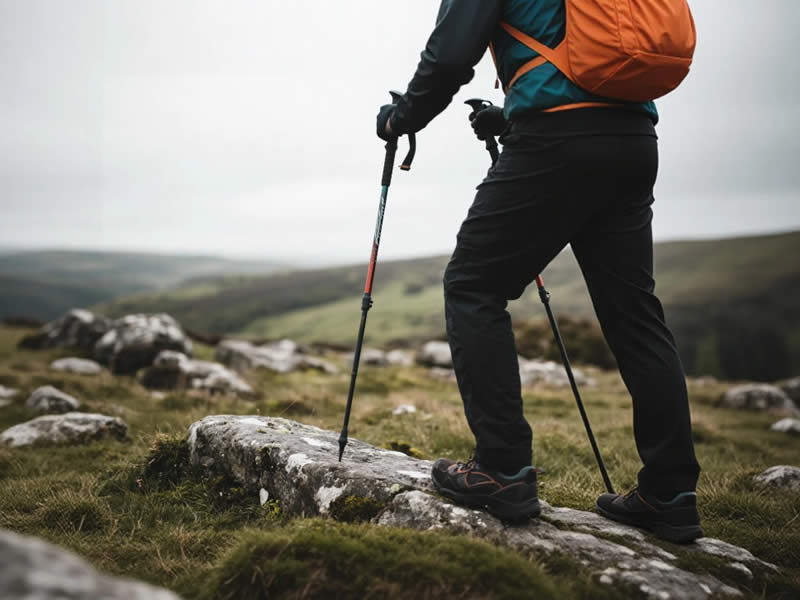
Dartmoor is not a gentle landscape. It features:
- Granite tors and outcrops – Hard, abrasive rock that can scratch, chip, or bend lightweight poles.
- Scree and loose rock – Unstable ground where side impacts are common.
- Deep peat bogs – Soft, claggy ground that can swallow a pole. Without mud baskets, you risk losing a pole.
- Wet, muddy conditions – Dartmoor is often wet, with streams and bogs that test pole locks and tips.
- Exposed ridges – High winds require secure locks that do not loosen under lateral stress.
- Remote sections – On the open moor, a broken pole can be a serious issue, as you are often miles from the nearest road or phone signal.
2. Why ultralight poles fail on Dartmoor
a. Carbon fibre – Ultralight poles are often made of carbon fibre. Carbon is light and stiff, but brittle. On Dartmoor's granite tors, a side impact against a rock can splinter the shaft, rendering the pole useless. Unlike aluminium, carbon cannot be straightened or repaired in the field.
b. Thin‑walled aluminium – Even aluminium ultralight poles often use thinner‑walled tubing to save weight. On rocky ground, these are more prone to bending. A bent pole may still be usable, but it is weakened and may fail under load.
c. Push‑button joints – Many ultralight folding poles (Z‑poles) use push‑button joints. On Dartmoor, peat and grit can jam these buttons, preventing the pole from locking or releasing. Cleaning them on the trail is difficult.
d. Twist locks – Some ultralight poles use twist‑locks to save weight. In the wet, muddy conditions of Dartmoor, twist locks are notorious for slipping. A sudden slip on a steep descent can cause a fall.
e. Lack of repairability – Ultralight poles often have limited spare parts availability. If a tip or lock fails, you may not be able to fix it on the trail. Heavier poles have widely available replacement parts.
3. What to choose for Dartmoor
- 7075 aluminium – Stronger than 6061 alloy, resistant to bending under heavy load.
- Steel lower section – Provides abrasion resistance on granite and extends the pole's life. Found on models like the Leki Makalu.
- Lever locks – Mechanical clamps that hold securely in wet, muddy conditions. Field‑adjustable and easy to clean.
- Replaceable carbide tips – Dartmoor's granite will wear down tips quickly. Replaceable tips extend the pole's life.
- Mud baskets – Essential for peat bogs. They prevent the pole from sinking into soft ground.
- Weight – Accept a weight of 250–280 g per pole for the durability you need.
4. Top poles for Dartmoor
- Leki Makalu – 7075 aluminium, steel lower section, SpeedLock Plus, replaceable tips. The gold standard for Dartmoor.
- Black Diamond Trail Pro – 7075 aluminium, FlickLock, comfortable foam/cork grip. Durable and reliable.
- Black Diamond Trail Back – Similar to Trail Pro, slightly lighter, still robust.
- Decathlon Forclaz MT900 – Best value. 7075 aluminium, lever locks, cork grips, replaceable tips. Durable enough for Dartmoor at a budget price.
5. Can any ultralight poles work on Dartmoor?
- If you must use ultralight – Choose a model with 7075 aluminium (not carbon) and lever locks (not twist). The Fizan Compact 3 (aluminium, lever locks) is one of the few ultralight poles that might survive, but it still has thin‑walled sections and is more vulnerable than heavier options.
- Accept the risk – If you walk carefully, avoid planting between rocks, and clean joints regularly, you may get away with ultralight poles. But on the open moor, a failure can be a serious problem.
6. Practical tips for pole survival on Dartmoor
- Fit mud baskets – Essential for bogs. Without them, your pole will sink deep and be difficult to retrieve.
- Carry spare tips – Granite wears down tips quickly. A spare pair is a lightweight addition to your kit.
- Rinse after muddy walks – Peat and grit can damage locks. Rinse with fresh water and dry.
- Check locks regularly – Lever locks can loosen with use; tighten with a hex key.
- Inspect for damage – After a rocky section, check the shaft for nicks or bends.
7. Final verdict
Ultralight trekking poles are not strong enough for the rough terrain of Dartmoor. The granite tors, scree, bogs, and wet conditions demand a more durable pole: 7075 aluminium with lever locks, replaceable tips, and mud baskets. Choose a pole like the Leki Makalu, Black Diamond Trail Pro, or Decathlon Forclaz MT900 – they are heavier than ultralight options, but on Dartmoor, durability is more important than saving a few grams. Invest in a pole that can survive the moor, and you will walk with confidence, knowing your gear will not let you down.




