




What is the difference between trekking poles and ski poles?
Trekking poles and ski poles are designed for entirely different activities, and they are not interchangeable. Trekking poles are adjustable, feature carbide tips for mud and rock, have small baskets, and use wrist straps for load transfer—they are designed for balance and reducing knee impact on varied, uneven terrain. Ski poles are fixed-length, have larger snow baskets, steel tips for ice, and angled grips designed for pushing off in snow; they lack the adjustability needed for hills and the grip required for rocky ground. Using ski poles on trails can be dangerous on rocky or uneven terrain, while using trekking poles in deep snow is ineffective. This article explains the key differences, why they matter, and how to choose the right pole for your activity.
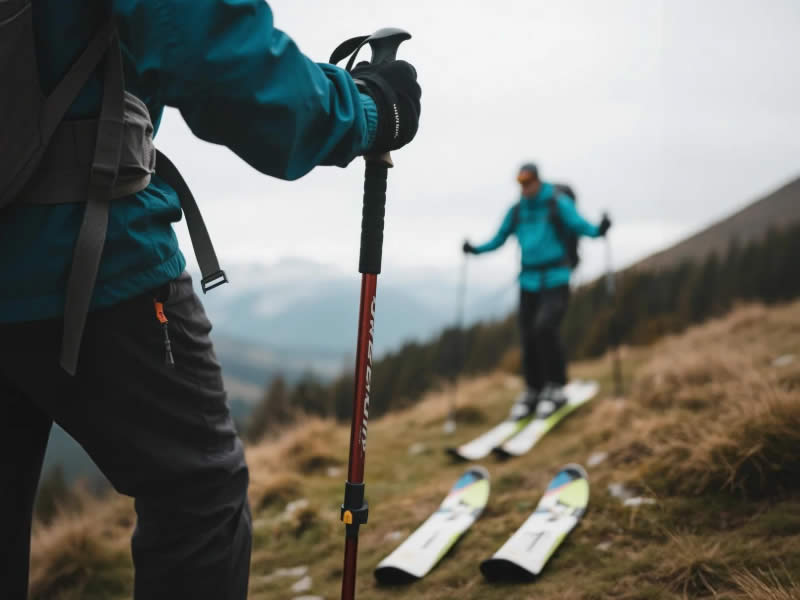
1. The core difference – purpose and design
- Trekking poles – Designed for walking on varied terrain (mud, rock, grass, gravel). Their primary function is to provide balance, reduce knee impact, and assist with ascents and descents. They are versatile, adjustable, and built for durability on abrasive surfaces.
- Ski poles – Designed for snow. Their primary function is to provide propulsion on flat sections, assist with turning, and help maintain rhythm in skiing. They are built for snow, not for rocky or uneven ground.
2. Key differences in detail
a. Length adjustability
- Trekking poles – Almost always adjustable, typically from 110–135 cm. This allows you to shorten for ascents and lengthen for descents, adapting to changing terrain.
- Ski poles – Fixed-length. The correct length is determined by your height and skiing style. You cannot adjust them on the mountain.
b. Grip and strap design
- Trekking poles – Straight grips with adjustable wrist straps. The strap is designed to transfer load from your hand to the pole, allowing you to relax your grip and reduce fatigue.
- Ski poles – Angled or ergonomic grips, often with a "grip strap" or "pole strap" that wraps around your hand. The angle is designed to facilitate the specific push-off motion of skiing.
c. Tip material
- Trekking poles – Tungsten carbide tips (hard, wear-resistant) designed to grip on rock, mud, and hard ground. They can also accept rubber ferrules for pavement.
- Ski poles – Steel tips (often tungsten carbide reinforced) designed for ice and hard snow. They are less durable on rock and will wear down quickly on abrasive surfaces.
d. Baskets
- Trekking poles – Small baskets (or none) designed to prevent the pole from sinking into soft ground. Mud baskets (slightly larger) are available for boggy conditions.
- Ski poles – Large snow baskets designed to prevent the pole from sinking into deep snow. These are much wider than trekking pole baskets and would be cumbersome on the trail.
e. Material
- Trekking poles – 7075 aluminium or carbon fibre, designed to be lightweight yet durable for rough terrain.
- Ski poles – Aluminium, carbon, or composite; prioritising stiffness and lightness for the specific demands of skiing, not impact resistance on rocks.
3. Why they are not interchangeable
- Using ski poles on trails – The fixed length is a major problem on steep ascents and descents. The large snow baskets catch on rocks and vegetation. The steel tips wear down rapidly on rocky ground. The grip angle is not suitable for walking.
- Using trekking poles in snow – The small baskets sink deep into snow, making them ineffective. The adjustable length is useful, but the lack of a large basket means the pole offers little support in soft snow. The carbide tips may not grip on icy patches.
4. When to choose trekking poles
- Hillwalking and backpacking – UK trails, Lake District, Snowdonia, Dartmoor.
- Long-distance trails – Pennine Way, West Highland Way, Coast to Coast.
- General walking – Day walks, rambling, Nordic walking (though Nordic poles are a separate category).
5. When to choose ski poles
- Alpine skiing – For downhill and piste skiing.
- Cross-country skiing – For touring and skating.
- Backcountry skiing – For touring, where you need a pole that can handle snow and ice.
6. Practical advice for UK walkers
- If you already own ski poles, do not use them for hillwalking – you risk damaging the poles and compromising your safety.
- If you need a pole for both, consider a trekking pole with snow baskets (optional attachment) for occasional winter use. However, it will never match the performance of a dedicated ski pole in deep snow.
7. Final verdict
Trekking poles and ski poles are distinct tools for different activities. Trekking poles are adjustable, carbide-tipped, and designed for balance and knee protection on rough terrain. Ski poles are fixed-length, steel-tipped, and designed for propulsion and control in snow. They are not interchangeable – using the wrong pole compromises performance and safety. For UK hillwalking, choose adjustable trekking poles with lever locks and carbide tips. For snow, choose ski poles suited to your skiing discipline. The right tool for the right terrain makes all the difference.




