




How to use trekking poles correctly for steep ascents in Snowdonia?
The key to using trekking poles on steep Snowdonia ascents (e.g., the Pyg Track, Watkin Path, or the Miners' Track) is to shorten them for leverage, plant deliberately, and push through the straps. Shorten your poles by 5–10 cm (compared to flat ground) to lower your hands for better leverage. Plant both tips firmly in front of you, push down through the wrist straps—not your grip—and step up. This transfers effort from tired quads to your arms, reducing leg fatigue on long climbs. Keep your back straight, lean slightly forward into the slope, and maintain a steady rhythm (left pole with right foot). On very steep steps, use a double-plant: plant both poles together and push up in a powerful upward motion. Lengthen poles back for the descent. Practice on gentler slopes first, and adjust length frequently as the gradient changes—it’s the single most effective technique for steep terrain.
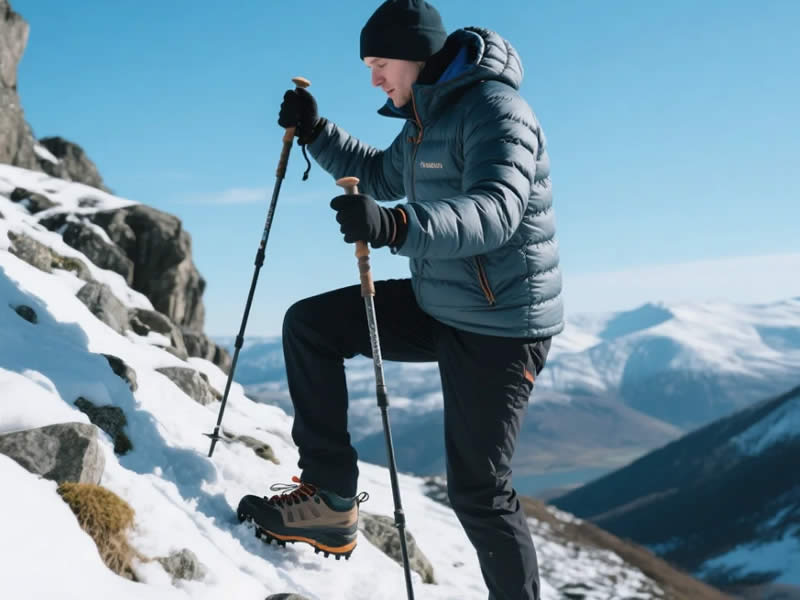
1. Why pole length matters on steep ascents
On flat ground, your poles should be set so your elbows are at 90° when the tip touches the ground. On a steep ascent, this length becomes too long—your hands are too high, reducing leverage and increasing shoulder strain. Shortening your poles by 5–10 cm (or even more on very steep sections) lowers your hands, allowing you to push down vertically rather than forward. This vertical push transfers load from your legs to your arms, offloading your quads.
- Too long – You reach forward, lose leverage, and tire faster.
- Too short – You hunch over, reducing efficiency.
- Just right – You plant close to your feet and push down vertically.
2. The double‑plant technique for very steep sections
On the steepest sections of Snowdonia (e.g., the final push up Crib Goch's approach or the steps on the Watkin Path), use the double‑plant:
- Plant both poles together on the step or ground ahead of you, shoulder‑width apart.
- Push down through both straps simultaneously as you step up.
- This gives you a powerful upward thrust, reducing the load on your legs and providing stability on loose rock.
3. Wrist straps – the key to efficiency
Your wrist straps are not just to prevent you from dropping the pole. They are the primary mechanism for load transfer.
- Adjust the strap – Your hand should go up through the strap from underneath, with the strap resting across the base of your palm (the fleshy part between your wrist and palm).
- Push down through the strap – When you plant the pole, the force should go through the strap, not your grip. This allows your hand to remain relaxed, reducing forearm fatigue.
- Grip gently – Hold the grip like you are holding a butterfly. The strap does the work.
4. Planting position and rhythm
- Plant close – On steep slopes, plant the pole close to your front foot, not far ahead. This gives you a vertical push rather than a forward reach.
- Alternating rhythm – Maintain a steady rhythm: left pole with right foot, right pole with left foot. This distributes the load evenly and helps you maintain a steady pace.
- Short steps – Take shorter steps on steep sections. This keeps your centre of gravity stable and makes the pole push more effective.
5. Adjusting for changing gradient
Snowdonia's slopes change frequently. Adjust your pole length as the gradient changes:
- Steeper – Shorten further.
- Leveling out – Lengthen slightly.
- Descending – Lengthen to your flat length or slightly more.
This takes practice, but it becomes automatic with experience.
6. What not to do
- Gripping too tightly – This fatigues your forearms and reduces efficiency.
- Planting too far ahead – This turns your pole into a brake, not a propellant.
- Ignoring the straps – If you are not using the straps, you are missing the main benefit.
- Not adjusting length – A fixed length on a changing slope reduces efficiency.
7. Practice on easier terrain
Before tackling Snowdonia's steepest ascents, practice the technique on a gentler hill. Focus on shortening the poles, using the straps, and finding a comfortable rhythm. Within a few walks, it will become second nature.
8. Final tips for Snowdonia
- Crib Goch approach – On the exposed ridge, you may want to stow your poles entirely. Practice detaching and stowing them quickly.
- Watkin Path – The steep steps are ideal for the double‑plant technique.
- Pyg Track – The variable gradient requires frequent adjustments.
- Weather – In Snowdonia's rain, lever locks (not twist) are essential for reliable grip.
9. Final verdict
The correct technique for steep ascents in Snowdonia involves shortening your poles by 5–10 cm, planting close to your feet, pushing through the wrist straps, and maintaining a steady rhythm. Use the double‑plant for very steep steps. Adjust the length as the gradient changes, and keep your grip relaxed. Practice on easier terrain first, and you will find that steep ascents become significantly less tiring and more enjoyable. With the right technique, your poles become a powerful tool for conquering Snowdonia's iconic peaks.




