




How to walk with trekking poles to save energy on the Coast to Coast path?
Walking the Coast to Coast path – a 190‑mile route from St Bees to Robin Hood's Bay – is a test of endurance across varied terrain: muddy moors, grassy hills, rocky descents, and long, flat stretches. Using trekking poles correctly can save significant energy by engaging your upper body and reducing the load on your legs. The key is the diagonal stride, proper wrist strap use, and adapting your technique to the terrain. Here is a detailed guide to walking efficiently with poles on this classic English trail.
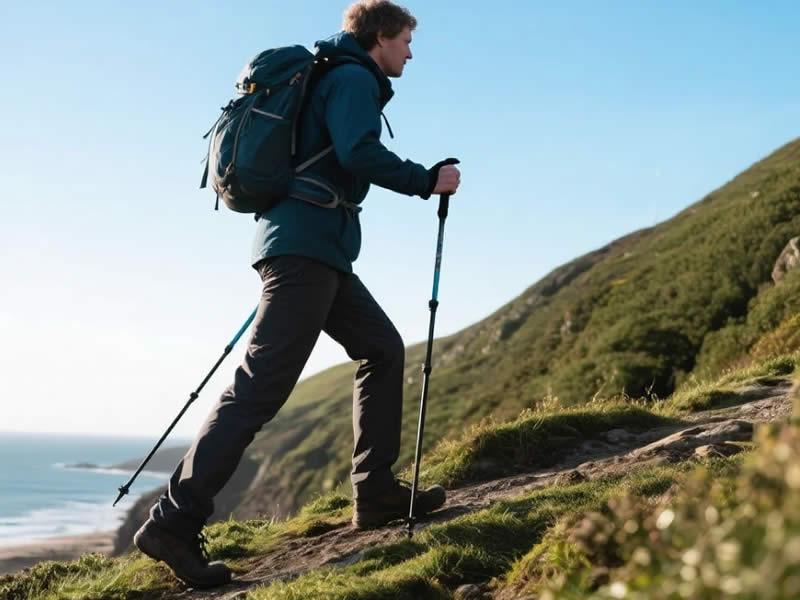
1. The diagonal stride – your fundamental rhythm
The most efficient way to use trekking poles is the diagonal stride: plant the left pole as your right foot steps forward, and the right pole as your left foot steps forward. This mimics your natural arm swing and engages your core, back, and shoulder muscles.
- Why it works – This rhythm transfers some of your leg workload to your upper body, spreading the effort across more muscle groups. It reduces fatigue in your quadriceps and calves, especially on the long, undulating sections of the Coast to Coast.
- Practice – On the first day, focus on this rhythm. It may feel unnatural at first, but within an hour it will become automatic.
2. The wrist strap – your energy‑saving tool
Your wrist straps are not just to stop you dropping the pole; they are the primary mechanism for load transfer. Using them correctly can save significant arm and grip energy.
- Adjust the strap – Put your hand up through the strap from underneath, so the strap rests across the base of your palm, not your wrist. The strap should be snug but not tight.
- Push through the strap – When you plant the pole, the force should go through the strap, not your grip. Your hand can relax; the strap does the work.
- Relax your grip – Hold the grip gently, like you are holding a butterfly. This reduces forearm fatigue and prevents blisters.
3. Adjust pole length for the terrain
The Coast to Coast path has varied terrain, and you will save energy if you adjust your pole length accordingly.
- Flat sections – Set your poles so your elbows are at 90° when the tip touches the ground (typically 120–125 cm for a 175‑cm walker). This gives you a comfortable, neutral position.
- Ascents – Shorten by 5–10 cm. This lowers your hands, giving you better leverage and reducing the work your quads have to do.
- Descents – Lengthen by 5–10 cm. This allows you to plant ahead of your feet, creating a braking effect that reduces knee impact and saves leg energy on the long downhills.
Adjusting your poles regularly takes only a few seconds and can make a noticeable difference to your energy levels at the end of a long day.
4. Walking on the flat – let the poles carry you
On the long, flat sections of the Coast to Coast (e.g., along the Vale of York or the old railway tracks), you can use the poles to maintain a steady rhythm. Plant the pole with each opposite step, push down through the strap, and let the pole's momentum help carry you forward. You should feel a slight "pull" from the pole as you step, which reduces the effort in your legs.
5. On descents – use the poles as brakes
Descending muddy or rocky slopes (e.g., the descent into Swaledale) is where poles save most energy. Lengthen your poles, plant them ahead of your feet, and push down to brake your speed. This offloads impact from your knees and reduces the muscle tension in your quads.
6. On ascents – use the poles as a lift
On steep climbs (e.g., the ascent of Great Shunner Fell), shorten your poles and use a double‑plant technique: plant both poles together on the step ahead, push down, and step up. This gives you a powerful upward boost, transferring effort from your legs to your arms.
7. Maintain a steady rhythm
A steady, consistent rhythm is more energy‑efficient than a stop‑start, irregular pace. Focus on a consistent cadence – around 60–70 plants per minute per pole. On long days, this rhythmic walking can reduce perceived exertion significantly.
8. Other energy‑saving tips for the Coast to Coast
- Use rubber tips on road sections – Save your carbide tips from excessive wear on the many road sections of the Coast to Coast.
- Clean poles daily – Mud and grit can affect lock performance; a quick rinse keeps them working smoothly.
- Carry spare tips – The abrasive terrain will wear down tips; replace them when blunt.
- Take breaks – Use your poles to support yourself during rest stops, reducing the load on your legs.
9. Final verdict
Walking with trekking poles correctly on the Coast to Coast path can save significant energy by engaging your upper body, reducing knee impact, and maintaining a steady rhythm. The key elements are: using the diagonal stride, pushing through the wrist straps, adjusting pole length for the terrain, and relaxing your grip. Practice these techniques on the early sections of the trail, and you will arrive at Robin Hood's Bay feeling fresher, faster, and with less leg fatigue. Your poles are not just for balance – they are a powerful tool for efficient walking.




