




How to use trekking poles to reduce knee pain on the South West Coast Path?
The South West Coast Path is a 630‑mile (1014 km) National Trail along England's coastline, famous for its relentless ups and downs—climbing in and out of countless coves, valleys, and headlands. This constant elevation change takes a heavy toll on your knees, especially on steep descents where impact forces can be 3–5 times your body weight. Used correctly, trekking poles can significantly reduce knee pain and protect your joints on this demanding trail. The key is to lengthen your poles by 5–10 cm on descents, plant the tip ahead of your feet, and push down through the wrist straps—not your grip. This transfers load from your knees to your arms and upper body, reducing impact by up to 20–25%. On steep, rocky descents (like those into Cornish coves), use a double plant to brake. Shorten poles for ascents and keep a steady rhythm. This article explains the biomechanics, technique, and equipment needed to protect your knees on the South West Coast Path.
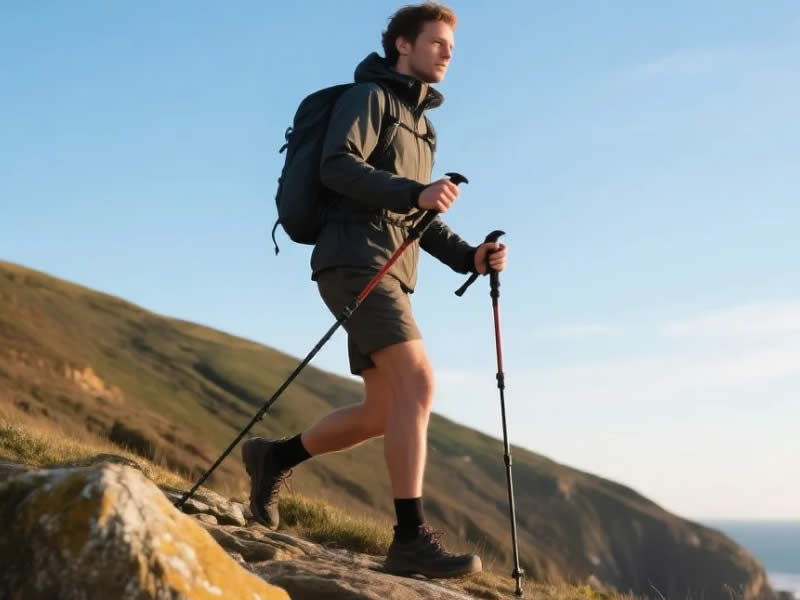
1. Why the South West Coast Path is hard on knees
The trail is not steep in the alpine sense, but it is relentless. Cumulative ascent over the full 630 miles is around 35,000 metres—more than climbing Mount Everest from sea level four times over. This constant up‑and‑down, day after day, can inflame the patellar tendon and other knee structures. On descents, the quadriceps contract eccentrically (lengthening under load), which is particularly stressful. The impact force at heel strike can be 3–5 times your body weight, amplified by a heavy backpack.
2. How poles reduce knee impact
Trekking poles reduce knee impact in three ways:
a. Load transfer – By planting the pole ahead of your feet and pushing down, you transfer a portion of your body weight from your legs to your arms and upper body. Research shows this can reduce knee joint forces by 20–25% on descents.
b. Braking effect – A longer pole allows you to brake your forward momentum, reducing the speed at which your foot hits the ground. This lowers the impact force.
c. Stability – Four points of contact (two feet + two poles) improve balance, reducing the likelihood of a sudden, jarring misstep.
3. Step‑by‑step technique for descents
a. Lengthen your poles – Before a descent, extend your poles by 5–10 cm (compared to flat‑ground length). This allows you to plant the tip ahead of your feet. On very steep, rocky descents, you may lengthen by up to 15 cm.
b. Plant ahead – Plant the pole tip about 20–30 cm ahead of your front foot, at a slight angle. The pole should be angled forward, with the tip below the grip.
c. Push through the strap – Your wrist strap should be adjusted so it sits across the base of your palm. Push down through the strap, not your grip. Your hand should remain relaxed.
d. Brake – As you step forward, push down on the pole to slow your momentum. You should feel a slight braking effect.
e. Double plant for steep descents – On very steep sections (e.g., the descent into a Cornish cove), plant both poles together ahead of you and push down simultaneously. This gives you maximum braking and stability.
4. Technique for ascents
On ascents, shorten your poles by 5–10 cm to maintain leverage. Use a double plant on steep steps: plant both poles together on the step ahead, push down, and step up. This transfers effort from your quads to your arms.
5. Pole length and adjustment
- Flat – Elbows at 90° when the tip is on the ground.
- Descents – Lengthen by 5–10 cm (or more).
- Ascents – Shorten by 5–10 cm.
Carry a hex key for your lever locks so you can adjust on the trail. Lever locks (cam locks) are essential for the South West Coast Path – twist locks can slip in wet, muddy conditions.
6. Equipment considerations
- Mud baskets – Essential for the muddy sections on the North Devon and Cornish coast.
- Rubber tips – Use them on road sections (the trail has many miles on tarmac) to save your carbide tips.
- Spare tips – The abrasive coastal rock will wear down tips; carry spares.
- 7075 aluminium – Avoid carbon poles; they are brittle and can splinter on rocky descents. Aluminium is safer.
7. Other tips for knee health on the South West Coast Path
- Short steps – Take shorter steps on descents to reduce impact.
- Keep your pack light – Every extra kilogram increases knee load.
- Strengthen your quads before the walk – Strong quads protect the knee joint.
- Rest days – Schedule rest days to allow knee inflammation to subside.
- Listen to your body – If you feel sharp pain, stop and rest. Do not push through it.
8. Final verdict
Trekking poles are an essential tool for reducing knee pain on the South West Coast Path. Used correctly—lengthened on descents, planted ahead, and pushed through the straps—they can reduce knee impact forces by 20–25%, protect your joints, and allow you to enjoy the magnificent coastal views without being hampered by knee pain. Practice the technique before your trip, invest in a good pair of aluminium poles with lever locks, and use mud baskets and rubber tips as needed. With the right technique, you can complete the trail with less pain and more pleasure.




