




How to adjust trekking pole straps for maximum efficiency on long days?
The wrist straps on your trekking poles are far more than a safety tether—they are a critical biomechanical interface. When set correctly, they transform your poles from simple walking sticks into tools that actively reduce fatigue, protect your joints, and propel you forward. On a long day in the hills, incorrect strap adjustment can lead to numb hands, aching forearms, and wasted energy. Here is a comprehensive guide to getting your straps right for maximum efficiency.
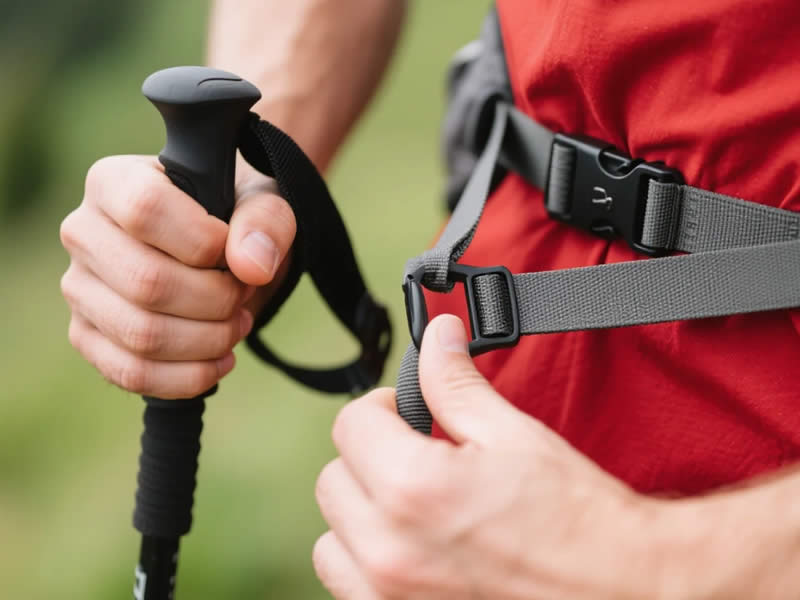
1. The Fundamental Principle: Load Transfer, Not Grip
Most beginners grip the handle tightly, believing that is how you control the pole. This is a mistake. The correct technique is to let the strap bear the weight. Your hand should remain relaxed, like holding a butterfly. When you plant the pole, the force should travel through the strap—across the base of your palm—and into the pole. The grip is only there to guide the pole, not to support your body weight. If you find yourself with sore hands or calluses, your straps are likely too loose or your grip is too tight.
2. The Correct Hand Placement: The "Underhand" Method
The most common mistake is to simply poke your hand down through the strap from the top. This places the strap across your wrist, which is inefficient and restricts blood flow. The correct method is the "underhand" or "upward" technique:
- Slide your hand up: Pass your hand up through the bottom of the strap loop, so the strap is sitting against your palm.
- Bring your hand down: Rest your hand on the grip. The strap should now sit diagonally across the back of your hand, between your thumb and index finger—not across your wrist.
- Check the position: The strap should lie across the fleshy base of your palm (the heel of your hand). This is the strongest part of your hand and the most efficient point for transferring force.
3. Adjusting Traditional Straps (Loop-Style)
Most poles (e.g., Black Diamond, Decathlon, and many Leki models) use a traditional adjustable webbing strap.
- Find the adjustment tab: Look for the small plastic slider on the strap near the handle.
- Set the tension: Loosen the strap so you can comfortably slide your hand through using the underhand method. Then, tighten the strap until it is snug—but not tight—across the back of your hand.
- The "finger test": You should be able to slide one finger comfortably between the strap and the back of your hand. This allows for efficient load transfer without cutting off circulation.
- Equal length: Ensure both straps are adjusted to the same length for a balanced feel.
4. Adjusting Trigger Straps (Leki System)
Leki's trigger strap system uses a quick-release buckle and a wide, padded strap. It is designed for fast, one-handed adjustments.
- Position the clip: The trigger clip should sit centred on the back of your hand when you grip the handle.
- Adjust the width: Use the slider on the strap to adjust its width, ensuring it cradles your hand without pinching.
- Snap and go: The beauty of this system is its adjustability—you can release and reattach in seconds to find the perfect feel for different terrain or glove thickness.
5. Why This Matters for Long Days
- Reduces grip fatigue: By transferring your weight to the strap, you avoid the need for a tight, energy-sapping grip. Your forearm muscles can relax, saving energy for the long haul.
- Improves circulation: A strap sitting across your wrist can compress the veins, causing numb or tingling hands. The correct position across the palm avoids this.
- Increases power transfer: A correctly positioned strap allows you to put "serious force" on the pole even with a relaxed grip. This is essential for using your upper body to help propel you on ascents.
- Prevents blisters: A loose strap causes your hand to slip and rub against the handle, leading to blisters. A snug strap keeps your hand in place.
6. When to Re-adjust
- Terrain changes: On long, flat sections, you may want a slightly tighter strap for a more "locked-in" feel for propulsion. On steep ascents, a looser strap allows you to choke up on the grip.
- Glove changes: If you add or remove a layer of gloves, re-adjust your straps to maintain the correct tension.
- Fatigue: As you tire, your hand may swell slightly. Re-adjusting your straps can prevent them from becoming too tight.
- Start of each day: The angle of your hand and the thickness of your clothing can change daily. A quick check of your straps before setting off is a worthwhile habit.
7. Common Mistakes to Avoid
- Strap too tight: Restricts blood flow, causing cold, numb hands.
- Strap too loose: The strap does not bear the load, causing you to grip tightly and tire out your forearms.
- Strap across the wrist: Reduces power transfer and can cause wrist pain.
- Uneven straps: One side tighter than the other leads to an asymmetrical walk and uneven fatigue.
8. Final Verdict
Correct strap adjustment is one of the simplest but most impactful things you can do to improve your walking efficiency. It is the difference between having your poles be a burden or an asset. Spend a few minutes getting them right—your hands and your legs will thank you after a long day on the trail.




